


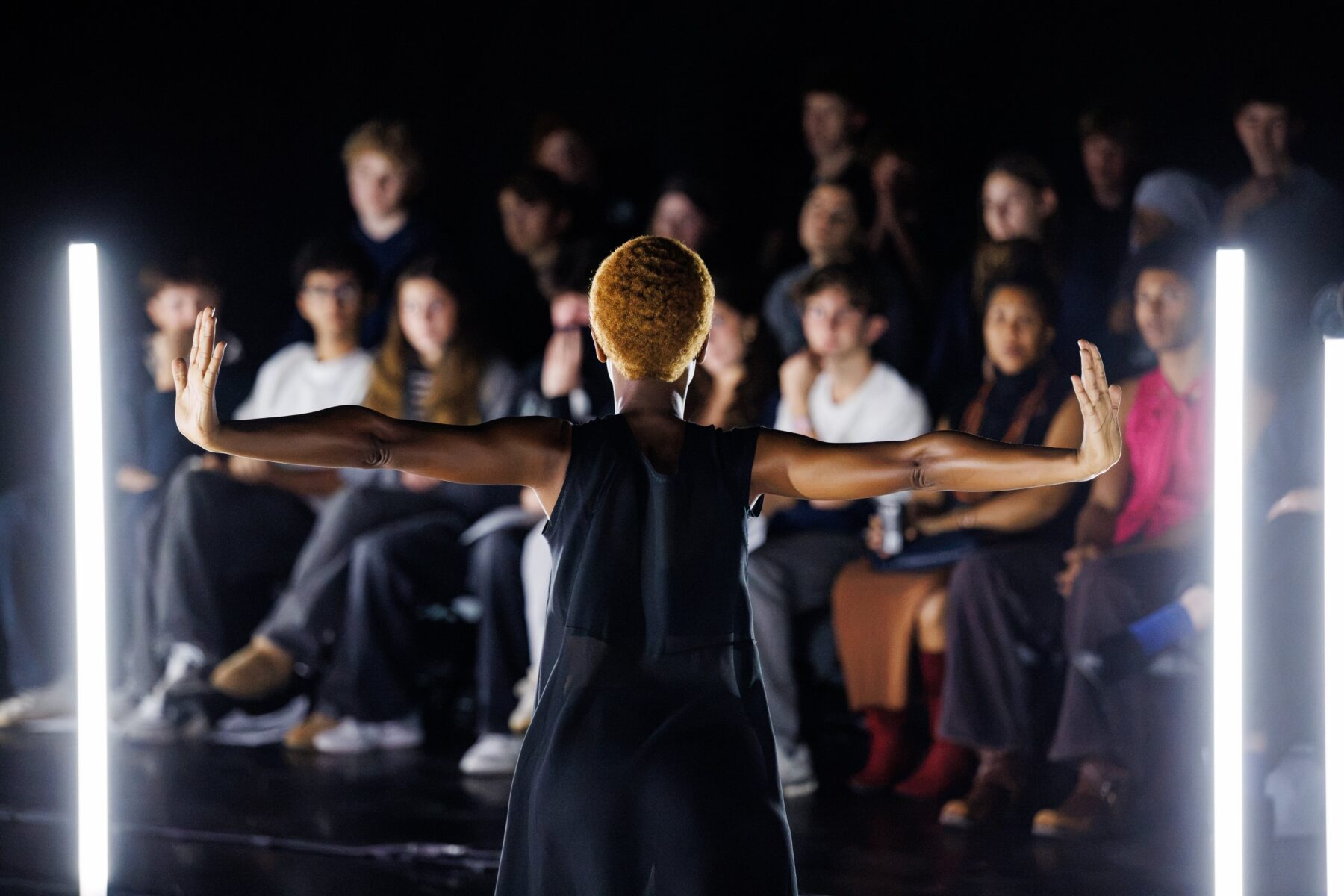
Dorothée Munyaneza performs “Toi, moi, Tituba…” at New York Live Arts, one of 14 offerings in this year’s Crossing the Line festival. Credit: Maria Baranova, Courtesy New York Live Arts
The 2026 edition of the annual, innovative Crossing the Line performance festival is the most expansive in its 19-year history. Running from Sept. 19 to Dec. 20, it features 14 global artists, seven North American premieres and four New York premieres. Produced by L’Alliance, a center of francophone cultures and French language classes based on Manhattan’s Upper East Side, the festival highlights boundary-pushing work by artists who have some relationship, broadly defined, to French, said Violaine Huisman, the festival’s curator and artistic director at L’Alliance.
This year’s artists, who have roots in Greece, Guadeloupe, Rwanda, Nigeria and Vietnam, bring “migratory voices” to various New York venues around the city and invite audiences to travel in their imaginations, she said.
Bookending the lineup are local premieres of pieces by artists who participated to great acclaim in prior years. Choreographer Lenio Kaklea opened this year’s festival with an acrobatic performance, The Birds, presented at PS21 in Chatham, New York; Caroline Guiela Nguyen will close it with Saigon, at St. Ann’s Warehouse in Brooklyn. (The U.S. premiere of her “Lacrima” in last year’s Crossing The Line was reviewed here on Columbia News Service.)
African artists coming directly from their home countries are notably absent from Crossing the Line, which, in past editions, has included participants from Democratic Republic of Congo, Morocco, Senegal, and elsewhere on the African continent. (Still, the French and Rwandan choreographer Dorothée Munyaneza, and the Nigerian American multidisciplinary artist Okwui Okpokwasili are featured this year.) Visa restrictions for Africans imposed by the Trump administration have proved all but insurmountable, Huisman acknowledged with regret.
The United States is making itself “more and more isolated,” Huisman said. Its official hostility to visitors from a range of countries is also making it a less attractive place for them to come. Huisman noted that as she has scouted festivals in Africa and Europe, she has found that artists based on those continents are looking less to New York as a place they need or want to present work. Even some artists in France shrugged at an invitation, she said.
Continuing to bring to New York as many new artistic forms, ideas and perspectives as they can is one means of resisting isolation, Huisman said. In this way, Crossing the Line is helping to hold the line.
Columbia Journalism School’s Arts & Culture M.A. reviewed six Crossing the Line offerings this year.
Here are the reviews:
- ‘This Is Unreal’ Melts Truth with Fiction in a Choreographed World of Mirage, by Mariel Ferragamo
- Leo Leruj’s Traces of Gounouj Sends a Loving Warning from Guadeloupe, by Diana Fonte
- In ‘Mille Secrets de Poussins’ Chaotic Chicks Entertain Kids While Teaching a Life Lesson (To Adults, Too), by Autriya Maneshni
- Ad Libitum is ‘At Your Pleasure,’ by Alex Miller
- In Camille Henrot’s Commedia dell’arte, Artists Get the Last Laugh, by Sarah Moran
- In “Toi, Moi, Tituba…,” Dortothée Munyaneza Speaks for Those Who Have Been Silenced, by Brynn Shaffer
About the author(s)
Columbia News Service