




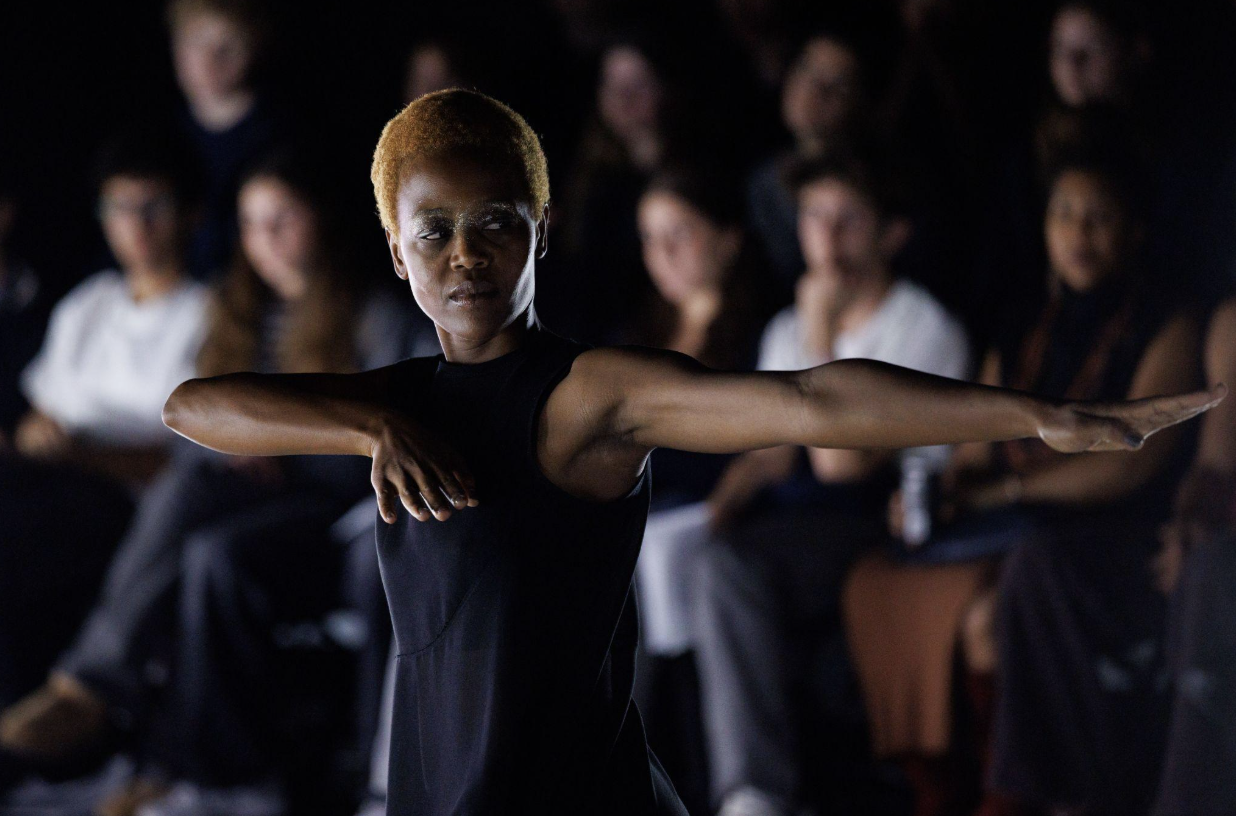
Dorothée Munyaneza in “Toi, moi, Tituba…” at New York Live Arts 2026. (Credit: Maria Baranova, Courtesy New York Live Arts)
In a stunning solo performance, Rwandan-British choreographer and dancer Dortothée Munyaneza explored the depths of systemic oppression by embodying several historical figures and joining them in a collective assertion of resistance. The hour-long piece made its American stage debut in front of two sold-out audiences at New York Live Arts in October as part of L’Alliance’s Crossing The Line Festival, in association with Brooklyn Academy of Music and Villa Albertine.
Drawing directly from French philosopher Elsa Dorlin’s essay, “Moi, Toi, Nous: ‘I, Tituba’ and the Ontology of the Trace” — which examines the 1986 historical novel Moi, Tituba, Sorcière by Guadeloupean writer Maryse Condé — Munyaneza resurrected the haunting tale of Tituba. An enslaved 17th-century woman, most likely of Caribbean descent, Tituba was among the first accused of witchcraft in the 1692 Salem witch trials of Massachusetts.
Little is known about Tituba beyond the context of the trials. Scholars assert that she was coerced into confession after severe beatings by her enslaver, Reverend Samuel Parris. But while her life was spared under Puritan law, which granted clemency to those who admitted to conspiring with the devil, she spent a year shackled in a Boston prison before an anonymous local settler purchased her. No one knows her last name, and there’s no documentation of her life thereafter. It’s as if she simply disappeared.
Whereas real Tituba never had the chance to tell her story, Munyaneza did — centering her as a vessel for summoning the voices of similarly marginalized women whose identities have been institutionally erased through the lack of formal record-keeping. Munyaneza bridged the gap between historical representation and contemporary reconstruction, illustrating that Black history is often skewed when reported by colonizers.
The performance began with Munyaneza lunging through a forest of fluorescent beams, all white with the exception of one magenta. The abstract, brilliant configuration by lighting designer Marine Le Vey visually placed Black voices against a backdrop of whiteness.
“Do you know her name?”
“Do you know our names?”
“Do you know my name?,” Munyaneza chanted into a microphone, drawing out each syllable with a crack of pain as though she reached back centuries to awaken the voices of fallen ancestors. Pulling strength from every fiber of muscle, she stood high on her tip toes and her eyes pierced through the audience. Between each sequence, her head dropped back. It was as if countless spirits were inside her, trying to break free.
Barefoot and wearing only a sleeveless black slip dress, Munyaneza paced the stage, organizing each light beam, carefully placing them down one by one to clear space for the story she was about to reveal. She harrowingly danced through the shadows — recounting Tituba’s narrative with the help of details from Condé’s imagined account — her origins in Barbados as a product of rape, her survival of the transatlantic slave trade, the mass hysteria that plagued Salem, the racism and abuse she experienced as a result, and her eventual return home.
At times, Munyaneza’s movements were so unsettling — robotic arm articulations, ferocious finger tapping, intense spitting and licking of her own skin — that it was unclear whether she was losing control of her body or conquering it. It’s an ethereal performance from Munyaneza, guided by deep frequencies and playful gargles in recorded music composed by Khyam Allami.
The climax of the performance came near the end of the show. Emerging from darkness, Munyaneza picked up a light beam and placed it right of center stage. It glowed pink. Delicately, she carried a sheer, white cloak to the fixture before gracefully slipping it over her head. Kneeling on the floor, Munyaneza cradled the light as if listening for a heartbeat, while a voiceover recited the last passage of Dorlin’s essay; it’s one of the only spoken segments in the entire performance:
To become Tituba, to care for the lives that lie in the archives, to communicate with the invisible, to listen to the ghosts, to find something of one’s own there, something familiar and held in common, a frame within which to situate oneself in the reams and folds of history. Tituba allowed me to name my own dead, to restore connections, even if the pattern remains to be understood. To tell in this way this history that has become visible, intelligible and speakable thanks to Tituba, Maryse Condé, and Guyanese-West-Indian literature, amounts not to a quest for origin, but rather a quest for worldliness, for reality. It is also a form of epistemic revenge — revenge against the blank page and the silenced, extinguished word, against non-sense and derealization. Finally, it is a tribute to the memory of Isabelle; it was she whom I wanted to revive here, it was she to whom I wanted to listen, to whom I wanted to talk and be connected: Me, you, us, Isabelle.
Isabelle (one can learn only by reading the essay) was Dorlin’s great-great grandmother, whose identity Dorlin uncovered while digging into the archives of her own family’s enslavement. Like in Tituba’s case, there’s no record of a last name for Isabelle, as slaves were degraded to mere property and stripped of family lineages. By summoning Isabelle, Munyaneza underscored this pattern of systemic erasure.
After Dorlin’s words were read, electronic beats crept in and light gradually brightened the stage, seeming to lift the weight of generational trauma from Munyaneza’s body. She appeared to be transformed, then embodying a living, breathing assemblage of ancestors — including Tituba, Isabelle and her own. By weaving fragmented phrases of her native Kinyarwanda into the performance’s vocal score, balanced with some English and French, Munyaneza asserted her own Rwandan identity as part of a transhistorical Afro-descendent experience.
Slowly, she took off the white cloak, unleashing herself from the suffering of her past. “I hear you, my people,” she said as the lights began to shutter. She was not only acknowledging the countless Black women whose voices she never got to hear, but reassembling them into a broken lineage — uniting them within her body and serving as the physical host for reparation. Finally, she twirled, arms wide in embrace of liberation, carrying Tituba and all the others with her.
About the author(s)

Brynn Shaffer is a New York-based journalist covering arts, culture, entertainment, business, artistic criticism and more.