




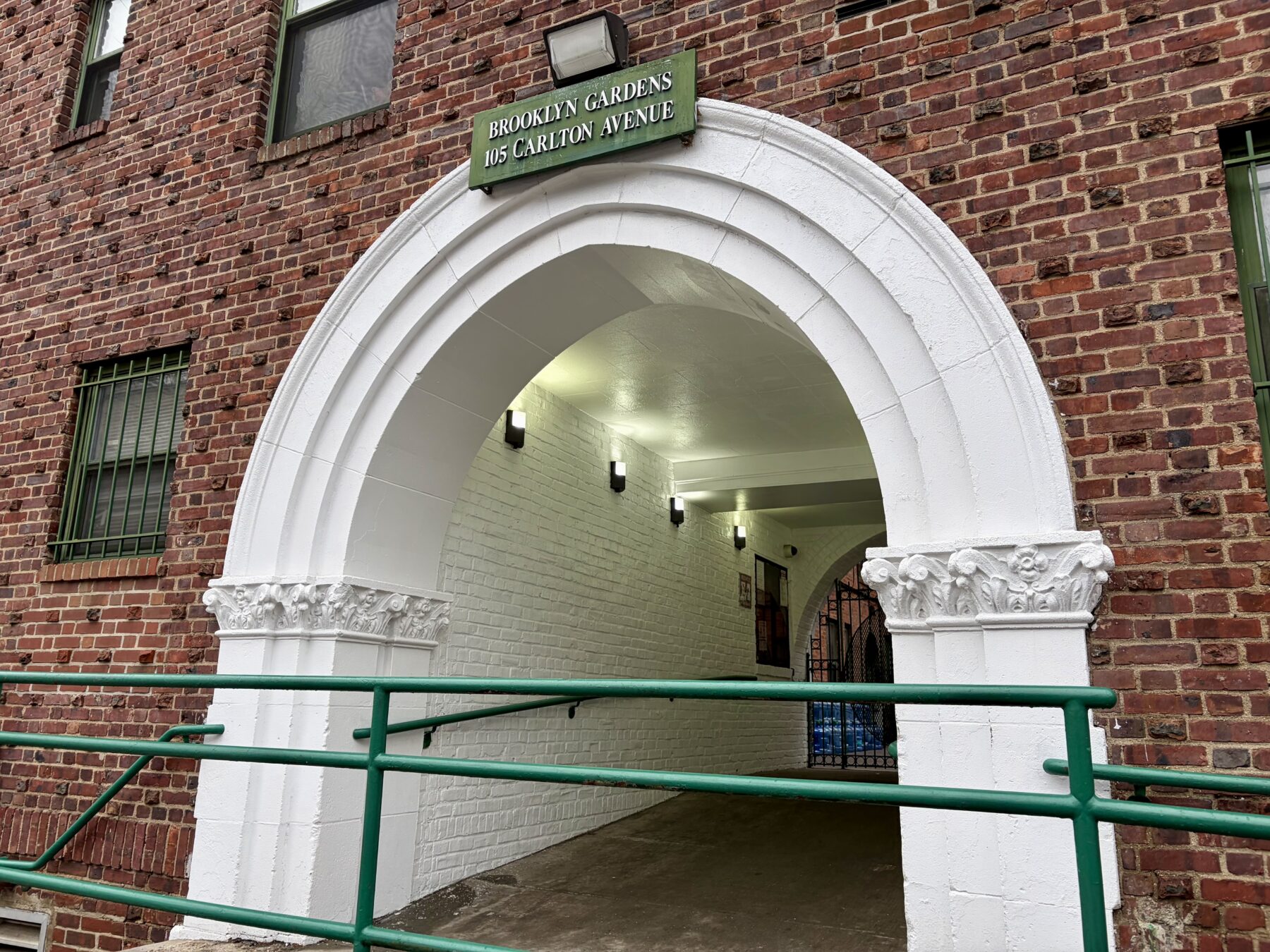
Oak Hall, part of Brooklyn Gardens, in Fort Greene, Brooklyn, Feb. 18, 2026. (Credit: Tereza Pesmazoglou)
I’m not going to screw this up, Fred Turbee, a now 71-year-old veteran, thought to himself as he stepped into the room of his single-room occupancy (SRO) building at Oak Hall on June 15, 2001. “The fact that I had a key to my space was just overwhelming. Nirvana,” he said, his oversized boxy glasses resting firmly on his nose.
In November 1999, Turbee was living in a rooming house in Mount Vernon, New York. It had been nearly two decades since he served in the U.S. Marine Corps. By that time, he was an alcoholic and a drug addict. He’d just been fired from his job loading trucks in the Garment District. One day, he sat in his parents’ living room and watched TV with his mom. “I didn’t tell her that I was also a big-time crackhead, but I admitted to her that I couldn’t get through the day without drinking,” he said. “I choked up, teared up a little, and, as moms do, she said, ‘Well, why don’t you go to the VA?’”
A few days later, Turbee went to the St. Albans Veterans Administration Medical Center in Hollis, Queens and asked for help. He was placed in a 14-day inpatient detox program, followed by rehab, then a therapy program. After that he was sent to Oak Hall, a building with permanent housing for 74 residents.
Oak Hall is part of Brooklyn Community Housing and Services (BCHS), an organization that runs supportive housing SROs. Residents live in private single rooms that share a bathroom, kitchen and living room, a setup designed to foster community. Each tenant holds an individual lease and key, and pays no more than 30 percent of their income in rent.
According to a 2018 study by the NYU Furman Center, there are about 30,000 to 40,000 SROs left in New York. Most offer little more than an affordable, basic private room. But this one, according to Jeffrey Nemetsky, director of BCHS, provides affordable, permanent and supportive housing with on-site case management for people vulnerable to homelessness because of their age, income, or disability. Staff members are trained to understand and identify mental health and trauma and the organization offers specialized programs for different populations such as seniors, domestic violence survivors and veterans.
Most of these hotel-style SROs disappeared after the city banned their construction in 1955. But in recent years, New York legislators have pushed to bring them back as a way to create more affordable housing for New Yorkers. In December 2023, Gov. Kathy Hochul announced a $50 million initiative to preserve up to 500 SRO apartments across New York State. In November 2025, then-City Councilmember Erik Bottcher proposed a bill, Int-1475, to alter the city’s administrative code and allow for the construction of new SROs as small as 100 square feet. Because it was introduced near the end of the legislative session, the bill did not move forward, but, in January 2026, it was reintroduced as Int-0066 by Councilmember Virginia Maloney.
Now, as New York faces unprecedented levels of homelessness, city and state officials are trying to revive these small, low-cost units. But, advocates question whether the push is enough to effectively address homelessness unless they are paired with support services. It is unclear how many of the city’s remaining SRO units are paired with supportive services. No public count was readily available and advocates did not identify one.
SROs have a checkered history in the city. In the early 1950s, these units made up over 10 percent of the city’s housing stock. But, after decades of neglect, overcrowding and political pressures all new construction was banned in 1955. By the 1970s, the city gave tax breaks to landlords for converting SROs to regular apartments. By 1981, New York lost 60 percent of its SROs.
“Some of this might have just been racist and classist, but some of it was legitimate,” said Larry Wood, director of advocacy and organizing at Goddard Riverside.
Some lodging houses, which Wood described as the bottom of the barrel of SRO housing, offered rooms as small as 50 or 60 square feet. Older SROs could also have one bathroom for as many as six tenants, creating conflicts over overcrowding, cleanliness and access. The stigma deepened, he said, during the era of deinstitutionalization when thousands of people were discharged from mental health hospitals and dumped into SROs with little support. SROs were seen as dirty and dangerous, occupied by junkies, alcoholics and the mentally ill.
The loss of so much low-cost housing turned out to be a disaster because the units were an affordable option for low-income people, said Jeffrey Nemetsky, Director of BCHS.
Recognizing this, the city is once again interested in building more SROs. But there are obstacles, including the same laws that were enacted decades earlier to stop their construction. New York ended the construction of new SROs for all buildings except those operated by nonprofit organizations and government-funded programs. While these entities are technically allowed to build SROs, they are still curbed by the state’s Multiple Dwelling Law, which sets requirements for light, air, and safety. What’s more, the Housing Maintenance Code was written around full apartments — which typically must be 400 square feet or more — not single rooms with shared amenities, making it extremely hard for SROs to be designed and approved.
This could change if Int-0066 passes. The bill, which is stalled in committee, would introduce shared housing rooming units — a modern version of SROs that follow updated housing maintenance, building and fire codes — with both rent-stabilized and market-rate versions. Some of the rent-stabilized units financed by Housing Preservation and Development would be made available to low-income tenants. Others would be set aside for those exiting homelessness.
These units are a tool that could help the city address the homelessness and housing crisis, said Alex Resnick, senior planner and policy analyst at HPD. “Not that it’s a catch-all solution, but one additional tool that we could refine from what it was in the past,” he said.
Separately, Mayor Zohran Mamdani has also turned to SROs as part of the city’s response to homelessness. In January 2026, the mayor and then-Department of Social Services (DSS) Commissioner Molly Park announced an emergency effort to open 50 new SRO-style shelters in Upper Manhattan because of the extreme cold. The units were designed to reach people who were hesitant to come indoors because they did not want to share rooms or were skeptical of other shelter options.
The exact location of these SRO-style units remains unclear. No public information was readily available, and Mamdani’s office and DSS did not respond to a request for clarification.
All of these efforts aim to mitigate New York City’s rising rates of homelessness, which are the highest since the Great Depression of the 1930s, according to the Coalition for the Homeless. In 2025, an average of 90,000 people slept in New York City’s core shelters nightly, 60,000 more than a decade earlier. Strikingly, one in eight children attending city schools experienced homelessness during the 2024–2025 academic year.
However, even if SROs return to New York, it remains unclear whether homelessness can best be addressed by simply providing more cheap housing, or whether housing must include social services to be successful.
Wood from Goddard Riverside is in the second camp. He says that although some people just need a cheap room to live in, affordable housing alone is not enough for many formerly homeless tenants, especially those who have been chronically homeless. For them, long-term stability depends on housing that comes with mental health and counseling support, he said.
The latter model, called supportive housing, emerged in the 1980s to help people struggling with mental health, substance use and chronic illnesses avoid cycling through homelessness and institutions, said Pascale Leone, executive director of the Supportive Housing Network of New York. Supportive housing programs also connect people with training and social services such as mental health treatment, substance use counseling, vocational and job training opportunities, child care support and parenting skills.
The Supportive Housing Network hosted five roundtable discussions last year with more than 100 tenants to learn about their experiences.
In the report, some raised concerns around hygiene and cleanliness. Others described the challenges of rooming with active drug and alcohol users while they themselves were in recovery. Some reported being threatened by housemates.
Turbee recounted living in such conditions.
“Rather than go to security and rat them out, I wanted to let them know that I’m serious about being clean here. So, you can do that stuff before you come back here, but not here,” he said. “This was my second chance and I wasn’t screwing this up for nothing,” Turbee emphasized.
Wood added that tensions over shared bathrooms arise so often that some tenants won’t move in if they have to share. Everyone should have their own bathroom, he said, or at the very least share a bathroom with only one person.
Another challenge facing the city over whether to build more SROs is that some 10,000 eligible people are already waiting for housing, some of whom reject shared units because they would rather wait for a private bedroom.
The debate, as such, is not simply over whether to build more SROs, but what kinds of SROs the city should prioritize. Many advocates support building more low-cost private units for students, workers and single adults, while arguing that people exiting homelessness need supportive services to help them stay housed.
Among these is Emmy Tiderington, a professor at Rutgers School of Social Work. Tiderington acknowledged that there is a need for affordable housing in New York City for a number of people who don’t have special needs such as serious mental illness, substance use issues and chronic health conditions. But, for those with more complex needs, housing alone may not be enough.
“It’s great that the housing piece got solved, but without those intensive wraparound supports, it’s going to be harder for them to maintain that housing,” she said.
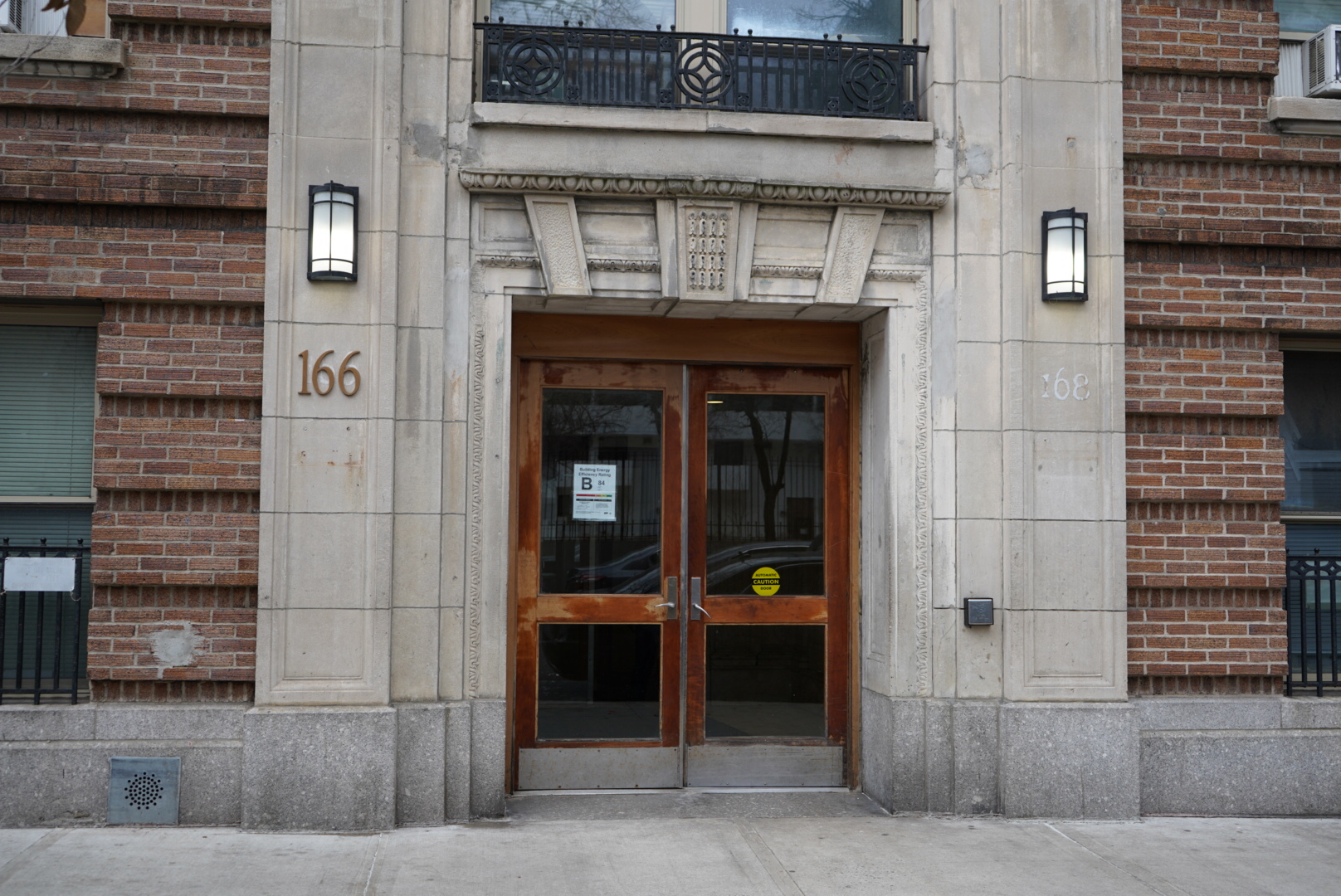
Capitol Hall on the Upper West Side, Jan. 16, 2026. (Credit: Tereza Pesmazoglou)
Capitol Hall, a supportive housing SRO on the Upper West Side, offers an example of what an added layer of support can look like.
Housed in a 10-story early 20th-century brownstone, Capitol Hall offers a mix of singles, shared, and suites, making up 201 single-room occupancy units.
The single units have private bathrooms. The shared units consist of two single rooms with a common bathroom, while the suites are made up of four single rooms with two shared bathrooms. All rooms include a bed, a kitchenette with a microwave but no stove, cabinets, a sink, a fridge, and a table with two chairs.
The managers aim to run Capitol Hall on three principles: shelter, affordability, support. They believe shelter is a basic necessity and right, which is why they prioritize permanent housing before addressing other problems such as mental health or substance use.
Once a person has a permanent place to live, the philosophy goes, then that person can begin to address his or her other needs.
“Having a place to sleep is 90 percent of it,” said Chris, 69, a resident who asked for anonymity because his family and friends do not know he was once homeless.
Capitol Hall tenants pay 30 percent of their income in rent and each tenant gets a case manager.
“My role as a case manager is to help stabilize the tenants,” said Alexis Hill, whose client list includes about 35 people, including Chris. “Although this is an independent style SRO, everybody needs some type of assistance.”
Hill said her role ranges from connecting clients with food benefits to helping clients with income services and employment resources. For each tenant assistance can look different. For Chris, much of Hill’s help has meant navigating his rental-assistance paperwork that could affect his housing stability.
Wood said that Capitol Hall’s supportive services are also meant to help tenants who have been chronically homeless adjust to permanent housing through rebuilding community and social routines.
Sometimes, however, Hill said, she also has to help clients with their emotions. Some only need her to listen to their frustrations and their fears, she said. A major concern among her clients, she added, is about aging. Roughly 70 percent of them are over 60. This is a concern echoed by Chris.
“My dad, he died at 62,” Chris said, his light blue eyes vivid under the harsh bright lighting of the common area of his home. “He was an alcoholic. He was found in the living room. He passed out and just fell down because he lived alone.” No one noticed for five days. “They only found him because the neighbors reported a smell coming from the room,” Chris said. He has been thinking of getting a roommate, someone who could call 911 if he fell down.
Capitol Hall does not have emergency buttons installed in tenants’ rooms. However, staff conduct more frequent check-ins with the most vulnerable residents to assess their well-being and encourage them to obtain a life alert system that can alert 911 or emergency services, Alexandra Badia, Capitol Hall’s director said.
The approach taken by Capitol Hall and Oak Hall helps homeless people find stability. Hill just wishes it was more widely available.
“I worry that certain citizens will fall through the cracks if they’re not placed in supportive housing. Specifically, citizens who have mental health concerns,” she said.
Until recently, the legislative push to bring more SRO-style housing into the city had made little progress. The original SRO bill, Int-1475, introduced by Erik Bottcher did not move forward and its replacement, Int-0066, has been stalled in committee since January. However, at the end of May, Mamdani released his housing plan, Block by Block, outlining his support for bringing back SRO-style housing. The plan states his administration will work with Council Member Virginia Maloney, who is the primary sponsor of Int-0066, to pass legislation that would create safe, affordable and diverse shared housing options across New York City.
But, as city officials move forward with efforts to revive SRO-style housing, advocates like Leone suggest that more research should be done before lawmakers pass it. Opening more SROs to ameliorate the housing crisis, without a deeper study of their impact, could risk ignoring the root causes of housing instability, she argued.
“Thinking that SROs are the answer to our housing crisis is a bit short-sighted,” she said.
About the author(s)

Tereza Pesmazoglou is a features writer interested in how policy, systems and social issues shape people’s everyday lives.