




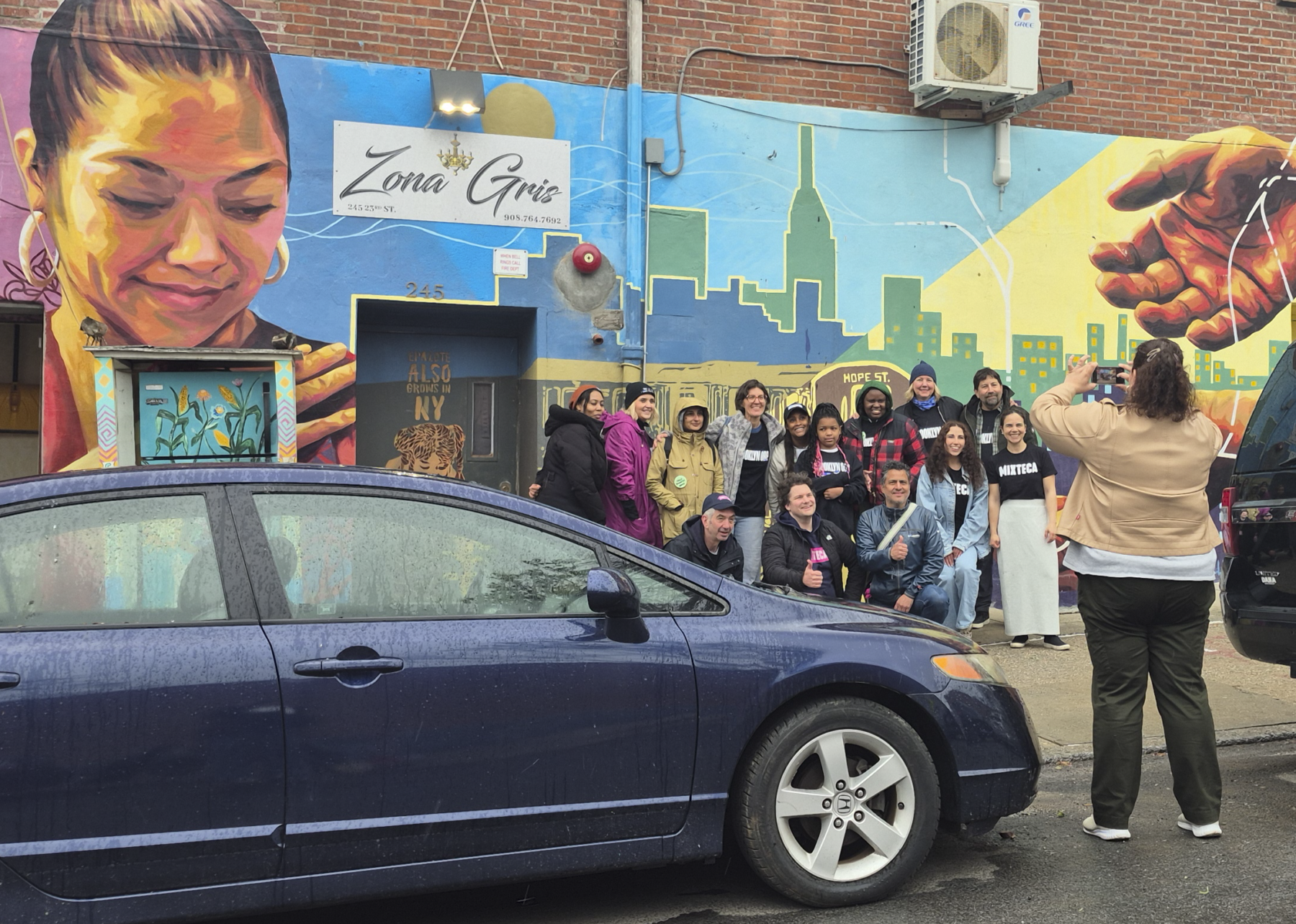
Volunteers from Mixteca Organization, Inc., and Brooklyn Org pose for a photo in Sunset Park after their weekly market offering free produce to Brooklyn’s Latino community. (Credit: Sophia Ramirez)
The food delivery truck was late. It was cold, it was rainy, the coffee ran low, and the volunteers were anxiously looking toward the main road.
“It’s not usually like this,” said Eddie DeLeon, the volunteer coordinator, on a recent spring morning. He tracked the truck on his phone, and thought it was about 10 minutes away. DeLeon has salt and pepper hair, and wears a knee-length black coat with a black shirt that says Mixteca.
Mixteca Organization, Inc., hosts el mercadito solidario, or the Solidarity Market, every week in the spring and summer. It’s like a food bank, offering free food for the local Latino and immigrant community of Sunset Park, Brooklyn, where their main offices are. The market is held off-site. Mixteca’s executive director, Lorena Kourousias is concerned the outdoor market could be targeted by U.S. Immigration and Customs Enforcement, and has asked a reporter not to publish the market’s location or time.
“We are a pro-immigrant organization,” said Kourousias. “We are not hiding that part of who we are just because the new administration doesn’t like immigrants and doesn’t take into consideration all the benefits of having an immigrant community here in this country.”
A speaker sent the soft violins of classic salsa music floating over the volunteers. The speaker sat under a hot pink tent, along with 30 cardboard boxes of fruit that were delivered earlier; mangos, apples, pears, and banana boxes were all stacked up in a row like a mini New York skyline.
The mercadito purchases its food from local, organic farms in upstate New York, New Jersey and Pennsylvania. Getting local produce means the market reduces its climate impact, with fewer emissions from trains or boats. But, if they can’t source locally, Mixteca’s priority is fresh, culturally-sensitive groceries like fresh chamomile for tea, and pepicha, a commonly used spice in Mexican cuisine.
“When our community moved to the U.S., they started getting the cheapest food, like maybe it’s $1 pizza, but that doesn’t mean they like it,” said Kourousias. She said that she hears from community members who miss the access they had to fresh fruits and vegetables in their home countries. That’s why Mixteca will splurge to offer mangos, which aren’t from local farms, because they remind the community of home.
Usually, there’s about 10 Mixteca volunteers and employees that run the market on Saturdays. But this day was Volunteer Day in Brooklyn, and the group Brooklyn Org sent about another 10 volunteers. They gave out more food than usual, and Brooklyn Org foot the bill for today’s groceries.
Assuming the second truck would arrive.
All the volunteers started to mill around now, chatting in Spanish about movies and how their grandparents are doing. A couple followed DeLeon’s lead to keep an eye out for the truck. Ana Salgado, a social worker and Mixteca’s senior coordinator, left to get more coffee for the volunteers and for the long line of community members waiting for the food.
The two tents that cover the market were at one end of the block. Ten feet up the block was a check-in table, run by two women trying to protect their computers from the rain. A few steps up from that waited about 100 people, split into two parallel lines so Mixteca doesn’t commandeer the whole block.
About 10 minutes before the market was set to open, the last food delivery still hadn’t arrived. Community members walked up to the market. Earlier that week, they reserved a spot online, where they got the address for the market. They also got reminders for the market over WhatsApp, the most popular texting and messaging service for Latin-American immigrants. On the day of their reservation, they arrive at the market and spot the hot pink tents. The regulars know to stop by the check-in booth, where they receive a numbered ticket, and get directed to the back of the line. The two women at check-in usually know the market-goers by name and ask about their family as they confirm their reservation at the computer.
The marketgoers are often enrolled in some of Mixteca’s many other services, like their computer or English classes. There, the team will tell them about the market.
“Unfortunately, not all of our community qualify for SNAP or for cash assistance,” said Salgado. “[The] mercadito is a program that all of our community can enroll in, regardless of immigration status.”
Mixteca also offers nutrition classes, including recipes for healthy meals that can be made with the market’s produce.
One of the marketgoers, a smiley man in a green zip up hoodie, was clearly a regular, laughing and joking with a Mixteca employee at check-in. She passed him a ticket and pointed toward the back of the line. He laughed, and asked her in Spanish if he really had to go all the way back there. “Are you sure? Oh, alright,” he said in Spanish. He laughed again and headed toward the back of the line, pulling his cart behind him.
He joined the back of the line, where everyone else was also in high spirits. Kourousias said this is because the team knows exactly how many people will be there, and the people know they’ll walk away with enough food for several meals, and that can come back in two weeks. “There is no need to fight, because there is enough for everyone,” Kourousias said.
The line is comprised mostly of older Latinos, people in their 40s, 50s, and 60s. A couple of younger adults brought their children. One woman arrived at the check-in table. Waving at the woman at the head of one of the lines, she called, in Spanish, “Are you the first one?”
“No, I’m number 50,” said her friend with a mock frown. She wore a purple beanie and a plastic poncho that the Brooklyn Org volunteers handed out.
Salgado came back with more coffee in a cardboard carafe. Two more volunteers join her, holding a stack of paper cups and sugar packets. They went up and down the lines and offered hot coffee to everyone.
Salgado went back to the front of the two lines and spotted it – a pale green delivery truck from Grow NYC.
“It’s here!” she yelled. She faced the lines, close to 150 people now, and shot her arms up. She called for a cheer, and the crowd whooped and yelled. The speakers played brassy mariachi music.
It took just a couple of minutes for the truck drivers to park on the main road and drive a yellow dolly over with the first pallet, a plastic-wrapped cube of more cardboard boxes, this time vegetables. The volunteers descended on the cube from all sides, moving like a NASCAR pit crew. They cut open the plastic to get at dozens of boxes of broccoli and beans. They pulled out 20 pounds of yellow onions and potatoes. A few volunteers unfolded plastic tables in a line against the brick wall. The truck drivers brought the second pallet around, this time cartons of eggs and milk. The volunteers disassembled the stacked cube just as quickly, and started putting all the groceries on the tables.
The market was up and ready to go. Salgado said to the crew, “Nos vamos.” We’re going. She called for the first 10 tickets to come shop at the market.
A group of older women walked under the pink tent to the first station. A volunteer stood behind each item and asked if they would like it. The first couple said yes to apples, but no to the oranges. They walk down all seven tables, filling up their little push cart. Each volunteer smiled and said “good morning.” The couple smiled back and thanked them for the food. DeLeon handed out spicy peppers wrapped in plastic so no one got chili oil on their hands. A volunteer with long, curly red hair danced along to a lively bachata. “La la la la,” she sang along as she handed out navel oranges.
Maybe five minutes into the market, a woman in a black coat arrived with her daughter in tow. The little girl was about 3 years-old, wearing a tiny puffer coat. They walked up the block toward the market and had to pass by all the tables to get to the check-in booth. The little girl stared at the singing volunteer with the red curls. She waved at the kid who startled and ran to catch up with her mom.
Every single person walked away with a tote bag or granny cart full of fresh produce, and many will return in two weeks. After collecting their food, they departed, heading back to their homes in Sunset Park. One of the last people to come through the line was the mother in the black coat and her daughter in the tiny puffer. The mom chatted with one of the volunteers when her cart started to roll away. The little girl reached up to catch the cart, even though it was a little taller than her. She saved it.
The volunteers waved goodbye to the last woman as she pushed her granny cart away from the market. The whole market took exactly 38 minutes to serve 150 people. The food was nearly all gone. Volunteers packed up a few extra pears and egg cartons. They’ll be brought to Mixteca offices, or put in the community fridge outside the office, an outdoor refrigerator that anyone can take from. The team started to break down a mountain of cardboard boxes, stuffing the flats into plastic bags for the recycling bin. They dumped rainwater out of the pink tents and folded down the plastic tables.
DeLeon, who’s been in charge of the playlist, grabbed his phone and picked the last song of the day – “Nuevayol” by Bad Bunny. The drums and trumpets carried the volunteers through the final stretch.
Their market turned back into a regular city block in minutes.
About the author(s)

Sophia Ramirez is an MA student at Columbia Journalism School and early career science journalist.