




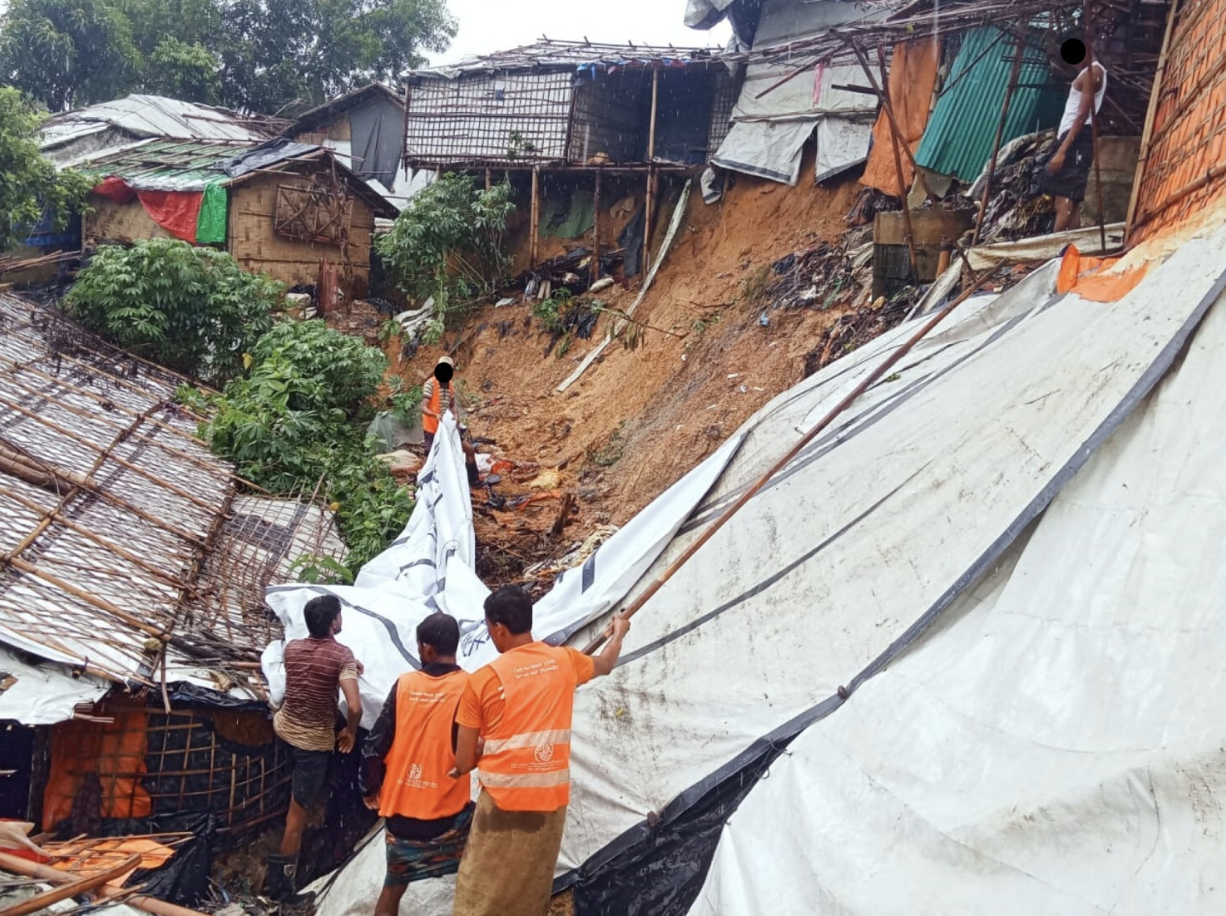
Refugee shelters being built on a hilly slope. (Courtesy image: Nazifa Rafa)
“Sometimes, we feel like death would be better than living in fear of dying every day,” said a young woman living in the Cox’s Bazar district of southeastern Bangladesh. She said she is worried that a landslide will wash away her hillside home, where she lives with her children.
Similar fears were expressed by many other Rohingya also living in the district, according to Nazifa Rafa, a Cambridge University researcher. Rohingya, targeted by the army, is a muslim community that had no other option than leaving the misty green mountains of the Rakhine region, in northeastern Myanmar.
Over ten months, Rafa visited 14 of the 33 regional camps established for Rohingya refugees escaping violence in Myanmar. Rafa found that the more than one million Rohingya living in these settlements are facing heightened vulnerability to climate-related hazards such as cyclones, floods, and landslides.
In a recent study, published in the journal Climate & Development, Rafa attributes much of this risk to Bangladeshi government choices limiting permanent construction materials and restricting the locations where these camps can be built — choices she said are designed to marginalize the refugees and to encourage them to return to Myanmar.
Other researchers confirm that refugees are at risk because of their status, and the idea that they would not stay long in the host country. “To a certain extent, it’s assumed that they will only stay for a short period of time,” explained Jörn Birckmann of the University of Stuttgart, a contributor to a 2022 Intergovernmental Panel on Climate Change report.
Rohingya refugees living in Cox’s Bazar, a fishing port in Bangladesh, are among the 117 million globally displaced people. This number has doubled since 2015, according to the United Nations High Commissioner for Refugees (UNHCR). Forty percent of them live “in fragile and/or conflict-affected countries,” which, according to a UNHCR report, means they are more vulnerable to climate change. “A lot of people who are migrating are losing access to insurance systems,” which makes them more vulnerable to climate disasters, said Birckmann.
For many Rohingya, most of whom arrived in 2016 and 2017, the vulnerability is two-fold. It is linked to the location of the camps, which have been placed by the border in hills, and to the nature of the materials they are permitted to use to build homes.
The risk of landslides has intensified in the area since 2003 because the number of people living on “risky slopes” has increased with the Rohingya influx, said Bayes Ahmed, an associate professor in the Department of Risk and Disaster Reduction at University College of London. During 2025, according to a study by Ahmed, the Cox’s Bazaar area had 1,278 landslides—a third occurred in the densely populated areas where the Rohingya settlements are.
By placing camps in hills near the border, the government aimed to send a message to Bangladeshi citizens that refugees would not remain forever, Rafa’s study reported. “The government was holding on to this sort of fiction of repatriation,” said Rafa, who also conducted interviews with officials for her study, which was funded by the Department of Geography of the University of Cambridge.
Location was also influenced by population density: Bangladesh has one of the world’s highest.
“We are overpopulated and a land-hungry country,” said an anonymous government representative quoted in Rafa’s article. “We do not have enough plain land for this settlement.”

One of the many camps that hosts Rohingya in Cox’s Bazar. (Courtesy image: Nazifa Rafa)
Rafa’s research also examined the construction materials that Rohingya are allowed to use. The government prohibits Rohingya from using permanent materials such as brick and steel, contending that the camps are temporary. This means, Rafa said, that their homes are more vulnerable to extreme weather and other climate change impacts.
In Ahmed’s view, however, expecting better housing is unreasonable. “The government cannot build permanent, nice, brick built houses for all,” he said, noting the economical and human resources that such a project would require.
Moshor Rof, one of three Rohingya refugees who assisted Rafa in her research, has been living in Camp 11 for nine years. Originally from Maungdaw, a town in the western part of Myanmar, the 25-year-old, who is passionate about academic research, has witnessed several climate-related disasters during that time.
Once, two men were killed “after continuous heavy rainfall for several days’ intense rain triggered landslides near my block,” said Rof.
“Living in stronger shelters would not only protect us physically, but also reduce the trauma and fear that returns every monsoon season,” Rof added.
Ilan Kelman, professor of disasters and health at University College London, said that, often, “disasters are not natural.” He argues that “when we see a disaster, it’s not because of the flood, not because of the fire, not because of the landslide or the earthquake or the storm,” but rather because people don’t have the power, resources or opportunities to adapt to extreme environmental events.
What Kelman depicts applies as much to other places as to Bangladesh. In West Africa, for example, 600,000 refugees live in camps disproportionately exposed to climate disasters, according to the Center for Global Development.
Although many organizations have sought to raise awareness about the growing climate-related vulnerabilities of refugees, many governments have not changed their approach. The UNHCR conventions and protocols that date from more than 60 years ago aim “to seek durable solutions, the number one being that people need to return home safely,” said Kelman. “It is well out of date, it does not and cannot serve contemporary needs.”
In 2020, the Bangladeshi government built a refugee camp on Bhasan Char island, in a swamp, two hours by boat from the mainland. The camp was constructed against the recommendations of UN agencies and officials, who concluded that there was a risk of warehousing people on a swampy, isolated island. In May 2020, 29 Rohingya refugees were transferred to the island; over 34,000 live there now.
“One of the hardest parts about living on Bhasan Char is restrictions on freedom of movement,” said John Quinley, director of Fortify Rights, a non-profit organization defending Rohingya refugees. In addition, the remoteness means help can be slow in coming: “Ambulance boats can’t really operate during the height of the monsoon season.”
In January, Fortify Rights published a report about the dangers of the situation. Some of the testimonials of people on Bhasan Char echo those collected by Rafa in Cox’s Bazar: many feel trapped and worried.
“There is no way for us to escape when there is a natural disaster, such as a storm or flooding,” one inhabitant told Quinley and his team. “We are in prison here.”
About the author(s)

Gustave Muckensturm is an investigative multimedia-journalist and born in Paris, France, member of the Stabile cohort at Columbia Journalism School, reporting on Immigration, Climate and Sports among other beats.