




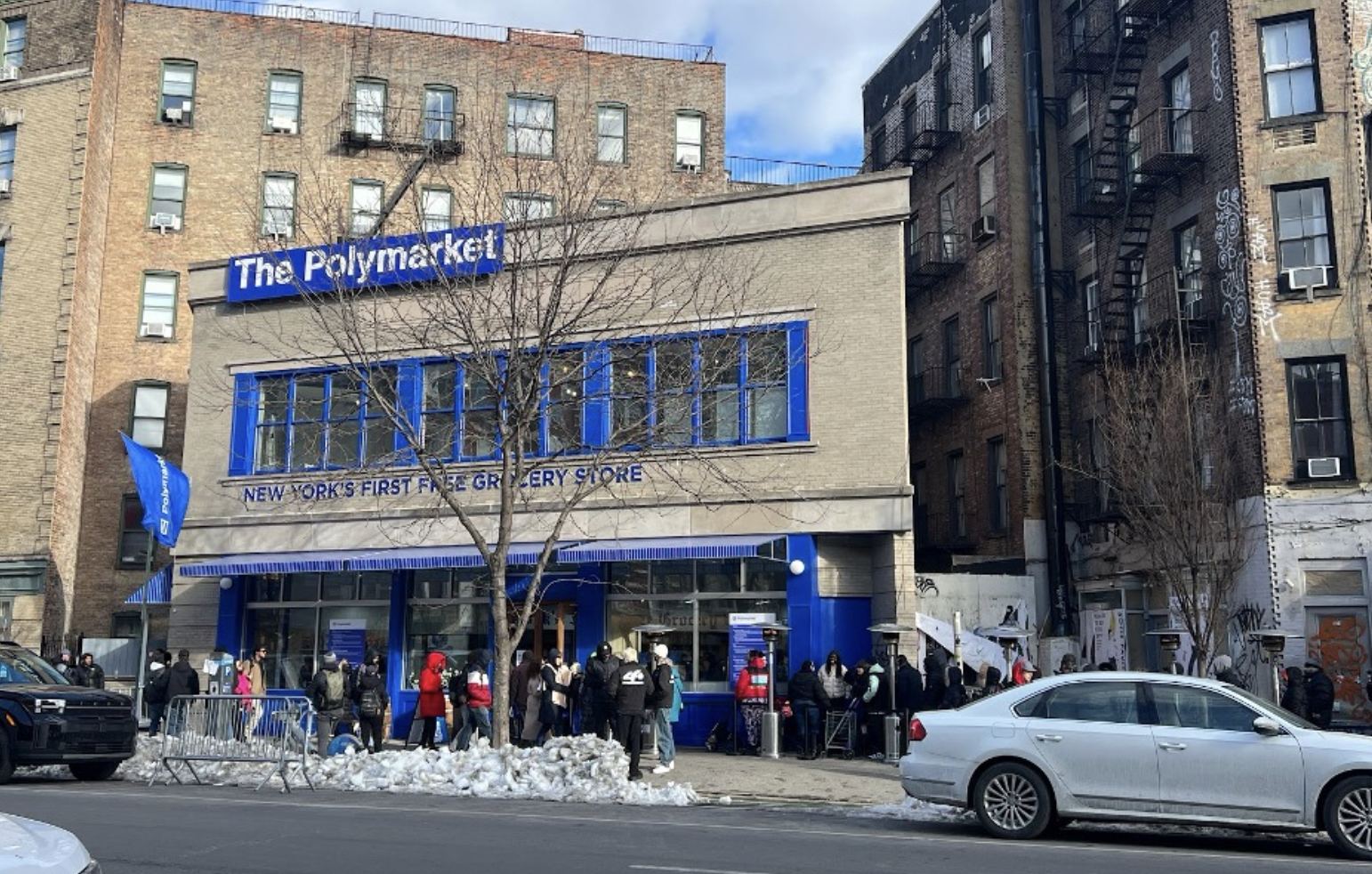
The Polymarket Grocery Store. (Credit: Katlyn Ma)
Polymarket, the world’s largest prediction market for betting on the outcome of future events, took a wager of its own this month that a pop-up store offering free groceries in Manhattan would help boost its brand with New Yorkers hungering for a break on rising food costs.
That bet appeared to pay off when the outlet opened for a five-day run on Seventh Avenue South in the West Village on Feb. 12. A line of consumers formed, stretching four blocks to the store’s entrance. Whether the free groceries promotion was enough to woo New Yorkers to risk money in the online prediction market remains unclear.
“We’re struggling already, imagine gambling,” said Jackie Suarez, who traveled from the Bronx for the free groceries. “I stay away from all that.”
Inside the store, it was difficult to miss the New York-based company’s branding effort. The Polymarket logo adorned the walls, and appeared on reusable shopping bags and cups of hot chocolate that employees handed out, also free of charge. Some consumers arrived with their own collapsible carts and shopping sacks. They were free to help themselves to staples ranging from fruit to toilet paper and then walk out. There were no cashiers or checkout lines.
It was a promotion tailored to the times. Affordability is a key issue in the city, where 42% of families with children cannot afford weekly food costs, according to a report last November by Robin Hood, an anti-poverty nonprofit, and researchers at Columbia University’s School of Social Work.
Grocery expenses in New York climbed 56.2% in the decade through 2023, compared to a 46.4% increase nationally, according to a New York State Comptroller’s report last April.
Food costs are such a concern in New York that Mayor Zohran Mamdani promised city-owned stores offering staples at wholesale prices, a central pledge in his election campaign last year. Some of the people waiting in line at the Polymarket pop-up wondered how the outlet might compare to the new mayor’s vision.
Gigi Hao, a 60-year-old retired home-attendant from Brooklyn, was there with a friend and focused on finding the most-expensive items to fill her bag. They exited with chicken, tofu, blueberries, pasta sauce and yogurt, among other goods, and planned a return trip for additional free items.
“Food is hard to come by these days,” Hao said, speaking in Cantonese.
Building goodwill among New Yorkers is what the pop-up was intended to achieve, according to Josh Tucker, a growth strategist at Polymarket. The company “hopes to enrich the community and give back to the city,” he said, while establishing “a physical representation of the brand.” The branding effort avoided any overt promotion of the gambling app. The only QR codes on display in the store led to a donation page for Food Bank For New York City.
Luke McInerney, 31, a software engineer in Manhattan, visited the pop-up, citing the “craziness of grocery prices.” He said he also was curious about what a free grocery store would look like as Mamdani develops a plan for city-owned supermarkets. McInerney is no stranger to Polymarket’s app, having used a $10 promotion to place an initial bet, which he lost. He said he most likely won’t make another wager.
Prediction market platforms allow people to place bets on politics, news, sports, culture and technology. The total value of wagers on prediction markets has stood this month at $126.7 billion, according to Dune, a crypto-data platform. Polymarket, which accepts wagers through its mobile app and website, represented 44% of that volume.
The prediction market has drawn criticism for the industry’s lack of regulation and consumer protections.
Tori Hall, 58, knew nothing about Polymarket before she learned about the grocery giveaway on Instagram. That was enough for her to skip a usual trip to a Trader Joe’s supermarket in her Forest Hills neighborhood of Queens and make the 60-minute journey to the pop-up store, where she stood in line for eight hours. Hall said she doesn’t gamble but would support the company “as long as they continue to help the community.”
Polymarket said its initiative has fed thousands of New Yorkers, alongside a $1 million donation to the Food Bank for New York City. The company said it may plan more events like the grocery pop-up in the future.
About the author(s)

Katlyn Ma is a Stabile Investigative Fellow at Columbia University's Graduate School of Journalism with experience spanning the US and UK.