




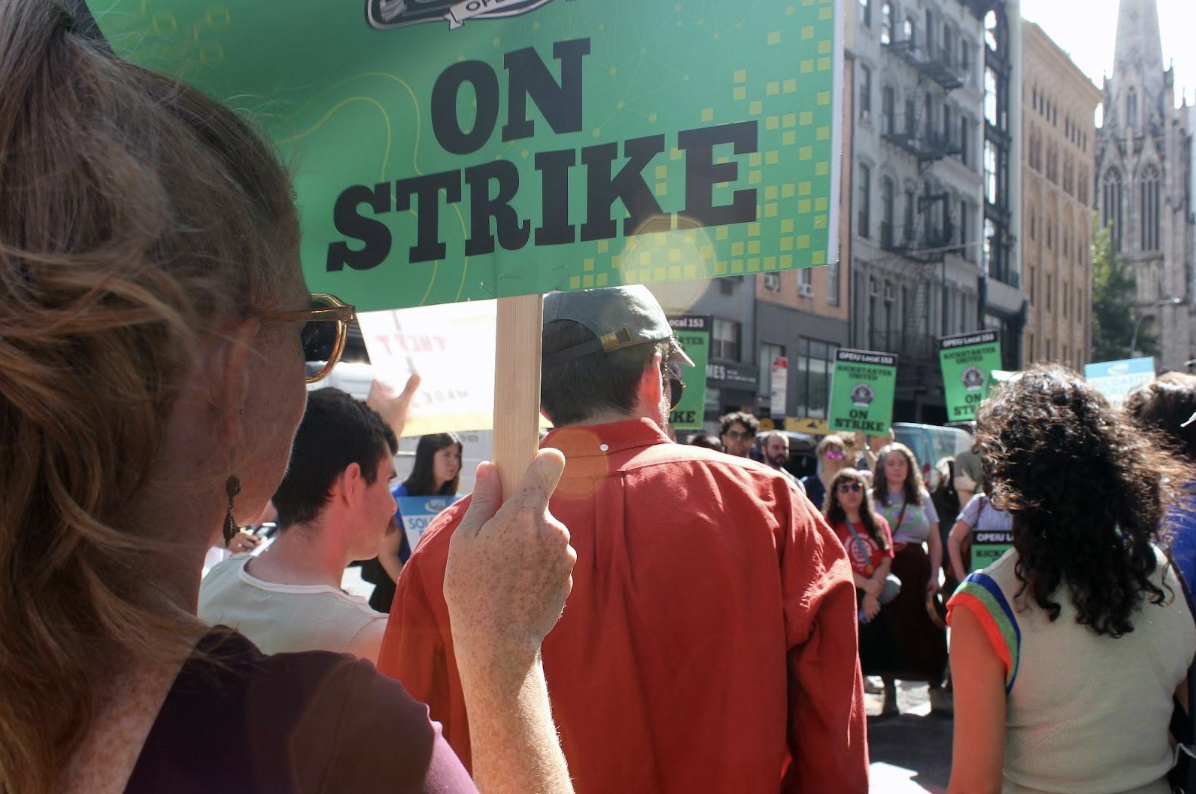
Kickstarter union members and supporters at a rally during their strike last fall. (Credit: Julie Lee)
At least seven unionized Kickstarter employees were told in early February that their roles were eliminated as part of a restructuring effort, a move that the union claimed was in retaliation for a strike last fall.
Four unionized employees were terminated and another three were offered roles outside of the union. Another employee, who was in a non-union role, was moved to a role within the union. Otherwise, the only employees affected were union members. As labor unions have become more popular in the tech industry, the terminations were viewed by the union as a means to chill worker organizing.
“A lot of folks feel like this is a direct result of our strike,” said one of the affected employees, who requested anonymity.
In October, unionized employees at Kickstarter went on strike over stalled negotiations for their latest contract. Among other demands, the union sought to codify their four-day workweek in their contract, a first for the industry. The strike ended in November after a record 42 days, with the union announcing it had won strong protections for their four-day workweek and a higher salary floor tied to cost of living. It was the longest strike to date amid a new wave of tech worker unions, after a weeklong strike by the New York Times Tech Guild in November 2024.
Three months later, Kickstarter eliminated the roles of at least seven employees who participated in the strike. The move was described as a “restructure” due to “changes to the organization,” rather than tied to performance or financial issues, said union members. In fact, the terminated employees had excellent performance and some were essential to the success of Kickstarter, said Dannel Jurado, a senior software engineer at Kickstarter and union steward who is representing two of the terminated workers in grievances between the union and company. “The union is operating on this being retaliation,” said Jurado.
Kickstarter CEO Everette Taylor and vice president of people Tarveen Forrester did not reply to multiple requests for comment.
In 2020, Kickstarter became the first modern tech company to unionize. During the unionization effort, the company fired two employees who were active in the campaign, Taylor Moore and Clarissa Redwine. The union claimed the terminations were retaliatory and filed two charges with the National Labor Review Board. Kickstarter later settled with one of the workers for around $36,000 in backpay, but continued to deny that the terminations were linked to the employees’ union activity.
Seth Goldstein is a labor attorney who represented Moore and Redwine in 2020. While Goldstein does not represent the recently terminated workers, he had strong words about any suggestion that Kickstarter’s actions were anything but retaliatory based on his experience with the company.
“It’s bullsh-t,” said Goldstein. “They can’t accept the fact that the workers organized successfully.”
The recent termination took place months after the end of the strike. Goldstein was not surprised.
“If they did it right away, then it definitely would seem like retaliation,” he said. Jurado, the union steward, found the timing suspect. Annual bonuses are usually awarded in March, so the terminated workers will not get bonuses, he said.
As for the employees offered non-union roles, union representatives viewed the decision as an attempt to reduce the size and strength of the bargaining unit.
The union is pursuing grievances internally with the company and has filed two charges with the National Labor Relations Board (One charge is available online but the other has yet to be docketed).
“No matter what happens, it’s important that we don’t just roll over,” said the affected employee.
About the author(s)

Julie Lee is a Stabile investigative fellow and previously covered issues such as surveillance technologies, artificial intelligence and the criminal legal system.