




Graphic: Julie Lee
Unionized employees at Kickstarter – an online crowdfunding platform – have been on strike since Oct. 2, the latest escalation of a months-long contract fight that centers on codifying a four-day workweek and a salary floor of $85,000.
The strike is a milestone for the growing tech worker labor movement.
“It’s only the second strike in the tech worker industry,” said Emily Mazo, a PhD student at Columbia University who studies labor organizing in the tech industry.
In 2020, Kickstarter became the first major U.S. tech company to have a “wall-to-wall” union across all non-managerial job titles. After a two-year battle, the union, Kickstarter United, ratified their first contract in summer 2022. Currently, 60 of the 100 employees are members of the union.
For the last few years, employees have had a four-day, 32-hour workweek. The crux of the contract fight has been around codifying this provision so that management cannot unilaterally take it away.
“They continue to say, ‘we have no intention of returning to the five-day workweek, but we want to be able to reserve the right to,’” said Dannel Jurado, a senior software engineer at Kickstarter who has worked there for over six years and has held several union leadership roles. “If you have no intention of it, why do you need to reserve the right?” he asked.
Workers are also fighting for a $85,000 minimum salary for all members. Even though Kickstarter became a fully remote company in 2020, many of its employees remain in New York, where it was founded and headquartered, or are based in other cities with a high cost of living, such as L.A. and Seattle.
“We still have folks in the company who are living paycheck to paycheck,” said Arleigh Atkinson, a senior software engineer at Kickstarter based in Portland, Oregon.
One in six union members currently makes less than $85,000 and would see a raise as a result of an increased salary floor, said Atkinson. Altogether, she estimated it would cost an additional $94,000 annually for Kickstarter.
“It’s a drop in the bucket compared to the total budget of the company,” she said.
Kickstarter did not respond to multiple emails and phone calls for comment.
Bargaining started in April, three months before the first contract was set to expire. Since then, the union has won some concessions, including establishing guidelines around the use of A.I. But after negotiations reached a stalemate, workers voted to strike.
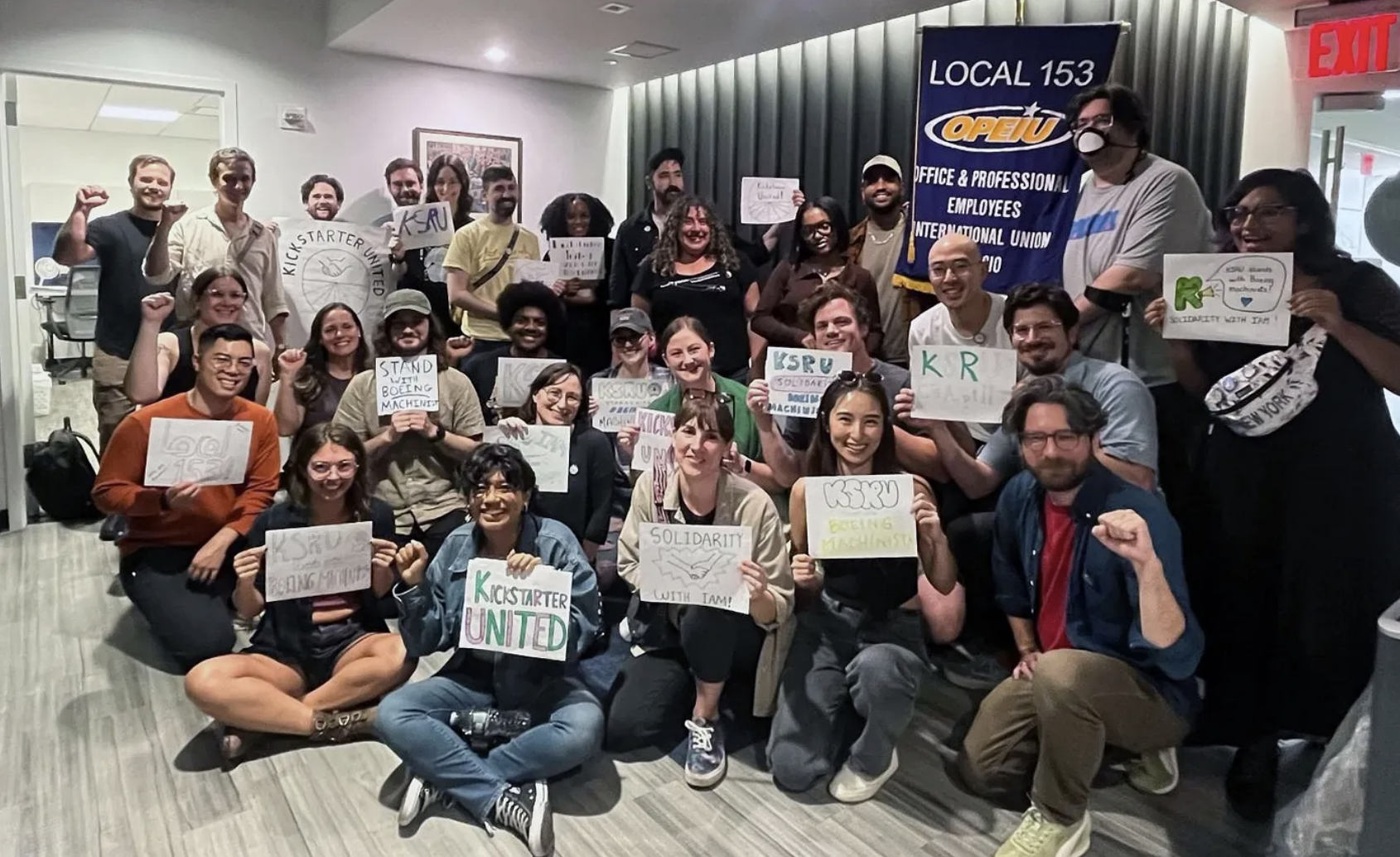
Kickstarter United members at a gathering earlier this year. (Courtesy: OPEIU Local 153)
“The point of all of this is to get an agreement,” said Sam Heyne, a staff organizer with Kickstarter United’s parent union, OPEIU Local 153. “That’s the goal here – getting a contract.”
Kickstarter United is part of a new wave of tech worker organizing that includes roles like software engineers and product managers. Last November, the New York Times Tech Guild went on a weeklong strike, reaching a deal with management a month later.
“It’s a sign of strength of the movement and the maturity of these tech worker unions that they are powerful enough to strike,” said Mazo.
The four-day workweek has become more mainstream in recent years. In 2022, the international advocacy organization 4 Day Week Global launched a six-month pilot in over 100 companies, including at Kickstarter. The largest study to date of the four-day workweek was published this July, finding that it resulted in improvements in burnout, job satisfaction, mental health and physical health.
“I haven’t seen any other examples of contractual language used to guarantee a four-day workweek, which is why I think this is so exciting,” said Ethan Marcotte, independent designer and author of “You Deserve a Tech Union,” a book about the tech labor movement.
The Kickstarter strike has so far lasted over two weeks and has no clear end date in sight.
“People may call our demand for a four-day workweek extravagant,” said Jurado, the Kickstarter United organizer based in New York. “People probably said that to the people who wanted the five-day workweek, right?”
Jurado is hopeful that their fight will inspire other workplaces.
“We need to show by example, because I don’t think it’s just going to be handed to us,” he said. “We have to fight. So, we’re going to fight.”
About the author(s)

Julie Lee is a Stabile investigative fellow and previously covered issues such as surveillance technologies, artificial intelligence and the criminal legal system.