




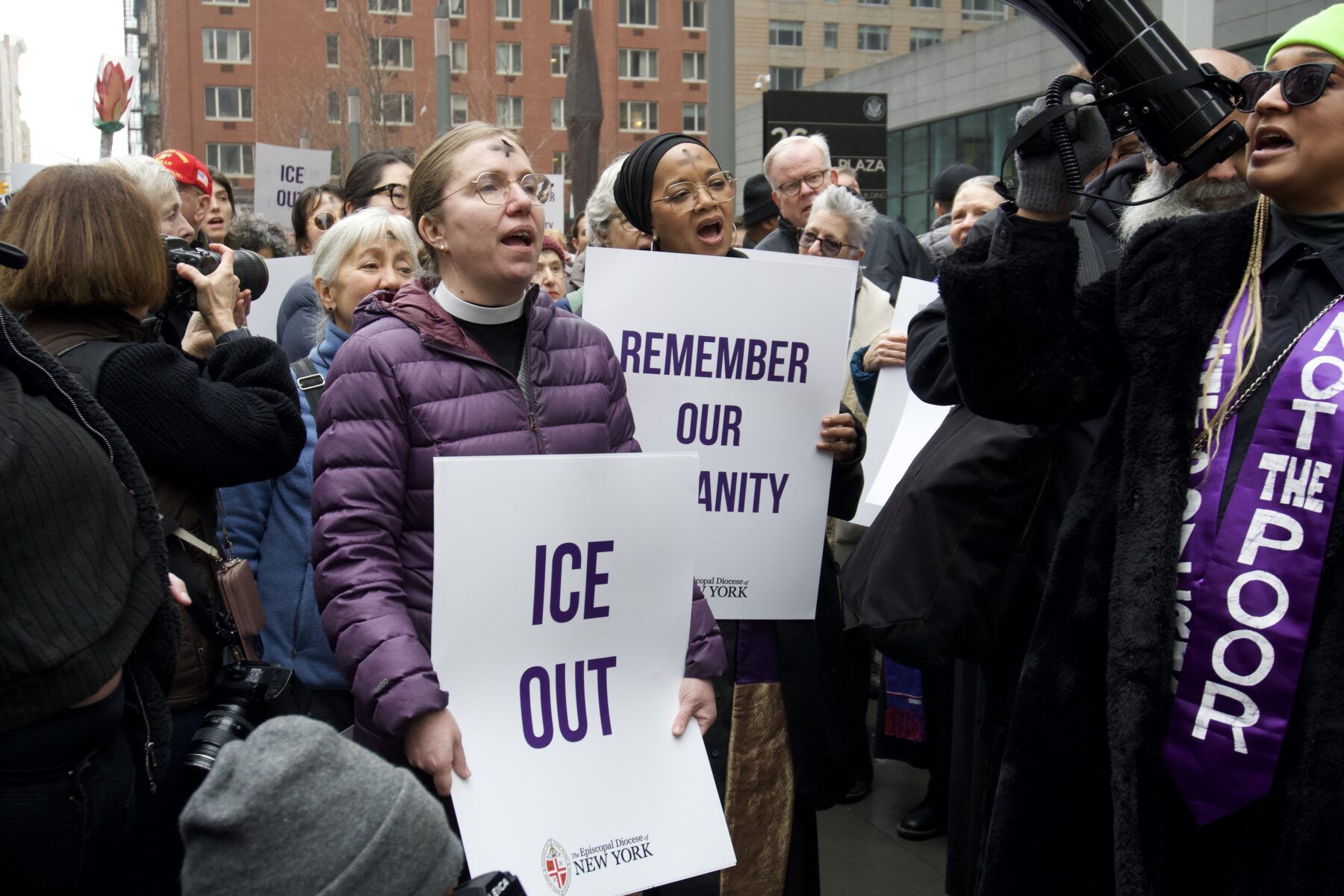
“Reclaim Your Faith” march, Feb. 18. (Credit: Sidney Kuri Poor)
Outside 26 Federal Plaza, the downtown Manhattan site for U.S. Immigration and Customs Enforcement detainees, the Rev. Adrienne Thorne, with ash streaked across her forehead, gripped a megaphone to deliver a message to a crowd of protestors that gathered on Ash Wednesday. “Protect immigrant mothers and parents,” she said. “Protect children who carry fear in their backpacks.”
On Feb. 18, the start of the 40-day season of prayer, fast and repentance for Christians, hundreds of followers met to protest, pray, and surround the Jacob K. Javits Federal Building, which houses an ICE detention center. They called it the “Reclaim Your Faith” march.
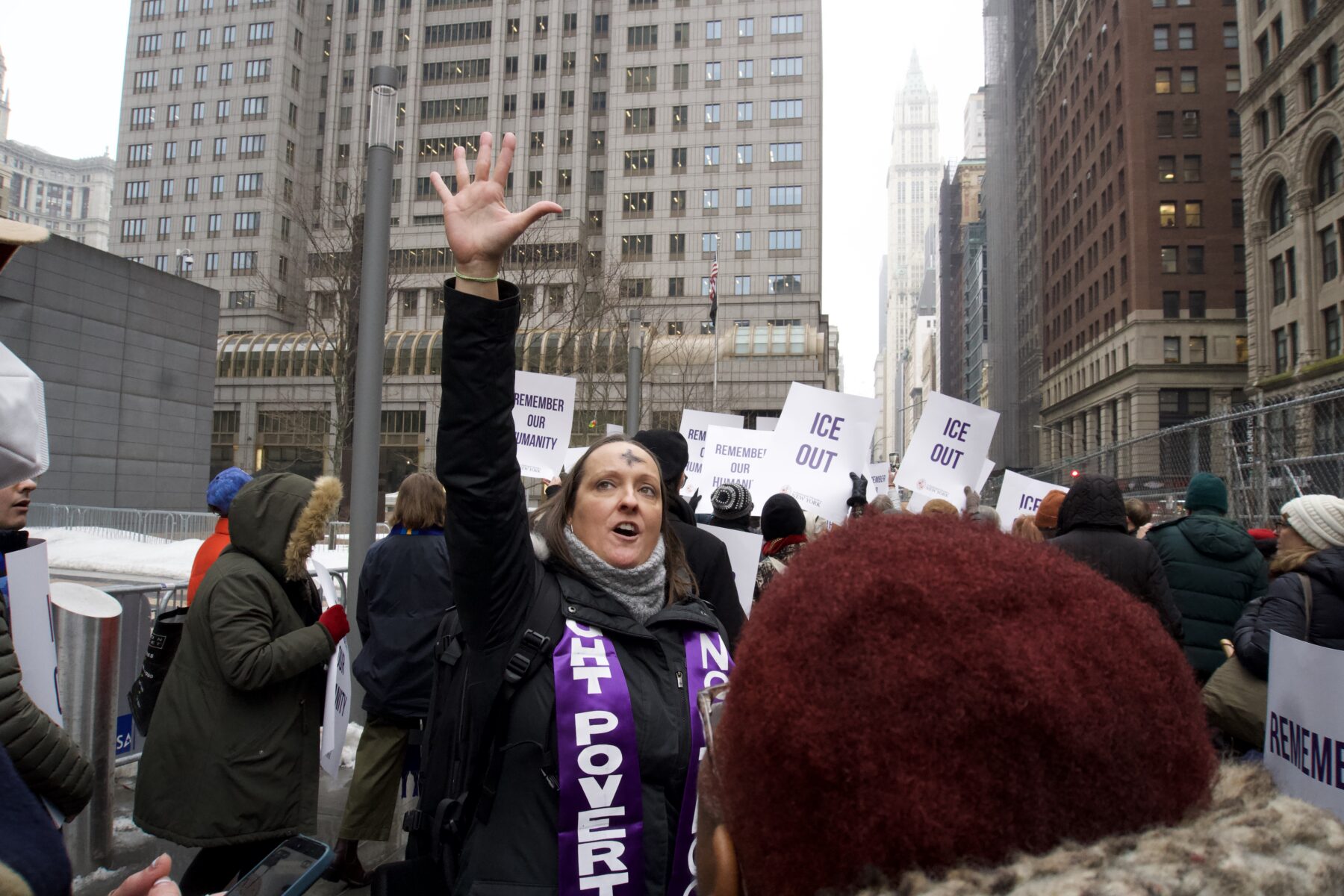
Protestors at the “Reclaim Your Faith” march. (Credit: Sidney Kuri Poor)
In the first 20 days of his second term, President Donald Trump rescinded protection from immigrant enforcement in churches. ICE arrests on New York City streets have more than tripled under the administration, including for noncitizens without a criminal record according to Documented, which cited an analysis of ICE data by the nonprofit newsroom. In response, Protestant churches across New York City have increased their support for immigrants and ICE protests. The faith leaders also cite concern about the threat of Christian nationalism, which represents a corruption of faith that clashes with the moral responsibilities of religious institutions today, according to the clergy leading the protest.
Harsh immigration policies are not really about immigration, “but about who belongs in America,” said the Rev. Anne Marie Witchger, rector at St. Marks Church in-the-Bowery. Churches and the clergy have a role to play in offering moral clarity when there’s a lack of moral compass among the country’s highest leaders, Witchger said.
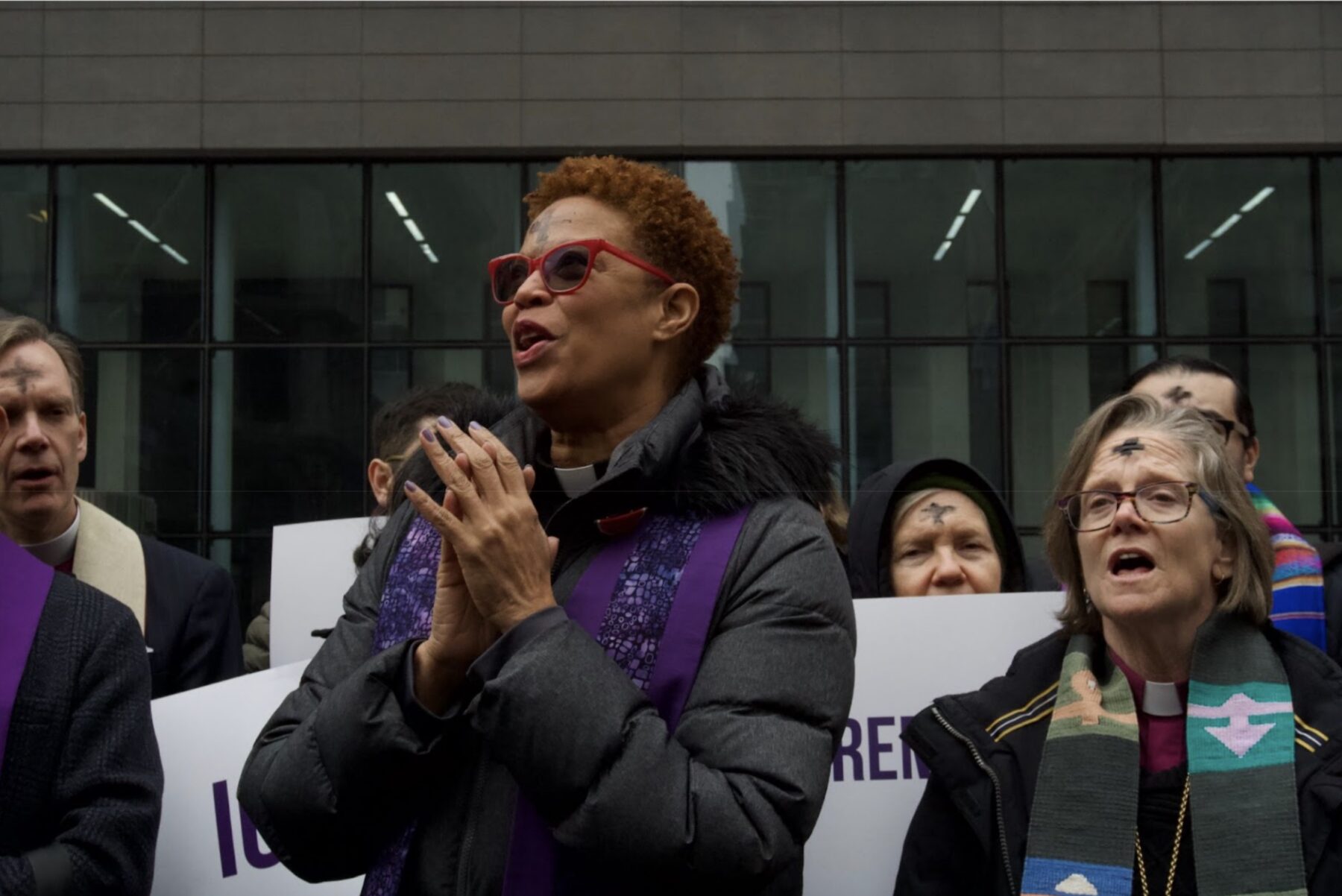
The Rev. Adrienne Thorne at the “Reclaim Your Faith” march. (Credit: Sidney Kuri Poor)
Thorne, who wielded the megaphone, grew up Catholic – a denomination that prohibits women from becoming priests. She now considers herself Episcopalian and is the senior minister at Riverside Church, an interdenominational congregation in Morningside Heights. Thorne said her faith calls people to love the stranger and the enemy. At the heart of Jesus’ story, she said, was a border crossing necessary to save his own life. While her activism is focused in the present moment, she recognizes that using faith as a mouthpiece is a strategy employed by activists such as Martin Luther King Jr. If you can get the people on your side, Thorne said, “you can move a city.”
St. Marks, which is housed in the second-oldest church building in Manhattan, has been a site of activism for decades. In the 1960s, the congregation aligned with the civil rights and anti-Vietnam War movements, and supported avant-garde cultural productions. Right now, Witchger and St. Marks are working to strike a balance between providing aid to immigrant communities and participating in public witness – the process of being present to document enforcement actions.
Since March 2025, religious organizations across the city have gathered weekly in Columbus Circle for events called “Moral Witness to Democracy.” This year, the Episcopal Divinity School, a progressive theological center in Morningside Heights, plans to launch a national “Love Thy Neighbor” Campaign in North Carolina. The goal is to equip faith leaders with identification for times of protest, and provide resources such as a “Protesting Faithfully Toolkit,” according to Mary Grace Donohoe, communications manager at the school.
The work involves hosting “Know Your Rights” meetings, encouraging neighbors to work with businesses and schools to provide mutual aid, public witness work, and programming for accompaniment, both for immigrants traveling to court and children walking to school, said Mira Sawlani-Joyner, leader of the Hands-Off Faith Coalition, which formed last year.
“We belong on the front lines,” Donohoe said. “If faith leaders don’t organize more effectively, we lose the gospel.”
Thorne drew a connection to the Christian period of Lent that began on Ash Wednesday. “We confess that we have not always loved our neighbors as ourselves,” she said. “We have looked away from detention centers, from court rooms, from children who wait for parents to come home. In the season of repentance, remind us that Lent is not only about private sorrow but about public outrage.”
About the author(s)

Sidney Kuri Poor is a journalist, photographer, and videographer born in Cleveland Ohio, and is now a dual masters student at Columbia University School of Journalism and International and Public Affairs.