



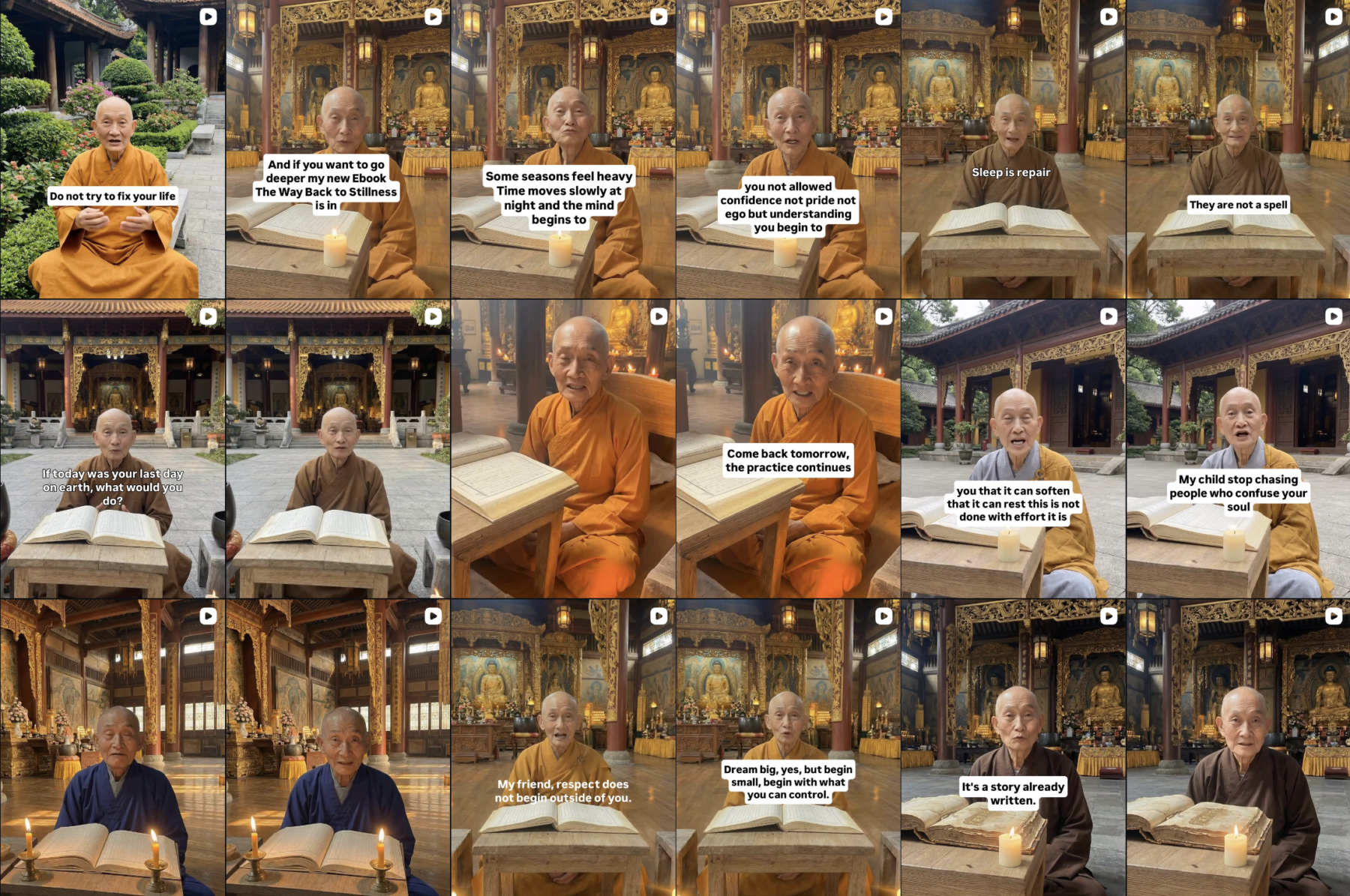
Yang Mun’s Instagram page has more than 2.5 million followers. (Credit: @yangmunus Instagram account)
Yang Mun, an East Asian monk with kind eyes, sat cross-legged on the floor of a temple, and spoke into the camera in a 90-second reel posted to Instagram in mid-January.
“You have lived through moments that could have hardened you, yet, your heart is still open and that is not weakness, that is courage,” he said, wrapped in a saffron robe amid soft candlelight, reassuring his 2.5 million followers. “You are not weak for feeling this way and you are not broken for hurting, this is what it means to be human,” he added.
In the comment section of the reel, hundreds of hearts, prayer-hand emojis, and pleas for guidance flooded in, as users thanked Yang Mun for “educating” them and making them “feel much better.” His reels draw millions of views from followers worldwide who seek daily spiritual solace from a Buddhist monk.
What many failed to notice, is that he isn’t actually real.
Yang Mun, an AI-generated monk, packages “Buddhist” comfort for a mass audience, blurring the line between religious wisdom and a monetary funnel. In the past few years, there has been a rise in AI-generated religious influencers, including Phra Maha AI, a virtual Buddhist monk created in Thailand and used to teach Buddhism on social media. Media and religion scholars say there are major ethical concerns such as deception about spiritual authority, commercialization of sacred traditions, and exoticized aesthetics that play into Orientalist tropes. Still, followers are responding to a real unmet need for nonjudgemental guidance.
Maria Wickersham lives in Seattle, and said that she thought those short videos felt like tiny pockets of spiritual wisdom. She grew up Roman Catholic and has struggled with anxious attachment since childhood. On her first day of graduate school in 2019, Wickersham was in a hurry when she popped open the metal lid trunk of her car, causing it to smack her in the front of her head. It hit her prefrontal cortex so hard that it caused permanent brain damage. She started getting panic attacks and her anxiety worsened.
One day, a Vietnamese friend introduced her to a Buddhist monk that was leading a 30-day anxiety meditation course on the app Headspace. It “helped rewire my brain,” Wickersham, 38, said. “When I saw the difference that it made in my approach to life and attitude towards how I can manage anxiety, that made me want to dig deeper into the roots of Buddhist philosophy.”
As she scrolled through her Instagram feed, she immediately recognized Yang Mun’s reels as the language of mindfulness that she’d been trying to practice. She commented on a video about ignoring external pressures: “it’s like you took the words right out of my brain.”
Yang Mun has amassed 2.5 million followers on his Instagram profile, including celebrities and activists, and more across various other social media platforms and accounts. His teachings promise to “combine ancient Eastern wisdom with simple modern practices,” and he directs viewers to a guided “30-day healing journey” for $49.99, and ebooks and subscription packages.
Labels are inconsistent: some videos carry “AI info tags” but his website insists that “Yang Mun is a real person.” In one video, he details his origin story; he was born in 1939 in a small village in China, and immigrated to Kansas at 8 years old during the Chinese Civil War. Under Meta’s AI policy, an AI label appears only if users self-disclose or Meta’s systems detect usage, which leads to inconsistent tagging (Meta owns Instagram).
Videos often end with Yang Mun prompting users to comment and engage, or an encouragement to buy his books to learn more, and the only account Yang Mun follows is the official “Walk for Peace” page, which chronicled a 4-month, 2,300-mile trek, by real monks from Texas to Washington, D.C., where they arrived in February. The comment section of his videos indicate that many followers may not know that he is AI generated.
Experts have criticized Yang Mun, citing serious ethical concerns.
“My number one concern is that this is a lie,” Venerable Dr Juewei, director of the Humanistic Buddhism Centre at the Nan Tien Institute in Unanderra, said in an interview. “It’s exploiting people’s need for simplicity and peace.”
Other scholars say the issue runs deeper.
Ryan Stagg, cofounder of the Buddhism & AI Initiative, said that Yang Mun “takes advantage of stereotypical Western projections of transcendence,” by depicting a bald solitary Asian man in the misty mountains, surrounded by golden statues of Buddha.
The appropriation of the appearance of a monk is “completely inappropriate,” Venerable Juewei added. “People trust a Buddhist monk.”
Yang Mun speaks in generic wellness tropes, not based on any Buddhist scripture, according to three experts interviewed for this story who also reviewed his videos.
Behind the social media curtain is not an elderly Chinese monk, but an Israeli marketer.
According to his LinkedIn page and public posts, Shalev Hani, Yang Mun’s creator, is a self-proclaimed “Digital Creator & AI Storyteller,” based in Israel. Hani claimed that he has made more than $300,000 since he launched Yang Mun last October, and that he recently turned down a $325,000 buyout. Instead, he charges $799 an hour, for a package teaching others how to build their own AI characters that “print money,” including AI rabbis.
“People like us who are real, don’t make that kind of money because that’s not the idea,” said Venerable Juewei. “The dharma is not to be monetized, the dharma is to be practiced,” she added, referring to the teachings of the Buddha.
When accused of being “deceptive” by a commentator on X, Hani replied, “We don’t make fake promises, crazy claims, or manipulate people emotionally like many other AI pages do.”
Reached for an interview, Hani said that a one hour call with him would cost $700. Columbia News Service clarified that the request was for an interview for a reported article about his company and not a consultation, to which he responded, “not interested sorry.”
Still, the fact that this monk has garnered so much attention, “speaks to a real need,” said Peter Hershock, an adjunct senior fellow at the East-West Center in Honolulu, Hawaii. “Young people are looking for a sense of intimate partnership and advice and counseling that’s confidential and nonjudgmental,” and that shouldn’t be disregarded, he added.
But this doesn’t mean religion and artificial intelligence cannot coexist. There have been more initiatives to use large language models to help preserve, or augment religion, rather than impersonate it.
At the nonprofit 84000, a global team of scholars, translators, and monastics, use AI to help translate more than 230,000 pages of the Tibetan Buddhist cannon into modern languages. The aim is to preserve Buddhist teachings and make ancient texts more accessible. In Japan, researchers at Kyoto University created “Buddharoid”, an AI-robot-monk designed to offer advice based on Buddhist scriptures. Most importantly, in both cases, visitors know from the start that they are interacting with a machine, and not a replacement for clergy.
By contrast, Yang Mun “feels like a betrayal because you are seeking refuge from reality and then you’re tricked because it’s not reality and that just feels very unsafe,” said Wickersham, the therapist from Seattle.
“Who do I trust? Who do I look to? Where do I go? It would start to make me question if I can trust anything.”