




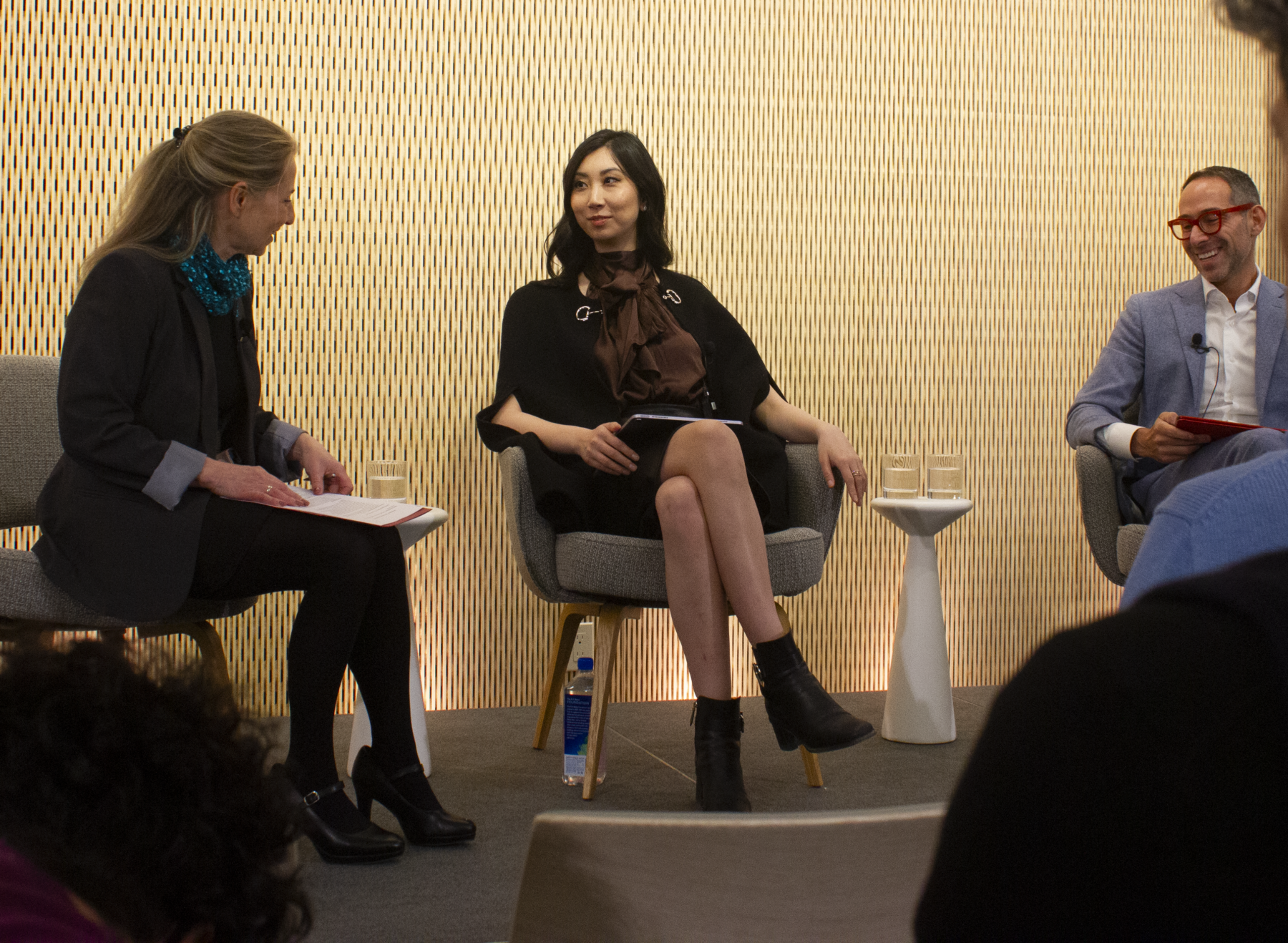
Hastings Center President and CEO, Vardit Ravitsky (left), presides over a debate between biotech entrepreneur Cathy Tie (middle), and Harvard law professor I. Glenn Cohen (right) on the future of gene editing. (Credit: Sophia Ramirez)
On April 23, at the Carnegie Council for Ethics in International Affairs in New York City, the Hastings Center for Bioethics hosted a debate between a bioethicist and a biotech entrepreneur. The question on the table: Should companies be allowed to edit the DNA in human embryos, changing the DNA of future generations? Although the event was framed as a debate, the opponents found they had much in common, perhaps a sign that public opinions about gene editing are becoming more favorable.
The debated technique is called germline gene editing. Every person has two basic types of cells. There are the cells that make up bones and skin and the rest of human organs; these are called somatic cells. Then there are eggs and sperm; these are called germline cells. The DNA in the germline cells doesn’t build the living person, but their future children, and their children’s children. Proponents of germline gene editing want to use this technique to remove certain genetic diseases from a person’s bloodline forever.
Cathy Tie, one of the debaters, founded her own company to do exactly that. She announced Origin Genomics in March, and claims the company will one day offer safe gene editing to parents who are worried about passing genetic diseases to their children. Her announcement is the latest in a recent batch of biotech companies who want to offer germline gene editing.
Glenn Cohen, a bioethicist and professor at Harvard Law School, came into the debate as the voice of caution.
“I don’t want to be dramatic, but this is about the future of the human race,” he said early in the night. The room laughed in response, but Tie did not.
The debate moderator, president and CEO of the Hastings Center, Vardit Ravitsky, took Tie and Cohen through rapid-fire questions to find points of disagreement. Is editing DNA in embryos inherently unethical? Both said no. Is it ethical to edit embryos in a lab? Both said yes. Is it ethical to someday move from the lab to a clinical trial? Both said yes.
Their only real point of debate was around which diseases would be safe and acceptable to remove from embryos. Cohen said that this technology should be limited to deadly diseases caused by a single gene defect. These are diseases like cystic fibrosis, sickle cell anemia, and Tay Sachs disease. There are thousands of other rare diseases in this category, many of which do not have a cure, and many of which kill in childhood. Single gene diseases are good candidates for germline editing because editing only one gene means fewer chances for unintended consequences. However, it’s difficult to determine what those unintended consequences could be, because germline gene editing has been significantly limited worldwide.
Tie does not limit herself to the list of single gene diseases. She agrees that gene editors should prioritize them. But she says she’d also consider using this technology in more complex diseases.
Diseases caused by multiple genes are far more complicated and usually have an environmental component. For example, lung cancer is associated with multiple genes, but can be triggered by polluted air, and humans can’t edit out polluted air.
This debate has been playing out for decades in academic journals, and more recently, on social media. At the far end of the pro-gene editing side, people say this technology must be developed in the U.S. now, or it faces loss in an arms race to foreign powers. At the far end of the anti-gene editing side, people say bad actors will produce genetically engineered “super-babies”, and usher in a new era of eugenics. But on the night of the debate, speakers steered clear of both extremes, and tended to agree more than disagree.
Tie’s main talking point was that ethicists are keeping scientists from developing gene editing into a safe treatment. She criticized the world’s leading gene therapy groups, which in 2025 called for a 10-year global pause on germline gene editing. Several countries, including the U.S., Canada, India and Mexico, have explicitly banned germline gene editing.
Tie said that every day she hears from someone who is suffering from a genetic disease in their family. She said she received emails from “a woman in Ohio whose mother no longer recognizes her [and] father in Shenzhen watching his son lose motor function to a mutation with a known address.” She said there is a gap between the academics, like those in that very room, and the people who are desperate for a cure to their disease.
A 2021 review in Trends in Pharmacological Sciences estimates that only 6% of rare genetic diseases have an approved cure.
“The honest truth is that people are tired of waiting for progress,” said Tie. “If we don’t work on it, it will never be safe enough.”
Cohen’s main concern with germline gene editing is that it means interfering with future generations without their consent. “There are future generations, great grandchildren, great great grandchildren who will be affected by the decisions we make,” he said.
That is the primary difference between germline gene editing and somatic gene editing, which already exists and is approved to treat things like congenital blindness. In somatic gene editing treatments, a living person gets a treatment that edits their DNA, and the changes do not get passed down. Their future children might continue to have the same condition, and would have to consent to their own somatic gene treatment.
In Cohen’s view, the somatic gene editing model is better, because it allows everyone to make their own medical decisions. Or, if the disease must be treated in childhood, parents can give consent on behalf of their child, not their hypothetical great grandchildren.
Tie pushes back on the somatic gene editing model because it is incredibly expensive. Some somatic gene treatments, like one for spinal muscular atrophy, can cost up to $2 million. Her version of germline gene editing, she claims, wouldn’t cost much more than the $15,000 to $20,000 that a traditional IVF round costs.
Still, Cohen and Tie agreed more than they disagreed. They agreed that germline gene editing should be developed, at least for some diseases. They also agreed that if germline gene editing were to grow popular, it should be guided by public discussion. If scientists really can control the genome of the future human race, they say, more people should get to join their debate.
The event ended with two guest speakers, Asaf and Nicole Ezra, a couple who have struggled to conceive a child without a genetic disease. “My disease causes cancer, and there is no cure for it,” said Nicole Ezra at the podium. “[I get] preventative, invasive procedures every six months to every year, on every part of my body,”
The couple has been attempting IVF for the past three years, without success. Eight months ago, they heard of Cathy Tie and her germline gene editing ambitions, and they reached out. Tie brought them to the debate to highlight their stories, and the stories of couples like them. Cohen seemed choked up with emotion as the Ezras talked about their experience.
Nicole Ezra ended by saying, “If Cathy tomorrow said ‘Hey look, here’s your embryos, we’ll fix them,’ I would take it.”
About the author(s)

Sophia Ramirez is an MA student at Columbia Journalism School and early career science journalist.