




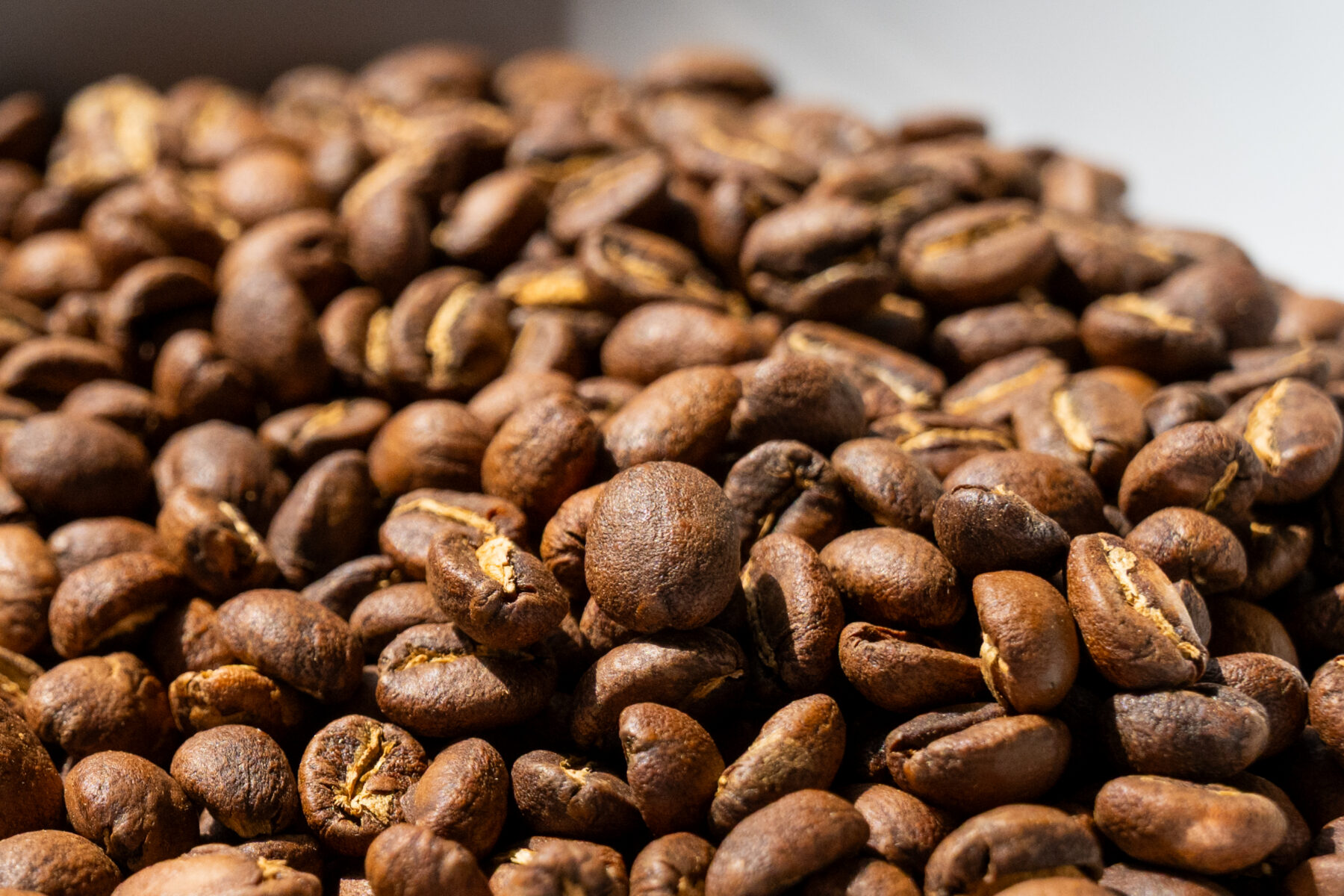
Specialty coffee has seen a recent surge in popularity, making high-quality coffee more accessible to sell and consume. (Credit: Jean Ortiz)
Jeremy Bradford graduated from Columbia University in 2020, the height of the pandemic, with a degree in anthropology. The “job market was quite desperate,” he said. So he turned to what he knew: coffee.
Before moving to New York in 2018, Bradford had worked as a barista in South Africa. After graduation, Bradford, now 32, landed jobs at various coffee shops in New York. Eventually, he learned how to roast coffee at a cafe, prompting him to imagine starting his own business.
Bradford is now a microroaster, or a specialty small-scale coffee roaster, and the sole owner and operator of Preface Coffee, based in Long Island City. With a passion for specialty coffee, he seeks out special high-quality beans and roasts them in small lots to preserve quality and flavor while aiming to support sustainability for farmers. Bradford is part of a growing group of similarly-minded solo business owners in the New York area.
Buoyed by an ability to buy green, or raw, beans in small quantities, access to others’ pricey equipment and consumer appetite for a specialty coffee, microroasters seem to have taken a page from the microbrewers, generating buzz and high-priced alternatives to mass market alternatives.
The increase in microroasters can be largely attributed to the accessibility of shared roasting spaces, said Jenn Ramirez, the general manager of Secret Coffee, a coffee shop in Brooklyn, which buys from Preface. “I just think it’s really fun and exciting for people who are kind of used to the same thing over and over again,” Ramirez added.
Bradford isn’t focused on getting with what the market is demanding, though knowledgeable consumers are cultivating sophisticated palates. Bradford has noticed that the pool of producers of high-end coffee has shrunk, so Bradford tries to work with lesser-known producers. “I just want to roast coffees that I enjoy drinking,” Bradford said, with a thick South African accent. If his preferences align with even just 0.5% of the market, he says, that’s enough.
Bradford relies on three sources of revenue: sales to consumers, wholesale sales, and private label business. At least 60% of his revenue comes from private labeling, or roasting coffee for other businesses like restaurants and cafes. He said that he generated about $300,000 in revenue last year, but he hasn’t yet turned a profit.
Microroasters may be able to start their business with minimal capital investment, but marketing is essential to break through the crowded space. Bradford uses his Instagram profile to speak directly to his customers and to promote new coffee bag releases, which he calls publications. Since he’s a lover of books, for every online order of coffee, he includes a book.
“It’s a difficult market to compete in, largely because of pricing, because specialty coffee is so expensive,” said Patrick Grzelewski, who oversees operations from sourcing to in-house roasting as the director of coffee at Variety Coffee in Brooklyn.
“It was really nice to feel that deep sense of responsibility that everything that I’m going to be putting out there is going to be a reflection of my work,” Bradford said about starting the business.
Despite some slowing, nearly 20,000 businesses are being formed in New York City each year. And many of those people are looking for smaller startups that do not require too much capital at the outset. Microroasting fits the bill.
Many established coffee shops, like Sey in Brooklyn and the mid-sized chain Variety, roast their own coffee. But instead of having his own commercial facility, a coffee roasting machine and packaging equipment, Bradford roasts out of a shared roasting facility called Multimodal, where microroasters are able to rent all of this equipment.
“It was just an easy opportunity to get started and also to be able to develop and build up a wholesale and an e-commerce platform from there,” Bradford said.
A place like Multimodal lets him focus on the most important aspect of his business, the coffee itself.
As a one-man company, Bradford isn’t able to visit the coffee farms himself, so he deals with importers who allow him to roast samples. One of them, called Unblended, partners with farmers in Colombia, connecting producers to Bradford, so he can buy their coffee. He’s focused on picking producers that aren’t as well-known in the industry.
Since Bradford roasts specialty coffee, his purchasing prices are considerably higher than what’s usually traded on the market. Whereas the overall market now trades at less than $3 a pound, Bradford pays about $5.50 a pound for his “bread and butter” coffee from Colombia. But he also purchases higher-end coffee, which can go from $7.50 a pound all the way up to $30 a pound.
He saves most of his money through equipment costs. Bradford currently pays around $130 for two hours to rent the smallest coffee roasting machine available, capable of holding around 11 pounds of green coffee, which still costs at least $20,000 if he were to buy it. The rent for the bigger machines can be as high as $700 for two hours.
To house these roasting machines, it requires a properly ventilated commercial facility, because many of these machines use natural gas. During the last quarter of 2025, the average asking rent of an industrial space in New York was $30 per square foot, which means it would cost about $2,500 if Bradford were to rent it on his own.
Are consumers willing to spend on specialty coffee? The National Coffee Association published a report that found that 55% of Americans drank a specialty coffee drink in the past-week in 2025. Ramirez thinks that part of the reason is the social aspect of coffee. “I think that after the pandemic, we’ve kind of been looking for human connection a little bit more,” Ramirez said.
But even with all of the popularity, the microroaster coffee market is still tough. Brian Zhou, the operator of the microroaster Thoughtful Coffee, said it’s harder to differentiate when higher-quality roasting machines are available at consumer-grade prices, lowering the entry barrier to having a microroasting business. Zhou hopes to open his own brick-and-mortar coffee shop in the near future.
Bradford is also trying to find a way to differentiate his business from others. He’s not sure if he wants to open a coffee shop or a tasting lab, but as he pondered, Bradford said, “All I do know is that I just want Preface to be a roaster that people associate as authentic with elements of surprise.”
About the author(s)

Jean Ortiz is a recent graduate of Columbia Journalism School who specializes in business and technology journalism.