



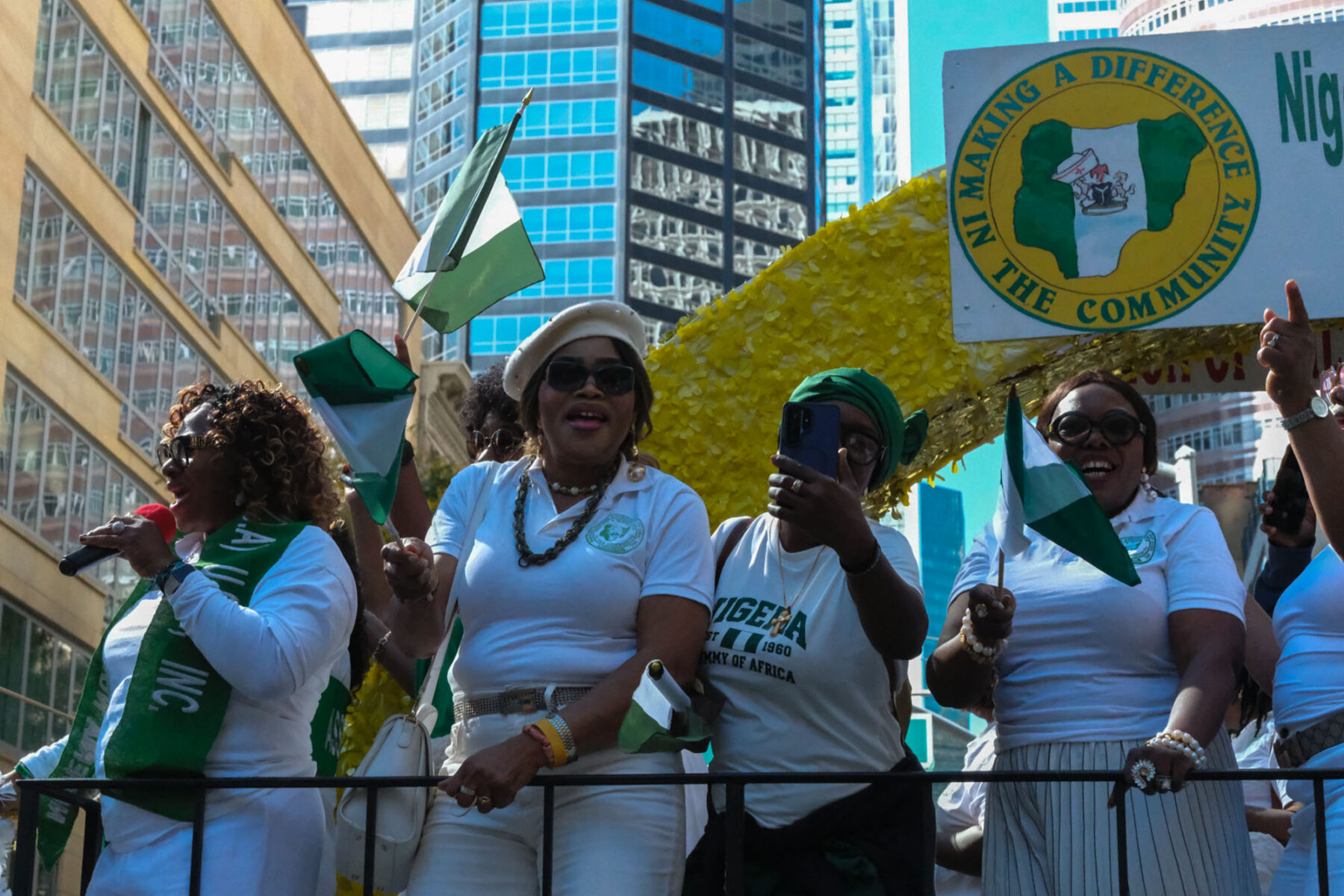
The Nigerian Nurses Association of USA float makes its way up 2nd Avenue in Midtown Manhattan. (Credit: Olivia O’Haver)
New York City’s 34th annual Nigerian Independence Day Parade kicked off on a clear, sunny early October morning. About 20 decorative floats flanked E 54th St in Midtown Manhattan. Typically celebrated in early October to commemorate the country’s freedom from British colonial rule in 1960, the parade has been a mainstay in the city since the Organization for the Advancement of Nigerians, or OAN, launched it in New York City in 1991.
“They started with one float and one float became two floats,” said Olutomi Aregbesola, president of the organization.“It just continued to evolve into something big and extraordinary.” This year’s parade, she said, is a “testament of our culture, how rich it is and also how resilient we are.”
Their mission is to promote Nigerian culture, image and influence in the U.S. through advocacy, civic engagement, and community service.
Up until the organization’s founding in 1989, there was no definitive space for Nigerians to come together in the United States. There were groups specifically for Nigerian doctors and lawyers, but not yet for the people as an entire entity, according to Aregbesola. With the help of her uncle and other like-minded leaders, the Organization for the Advancement of Nigerians was born.

A woman waves the Nigerian flag along E 54th St in anticipation of the parade procession. (Credit: Olivia O’Haver)
“I feel like I’m with my family,” said Kiana Alexis, who is part of the promotion and marketing team for the non-profit.
Although the parade was set to start at 10 a.m., the wheels didn’t start rolling until about noon. Alexis admitted that Nigerians tend to be on their own timeline. “We’re Nigerian, so if we tell you to come at 10 o’clock, it’s probably going to start 45 minutes after,” she said.
Many revelers wore traditional Nigerian clothing and headdresses to show their pride. One of them, Hajare, whose last name is unknown, wore a calabash — or a large hollowed out gourd worn above the head that is typical among the Fulani tribe. The tribe is one of 371 concentrated in Nigeria, though they are spread out across Mali, Guinea, Senegal, and Niger. They come with their unique language known as Fula, and their own style. The Fulani women engrave their calabash and use them to carry what they need for the celebration. The women balance calabash expertly atop their heads. “Back home, we use them to put milk and yogurt inside,” she said. Today, she uses the calabash to store her everyday necessities. “I have water, my wallet, and my keys so it can balance,” she said.

Festival-goers make their way to Dag Hammarskjöld Plaza for the ongoing celebration. (Credit: Olivia O’Haver)
As the parade swung onto 2nd Avenue, Afrobeats burst from mounted speakers. A seemingly endless sea of green and white filled the street, as did the beats of internationally known artists: BNXN, Runtown and Patoranking.
“Nigerians, we like to leave our mark anywhere and we’re also very prideful,” said Argesbesola.
Prominent Nigerian representatives joined the party: Amina Mohammed, United Nations deputy secretary-general, as well as Ambassador Jimoh Ibrahim and Consulate General Abubakar Jidda.
It was not just the Nigerian diaspora that came together, but also many tribes that hail from the country.
Chibuzo Ewnke is Ewnke is part of an ethnic group called the Igbo, and has been celebrating since the parade’s debut in 1991. His people account for about 18% of the Nigerian population. They span across seven different states in the country. The meaning of the day’s parade in the streets of the city was simple, unity. As the parade came to a close and floats were dismantled, some Nigerians drifted away from 2nd Avenue as others began arriving at the Dag Hammarskjöld Plaza for the festival to start, because the celebration is an all-day affair.
“The children at night, they do their parties,” Ewnke laughed.
In the late 90’s, the parade made the transition into a festival, complete with artists and food stalls that sold food like fried yams, fish, and jerk chicken. “We love to show off. If we’re going to have a parade, let’s have a real parade, let’s have our artists come and perform, let’s show the world what our food tastes like,” said Aregbesola.
By kickoff, Mayor Zohran Mamdani had joined in. He commended the Nigerian community for their entrepreneurial spirit, their Afrobeats and most importantly, the life they bring to the city. “The impact of Nigerian New Yorkers is felt across the five boroughs. Our city is richer in culture, stronger in community, and more vibrant because of your contributions,” he wrote in a post to X.
Olutomi looked back on the event, which attracted hundreds, with pride.“The parade reminds us that there is a community, we do it for our footprint in America but also for our government back home,” she said.
About the author(s)

Olivia O'Haver is a journalist at the Graduate School of Journalism with interests in international issues and visual storytelling.