




Mario de Jesús Pereira Iguarán was sitting on 23rd Street on Sept. 24, waiting for a new DoorDash order to come in. A notification popped up on his phone, so he mounted his e-bike and sped to the restaurant to pick up a meal. The ride took 15 minutes. He then waited 10 minutes for the order at the restaurant, then 20, and eventually 40. Finally, an hour later, the customer canceled the order. “I lost all my time,” Pereira said in Spanish, “and I was paid nothing.”
Time spent on canceled trips is one of the ways DoorDash failed to pay workers, according to the city. “It can happen three, four times a day,” Pereira said.
On Sept. 22, Mayor Zohran Mamdani announced a $131.5 million settlement with the company to compensate these workers.
“We are speaking about something that was sustained, something that was rampant for a quarter of a million workers,” Mamdani said at a news conference announcing the agreement.
After analyzing 152 million DoorDash transactions and 110 million hours of work over the last four years, the Department of Consumer and Worker Protection (DCWP) found that the app company had underpaid more than 260,000 delivery workers. The agency identified several ways in which these violations occurred. These included leaving working time “out of the count” in violation of the minimum wage pay rate rule and failing to pay workers the legally required rate for the time spent on cancelled trips, or on trips that went over city limits.
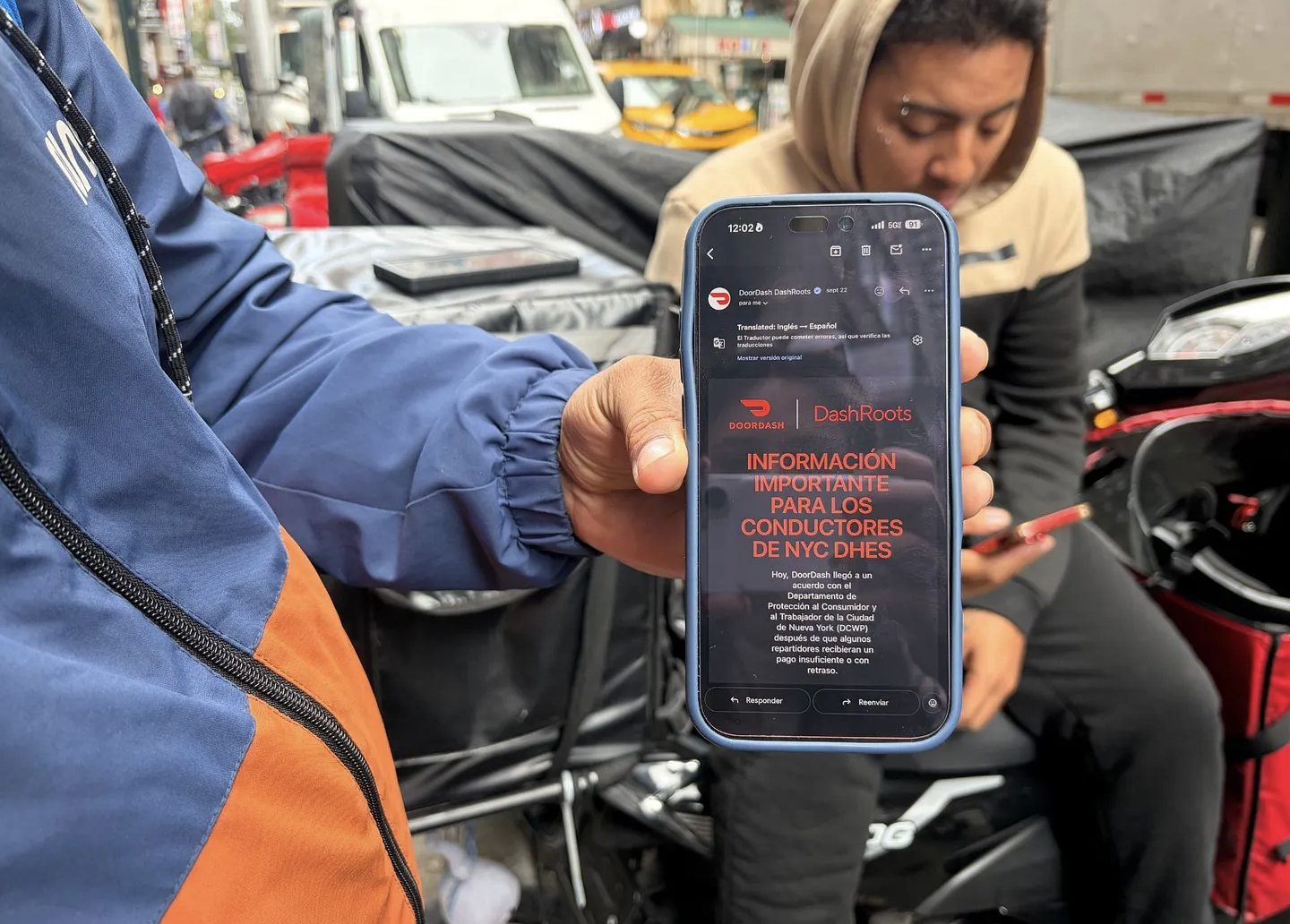
A delivery worker shows an email from Doordash announcing the settlement. (Credit: Paula Ojeda)
In a statement to Columbia News Service, DoorDash said that “most of this settlement isn’t about late or missing pay, but how to calculate bonuses paid to Dashers for online or on-call time.” On-call time is the time delivery workers spend logged into the app waiting for orders.
Though happy about the win, riders are also cautious about issues that may arise. “We have to see what happens, if they are really going to give us our money back,” Jeickson Landaeta said, grateful that the city has stepped in. In late October, workers will receive an email from a third party administrator who works for the city informing whether they are entitled to the compensation and, if so, how much they will receive. The amount will be determined based on microdata analyzed by the DCWP which could identify the workers that were harmed and to what extent
“Many workers use fake names,” even though it’s against the company’s rules, to work on the apps “because they are undocumented,” said fellow delivery worker José Manuel Ramírez. He added that sometimes DoorDash accounts get blocked by the company, and riders open new ones with a different email address, so notices regarding settlement compensation “could be delivered to an address I can no longer access.”
The company told Columbia News Service that the settlement would be paid via direct deposit or, in the case that’s not possible, a mailed check. “If that mailing comes back undeliverable or the check isn’t cashed within 90 days, the administrator is required to take additional steps to find a correct address, including a skip trace, a phone call, and an email attempt, then re-mail the check or attempt a direct deposit.” DoorDash said. “So losing access to the email on file isn’t a dead end, there’s a built-in process to track the worker down through other means.”
The mayor said that from the total amount of the settlement, more than $115 million will go “directly to workers” and the remaining $16 million consists of “civil penalties and costs.” This includes part of the investment the city will make to create a system by which delivery workers can share their own app data with DCWP so that they can keep track of events that may result in violations independently from the app companies.
Pereira hopes to receive an email sometime in October confirming he is one of the Dashers entitled to compensation. “I would spend it with my family, because that’s who we [delivery workers] work for. I work for my children, for my wife. I would only give it to them or spend it with them,” he said.
About the author(s)

Paula Ojeda is a Stabile fellow at Columbia Journalism School. Originally from Uruguay, she previously covered crime and justice for El País, Uruguay's leading newspaper.