




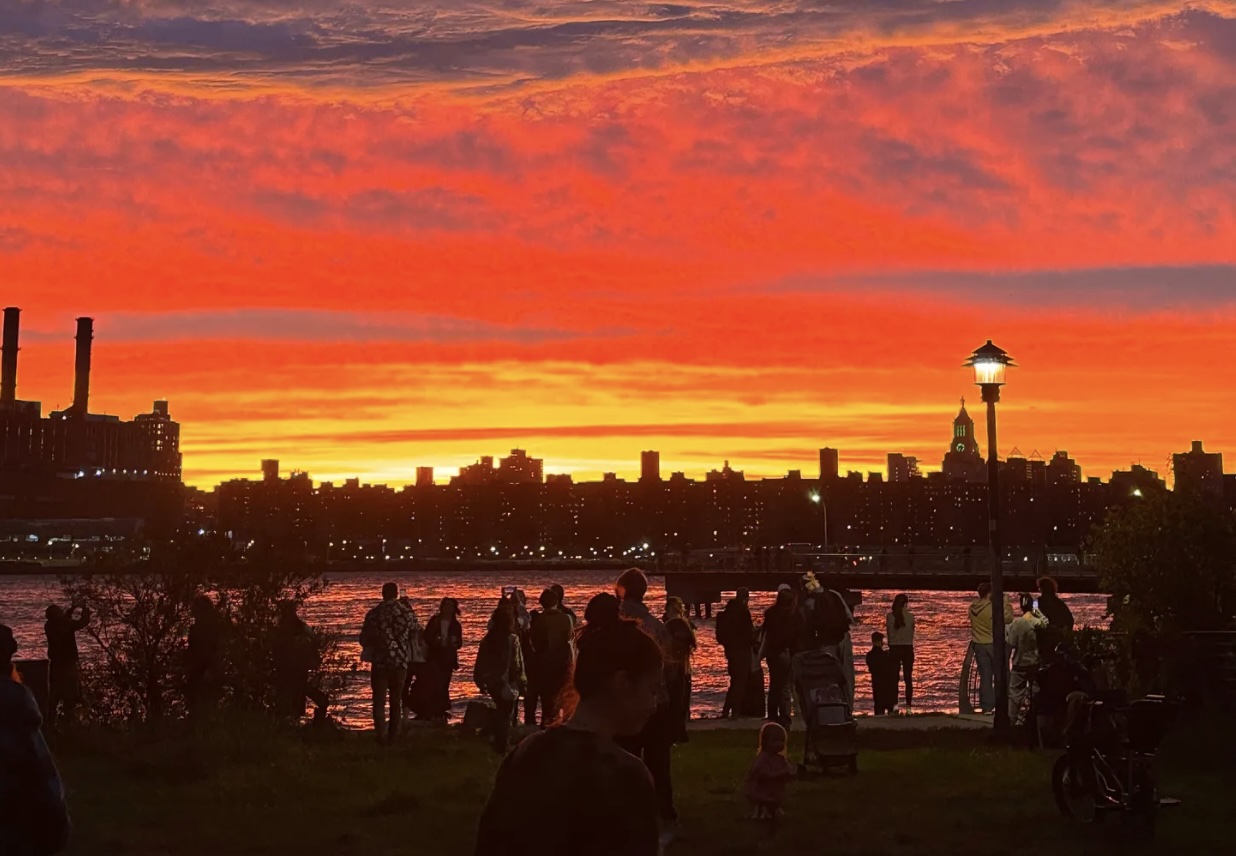
Transmitter Park on Sept. 25. 2026. (Credit: Devadeepa Das)
On Sept. 25, Lindsay Matheos and Paul Papantonious tied the knot at the Greenpoint Loft, whose rooftop overlooks the WNYC Transmitter Park. They chose the park, with its sweeping view of the Manhattan skyline across the East River, as the backdrop for their wedding pictures. As a crowd gathered to congratulate them, Lindsay reflected on the park.
“It’s nice to have this raw, communal space that is very conducive to community in moments like this,” she said.
This park’s character was recently put at risk by a proposal for a new marina and restaurant. Steered by local businessmen Josh Cohen and David Schmitt, the plan called for a 25-year lease with the New York City Parks and Recreation Department through its concessionaire program. The proposal drew significant local pushback and was withdrawn on Sept. 15 at the Brooklyn Community Board 1 meeting.
Part of the outrage stemmed from the proposal’s size relative to the park. While the park is officially listed as 6.61 acres, only approximately 24% of this is parkland. The rest is water and the pier. Elissa Iberti, chair of Friends of Transmitter Park, a volunteer group, spearheaded a petition against the development that collected more than 500 signatures. “Everyone was stating the same feeling: too big, too much scale,” she said. The Friends took the lead in organizing the response, contacting city officials, and securing a public hearing where residents were able to voice their opposition.
Even City Council Member Lincoln Restler, who represents the district agreed. “I’m grateful that the Parks Department listened to our community’s overwhelmingly negative response to the proposed plan for a concession and marina at Transmitter Park and is reversing course. This beloved local park is simply too small for a marina and large restaurant,” he said in a written statement.
Many residents were relieved with the scrapping of the plan, but concerns about potential development in the park remain. “It really feels like this is our backyard,” said Kim Esasky, a Greenpoint resident who has been walking her dog in the park for four years, “The more we develop, the more it brings tourism, which is important. But when is enough going to be enough? When is my neighborhood just going to just feel like home?”
The now-defeated plan to redevelop Transmitter Park is just one of several changes under discussion for this section of Brooklyn’s waterfront: new high-rises keep cropping up, while rent keeps rising. “The waterfront has become a battle ground, in some capacity. A consistent sentiment that people have is that the waterfront is going to be for only the rich people,” said Rick Paulas, a local historian, who has lived in the area since 2021.
Not everyone, however, was pleased with the resolution. Dylan Wells, who moved into the neighborhood a year and a half ago, was particularly disappointed. “I liked the idea of changing the park. We have an abandoned building in the park that could be used for something. As long as there was a good use of public land for public purposes, there was a way forward.”
The Parks Department is now considering alternatives for improving the park while preserving its role as a public space for Greenpoint. “What we ultimately want to do is provide all of the amenities — a public bathroom, space for maintenance staff, and space for Friends of Transmitter Park — and we’re going to look at both options for how we can do this — either via a cafe project, or through a Parks-led capital project,” said Chris Clark, press officer for the New York City Department of Parks and Recreation.
About the author(s)

Devadeepa Das is an MS student at Columbia Journalism. She is focused on cultural and human interest stories.