




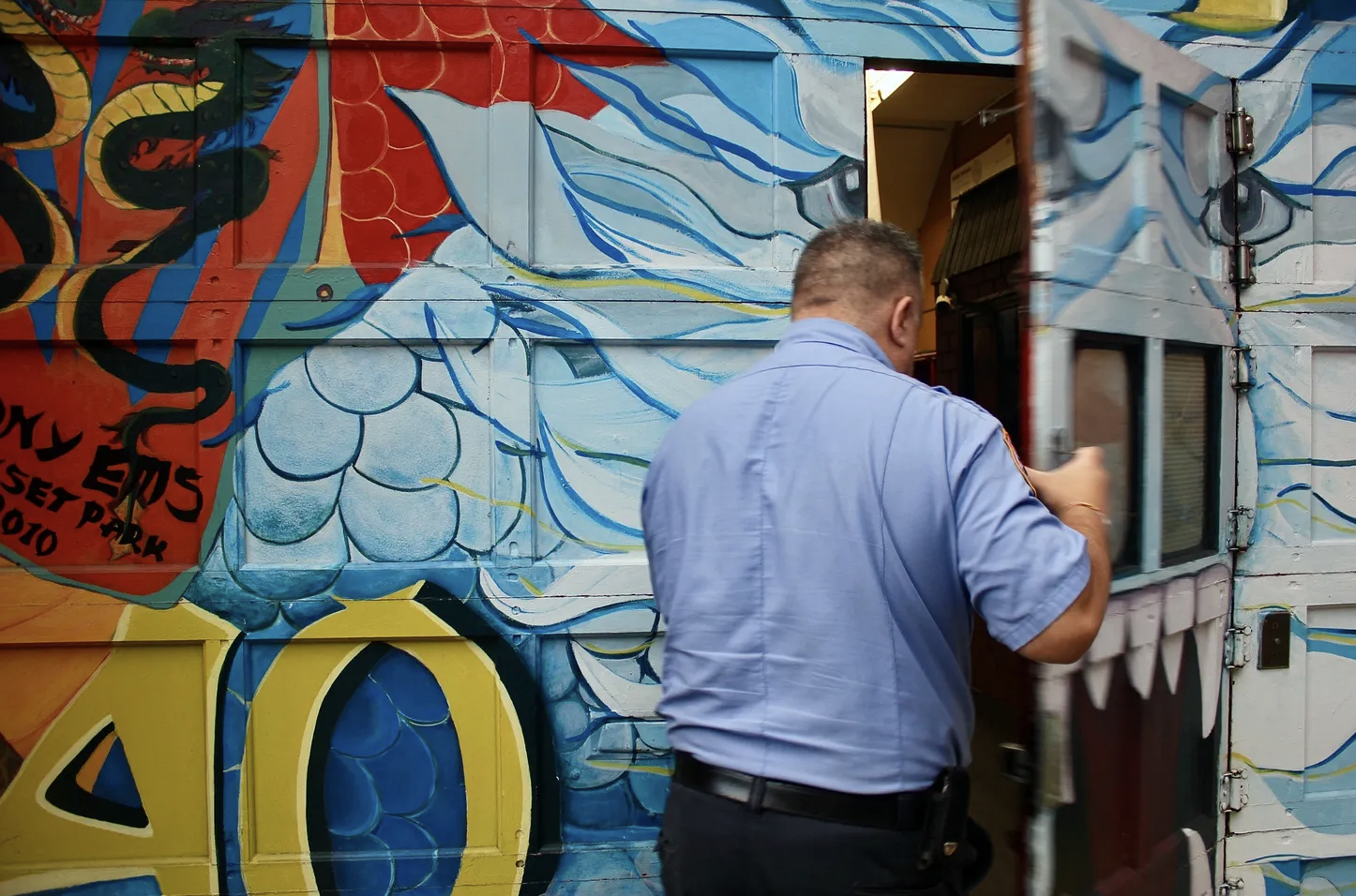
Lt. Anthony Almojera outside Station 40, Sunset Park, Brooklyn. (Credit: Éilis Mathur)
On April 6, 2025, Vincent Polizzi was dispatched to an address in Bensonhurst, Brooklyn. An 11-year-old girl had called 911 to report that she and her siblings were being stabbed. Polizzi, accompanied by another emergency medical technician (EMT) and four police officers, broke down the door to find a man armed with a meat cleaver and three young girls with life-threatening injuries. Polizzi and his partner cared for all three.
In June 2026, they received the Chief James Scullion Medal, one of the prizes awarded at the annual Medal Day to celebrate the lifesaving actions of New York City’s EMS workers. The New York City Fire Department (FDNY) called their actions “nothing short of heroic and extraordinary.”
But immediately afterwards, Polizzi did not feel supported. A representative from FDNY’s grief counseling service visited his station at Sunset Park with a lavender diffuser and massage chair cover, he said. It was the only check-in.
FDNY declined to comment for this story.
Same Departments, Different Rules
FDNY’s Counseling Service Unit (CSU) provides mental-health evaluations, treatment, and referrals. Originally set up for firefighters, it now serves all members, including Emergency Medical Services.
EMS work carries a heavy emotional burden. A paramedic and EMT will respond to many traumatic calls over a career. EMS workers face high risks of anxiety, depression, PTSD, and suicide.
Anthony Almojera, a lieutenant at Station 40 for more than 10 years, is vocal about the toll of the job. He has counted 14 suicides since 2020 and had 47 members reach out to him for support with their suicidal ideations – five in September alone. He has had his own experience with ideations and a partial attempt.
Fire and EMS have been merged under FDNY since 1996, but differences remain. Firefighters starting pay is $54,122; EMS workers start at $43,932 after three months of training. Firefighters have no fixed annual limit on paid sick leave, so they can take this time for qualifying mental health reasons. EMS members get 12 paid sick days a year. “EMS burn through their time or go off payroll,” explained Almojera.
The root of the problem, according to Michael Greco, president of Local 2507, the union representing EMS workers, is that mental health trauma is not considered a line-of-duty injury under workers’ compensation.
“If you simply recognize mental health as a work-related illness…I think it would help ease the burden of the mental health crisis in EMS,” Greco said.
Almojera said that during the pandemic, CSU staff told him “we were never set up for EMS, we were supposed to only be here to help firefighters.” He said CSU is trying to change, especially under Rev. Ann Kansfield, who was appointed as director in May 2024. “But the damage is done,” Almojera said.
Two and a Half Hours
Raymond Magarie retired in 2021 after working at a station in South Jamaica. In 2017, Magarie responded to a fire at a two-family house in Queens. At the scene, firefighters pulled victims from the building and brought one to his ambulance. His responding officer ordered him to perform CPR on the person, who was already dead. “When you try to attempt CPR on a burnt corpse, it doesn’t work out too well,” Magarie said.
With no doctor from FDNY’s Office of Medical Affairs on scene to authorize stopping, he and his partner had to continue CPR to the hospital, where the patient was declared dead. They were then sent back to retrieve other bodies.
Afterward, dispatch refused their request to put them out of service because there were too many other calls holding, Magarie said, so he called dispatch on his personal phone. “You need to immediately put us out of service for emotional gathering,” he said. A supervisor then approved it.
CSU was alerted. Despite being based in the same borough as Magarie’s station, “it took them two and a half hours to respond to our station, which is literally 20 minutes away,” Magarie said. The person who came was a firefighter on light duty, not a licensed social worker. “Within the first 30 seconds of him speaking, we walked away in disbelief because they had no idea what we had experienced.”
Two days later, CSU told Magarie he was required to come in to their office. When he arrived, staff there did not know why he was seeking mental health services. He was eventually able to speak to someone. “I’ll be honest with you,” Magarie said, “I felt a little better,” and he went back weekly to CSU. But their initial response left him without help when he needed it most.
The department’s own screening also seems to produce little follow-up. At annual medicals, there are mental health questionnaires. For the last three years, Almojera said, he has deliberately failed them to see what would happen. A social worker gave him some pamphlets. “They don’t want to open a Pandora’s box,” he said.
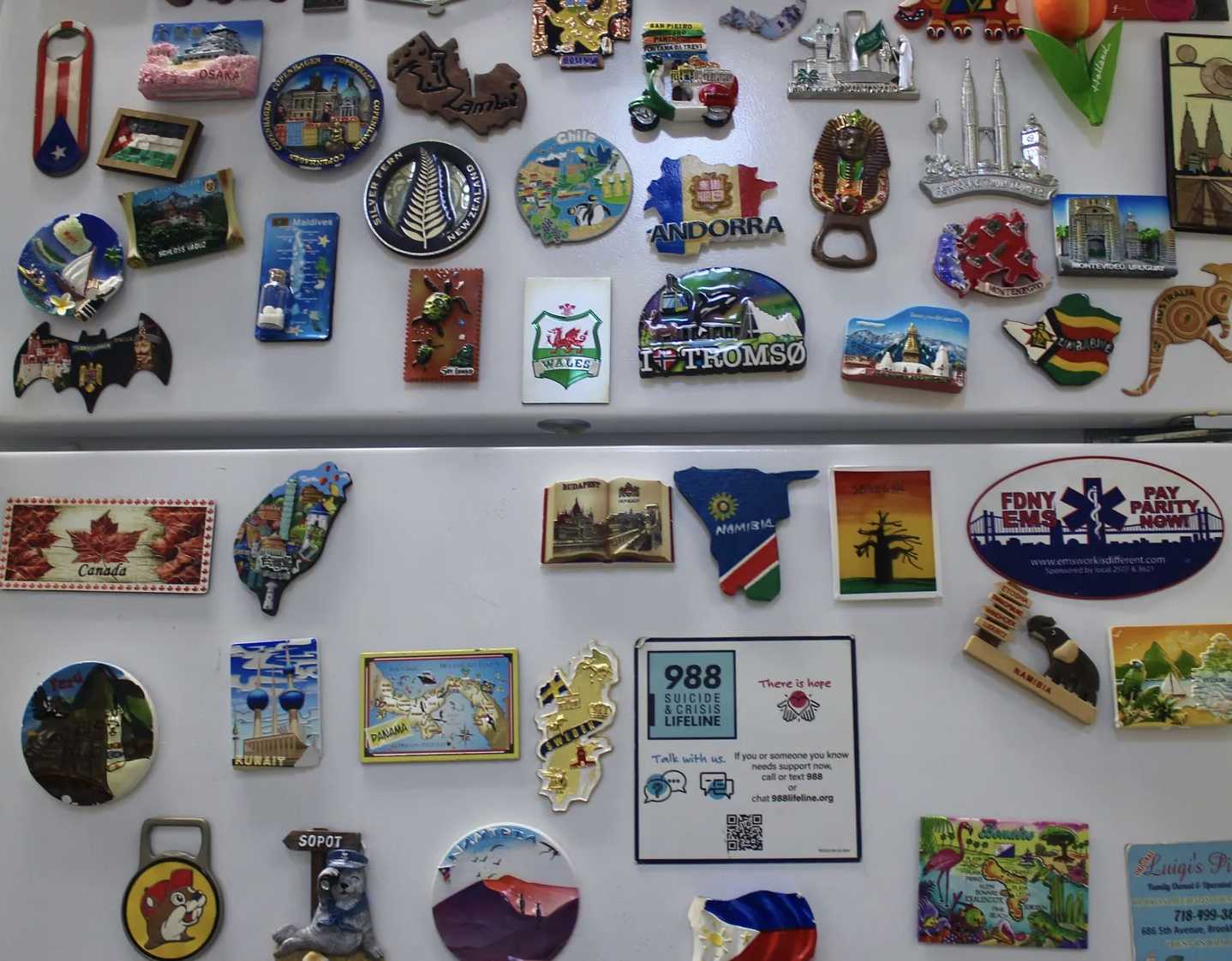
The kitchen fridge at Station 40 (Credit: Éilis Mathur)
Looking Elsewhere
Not every experience with CSU is negative. Carmine Fiore is a retired EMT who now advocates for better mental health support and understanding in EMS. Fiore has had his own struggles with addiction and was referred by CSU to rehabilitation programs more than 30 times. “CSU did save my life,” he said.
Fiore sees a systemic problem of limited services and delays. “The services they [CSU] provide are very minimal when it comes to PTSD, mental health, and addiction,” Fiore said.
PTSD is common among EMS workers. One treatment is Eye Movement Desensitization and Reprocessing (EMDR), where the patient focuses on memories while following a side-to-side stimulus, such as moving fingers, with their eyes.
CSU does not schedule EMDR or refer members to it, although it does send people to outpatient programs that include such therapies. “The modalities they use are very, very archaic,” Fiore said. He does not expect CSU to start providing new modalities, but believes “the conversations should be had.”
Many EMS workers are turning outward. The FDNY EMS Help Fund was set up in 2017 to provide hardship funds, but during the pandemic it was needed for mental health support. The fund now collaborates with Hands on Health Associates (HOHA), a state Office of Mental Health-licensed clinic. Hands on Health Associates accepts EMS workers’ insurance and the Fund covers the copays. Hundreds of people have used it.
“Both of the two primary clinicians who serve in the program are EMDR certified,” said Denise Torres, one of these clinicians.
Hands on Health Associates often has EMS workers mentioning CSU. “A good quarter of my folks have at one point either attempted to reach out and never heard back, or eventually got counseling and questioned what they were doing,” said Torres.
Torres describes Hands on Health Associates as “a buoy in a big scary ocean.” Some clients hang on for a while, she said, but others “just needed to catch [their] breath and can paddle back to shore.”
Suicide & Crisis Lifeline: 988
Hands on Health Associates Hotline for EMS workers: 1 (646) 838-3948
About the author(s)

Éilis Mathur is an investigative reporter, who currently covers healthcare and politics.