




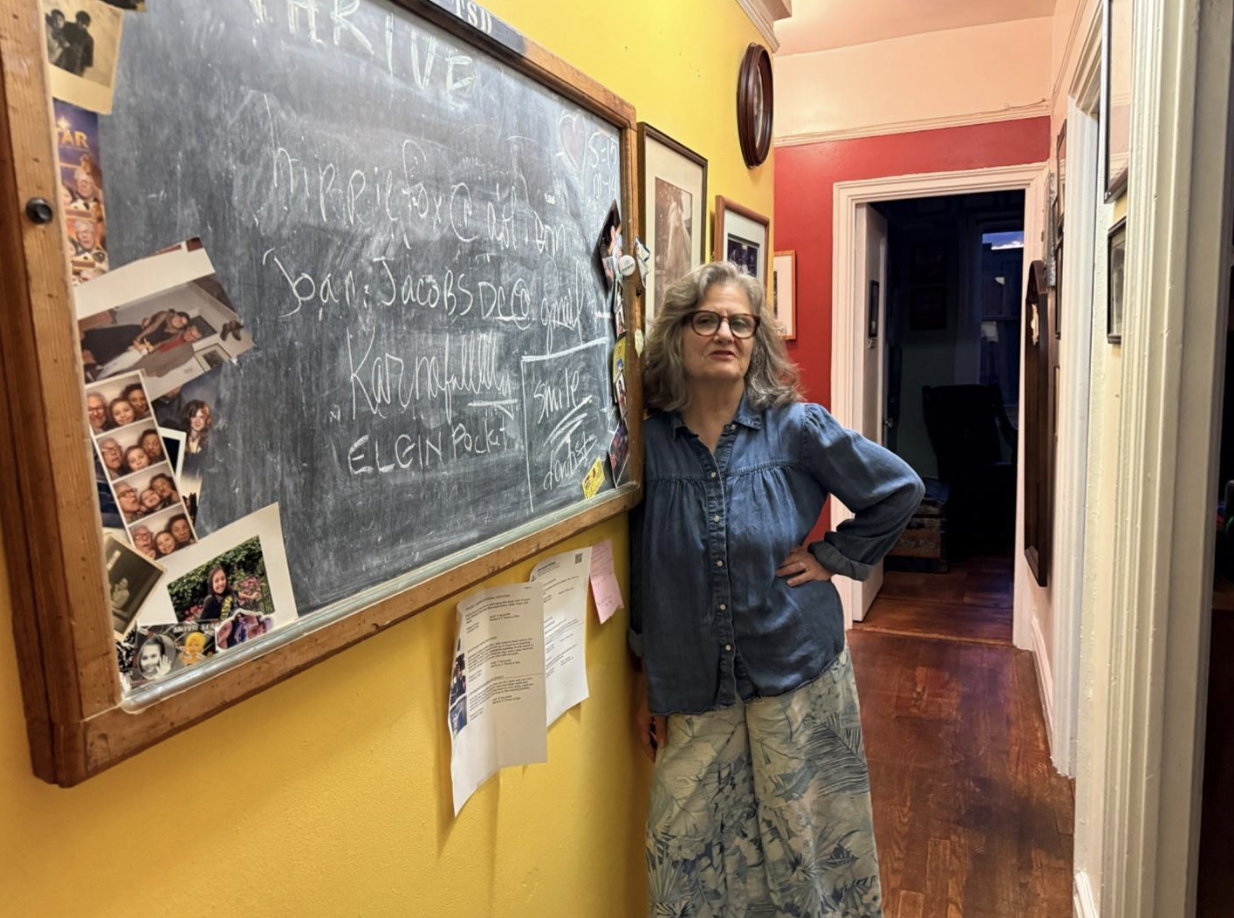
(Credit: Daniel Rivero Alvarez)
Visitors to Katha Cato’s Jackson Heights apartment encounter a warning before she opens the door.
“Fascists? We don’t need no stinking fascists!” reads a large poster taped to the hallway wall beside apartment 6F. Next to it, another declares: “First Amendment practiced here.”
Katha Cato, 71, and her husband, Donald “Preston” Cato, 81, have lived in Jackson Heights for more than three decades. Their apartment is both home and headquarters for Queens World Film Festival. Papers cover a large worktable. Film equipment, artwork and memorabilia fill the rooms.
Now Katha Cato is putting the First Amendment at the center of a new festival. On Nov. 13 and 14, Queens World will hold its first Queens World First Amendment Film and Arts Festival, bringing together film, poetry, dance and other forms of expression around the First Amendment’s five freedoms: religion, speech, press, assembly and petition.
Cato rarely gives a short answer. She riffs, jokes, imitates people and interrupts herself, then can turn suddenly earnest. Preston, quieter, drifted in and out of conversation, occasionally correcting a detail or adding one of his own. Cato describes herself as having been “offensive and provocative” her whole life, and near the end of an interview launched into what she calls “the cave speech,” her meditation on why people gather in the dark to experience stories together.
In this interview, which has been lightly edited for clarity, Cato spoke about the new festival, the unconventional filmmakers she champions, the young artists who have passed through her apartment and what 34th Avenue has come to mean to her neighborhood.
Can you walk me through how you and Preston put a film festival together?
We take the cover off this 6-foot table. We have another 6-foot table, and we’re very old school. We will tape out the grid of the entire schedule, and then we’ll sit around and we’ll go through the films. He’ll start to put things together thematically, and then we’ll stand here, and you start to look at it. You start to see these themes that he’s got weaving through the whole thing.
Preston Cato mentions a 35-second film about a teddy bear that Queens World once screened on opening night.
Absolutely, that is our crowning achievement. A 35-second film. We played it twice because it was so short, and we want it just to be us and, you know, do something you don’t expect. And people still talk about that. It’s a perfect story the way it’s told. There’s no dialogue. It’s beautiful. It’s really beautiful.
So that’s something I would imagine many film festivals would not do.
Most film festivals will not play shorts on the opening night. We almost always do because we want you to really get an idea for what’s coming. I probably don’t care about the industry. There’s 13,000 film festivals. The industry doesn’t need me.
You know who needs me? These outsider filmmakers who are doing 35-second films about a teddy bear that commits suicide. That’s who needs us. The saw lady. That’s who needs us, and this is valuable work.
Artists don’t decide to be artists; we’re chosen. It just happens. We are powerless. Look around, this shit that we make. We are powerless over it. We’re powerless over it. So that’s who needs us.
Internally, the mission statement is two words: the films.
You really invest in mentoring and working with independent filmmakers, young filmmakers. What is your role in the community in terms of cultivating filmmakers who are local?
Neither one of us had that network or support, and I can pick out a young Don Cato and a young Katha Cato in any crowd. I can see them, like, leaning towards this, but not wanting to. And you have to understand also the CUNY system and Queens is made up very much so of first-generation college students.
So let’s take a look at that story. Parents come here, maybe they’re 25, 26, and they have a baby with them, and they come here from wherever. They’re educating themselves. They get a job. They get certificates. They go back to school. They become a citizen. They do all of this, and then their first college student says, “I want to be an artist.”
Honey, you were supposed to be a dentist, and we’ve been talking about this since the womb. Okay, right? No, I want to be an artist.
So our role is not only to develop that young person, but to help those parents understand, we’re going to make a community for your child. They’re going to be okay. They’re going to get skills. We’re going to demand that they finish things. We’re going to demand that they’re on time. They will be better for having been here. And if they run out of the fumes to be an artist and they go over here and they do this, they’re going to be ready for that as well.
When we spoke on the phone, you asked me if I was familiar with 34th Avenue. Why did you ask me that? And how have you seen the neighborhood evolve since you’ve lived here?
So 34th Avenue is an open street, very controversial. When 34th Avenue opened, it was a godsend because all of these families living in these tiny apartments, not used to being home alone with their kids all day long, fathers in the traditional homes really not used to that whole situation. These families are going a little bit cuckoo. So having a place to be outside, and we also have the least amount of green space of any place in New York City, so there’s no place for people to sit with their strollers, et cetera. We found it to be a great thing.
There were many who had a horrible thing, a horrible ish about it, and there was a lot of ish. But it’s died down now, and here it is, and we’re making it work.
Now it’s very Latin, it’s very South American, and it’s exciting. And the food has changed, the restaurants have changed, the young people have changed. But Jackson Heights is where we’re all right on top of each other, and we’re making it work. We make it work.
I want to talk for a moment about the First Amendment Film and Arts Festival. Where did the idea come from? Why now?
We always go our own way. We always do what we want to do. We’re not trying to impress the industry. We’re trying to engage the community. We’re trying to create a situation that is sustainable. If you take us out of it, can this thing still go?
The world has enough film festivals. What is something that we can do differently? So I belonged to a couple of arts groups, and there was a guy in there who was talking about, in 2016, he started a movement about the First Amendment, where he was asking cultural organizations just to read the First Amendment.
So George came in, and he said something. He said, “You know, really, the First Amendment is what has probably made,” and he pointed to me, “her career possible.”
And I thought, you know, that’s absolutely right. I’ve been offensive and provocative my whole life, and people would never expect it of us, and we like that.
So we thought if we do a smaller, scaled-down festival, not just a regular festival, what could we do that would make people want to come to something different? And so we landed on the First Amendment Film and Arts Festival.
The reason Film and Arts is because there’s such a rich dance culture in Queens, and there’s a blossoming, blossoming, growing, expanding, exploding poetry and spoken-word community across New York, so we decided, let’s see what we can do. We just really went hard this week letting people know we’re looking for work.
And when you say “work,” you’re talking about poetry, film, anything that’s a kind of artistic expression, but connected to the First Amendment?
Freedom of the press, freedom of religion, right to assemble. This is not a protest. This is a celebration. We don’t really care if you agree with it. We really don’t care. This is literally two hours of a potential 100 years on the planet. Come on, think of it.
I attended a recent Community Board 3 meeting, and I was looking at agendas from the past. One thing that struck me was a request for a performing arts center in Jackson Heights. What do you make of that?
Where? Do you know? I would love to know who this is because I don’t know if Jackson Heights Beautification Group is still pushing that. And where are we going to put it?
You know, our first year we screened in the Jackson Heights Cinema, which should have been preserved as a landmark building. It’s Target now. We loved being there so much. That gorgeous chandelier, and you know how skanky 82nd Street was at the time. Then you go in, and it’s like the lobby from the ’30s. They had a photo booth. It just was the carpet, everything.
We’re all in favor of a performing arts center. With the equipment now, come on, we can do wonderful screenings in alternative rooms. We’ve screened Diversity Plaza, Travers Park, in the street. We’ve screened at hotels. We’ve screened at the beach in Rockaway, camps, basements, youth centers, hostels. This very room.
We’re all in favor of more spaces for people to come and hear each other’s stories because we have the cave speech.
And since you asked the last question, I’m going to end with the cave speech.
From the beginning of time, we have gathered in the darkened caves around the flickering lights to share our stories. We’ve upgraded the caves. The flickering lights are now zeros and ones, but the impulse to gather remains and is in the darkness.
When we gasp in unison, when we laugh in unison, when we pretend that we are not crying in unison, it is when we, that is how we regain our humanity, and we are reminded that they is we, them is us, and I’m literally just another you.
About the author(s)

Daniel Rivero Alvarez is a Queens-based reporter and part-time M.S. student at Columbia Journalism School, returning to journalism more than two decades after getting his start at the Miami Herald.