




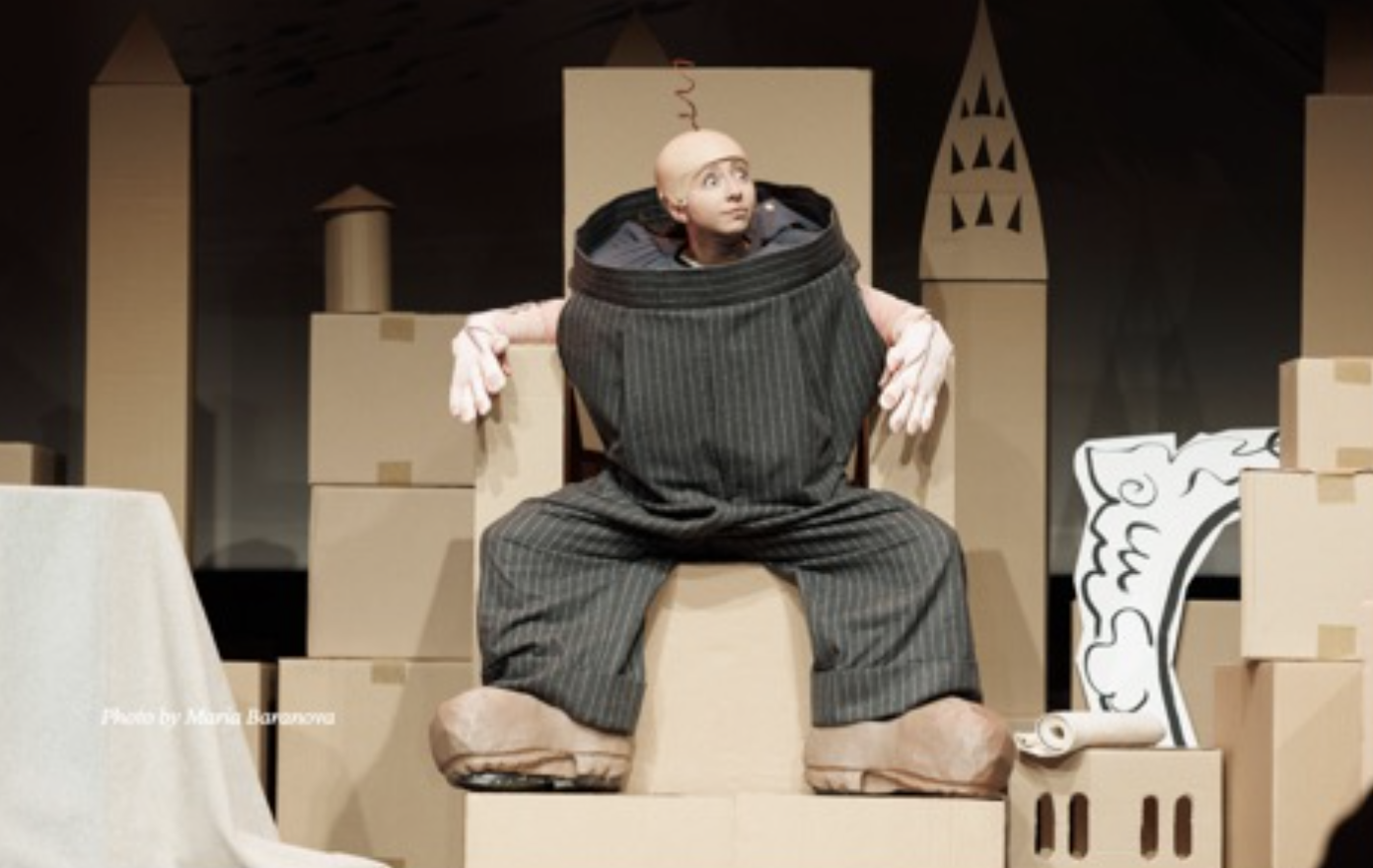
Alex Tatarsky as Pantalone in Camille Henrot’s Commedia dell’Arte as part of L’Alliance New York’s Crossing The Line Festival. (Courtesy image: Maria Baranova)
In Camille Henrot’s Commedia dell’arte, the archetypal characters of the titular Italian theater tradition are mapped onto the struggling artists and entrepreneurs of a New York City apartment building. Despite their origins in the 16th century, the well-worn tropes fit snugly over figures from the modern day – the tech bro, the greedy landlord, the Substack writer – and offer a chance for the audience to laugh at the perils faced by artists. If the set of stacked cardboard boxes and cartoon cut-outs suggests a flimsy recreation of today’s world, then belabored references to pop culture confirm: this play is about right now.
The plot followed a neat and predictable arc. The innocent clown Pierrot journeyed from penthouse to basement in a light-up cardboard elevator, arriving at different apartments with the intention of finding a lost package belonging to set designer Dagmara (Irina Varina). She had not been paid for designing a production of Mary Poppins, and faced eviction if she could not make rent.
In the penthouse, entrepreneur Il Capitano (Isa Spector) and his sexy assistant Fidelity, whose bare legs strutted beneath a wheeled computer desk, provided a satisfying satire of the venture capitalist-type. Historically represented as a braggadocious military officer with cowardly innards, Il Capitano’s transformation into an entrepreneur who makes terrible electronic music was a playful indictment of tech bros. In one instance, Capitano insisted that he could bail out Dagmara because, “I don’t have anything liquid, everything is in portfolio.”
Biting satire was not reserved for the baddies. Henrot’s version of Harlequin, portrayed here as gossip-in-residence Caterina “Cat” Harlequina, poked fun at the writer-turned-Substacker. Cat introduced herself as a kind of narrator, immediately locating the action in the present day with Gen Z slang so frequent that the program includes a lexicon for phrases like “historical L” and “unsubscribe.” Cat mentioned having “a little tantrum, as a treat,” says she’s “not scared of AI taking my job,” and jokes that a woman’s bisexuality means she “only dates men, but feels bad about it.” Given the speed at which referential internet humor moves, such lines already felt out-of-date – a joke about Charli XCX’s Brat album came two years too late.
If the Gen Z humor fell flat, the physical comedy meets the mark. Alex Tatarsky’s turn as the perverted, money-obsessed landlord Pantalone brought fresh air to a musty archetype seen previously in the likes of Ebenezer Scrooge and The Simpsons’ Mr. Burns. In this iteration, his name was taken literally: Tatarsky is clad neck-to-ankle in a ginormous pair of pants. The oversized costume, paired with Tatarsky’s flicking tongue and stiff movements, add another layer of nonsense to the slapstick sequences. A live band provided a backing vamp and sound effects as Pierrot wrestled to remove Dagmara’s package from Pantalone’s veiny, elongated hands, and a slide whistle accompanied an all-cast fight for a fraudulent rental agreement that would let the set designer avoid eviction.
It seems inevitable that, in a modern-day version of commedia dell’arte, the evil figure of Pantalone would abuse his power for sexual predation. In one moment he forced Dagmara to hand over her belongings, which he stuffed into his pants, and eventually forced her to unzip her green lycra bodysuit down to just a pink and fishnet layer while he moaned, simulating assault.
Dagmara is distinct as the only main character not taken from the commedia archetypes. Instead, she was portrayed as a grasshopper in a nod to Le Cigale et la Fourmi, a French fable that describes a carefree insect singing rather than working, in comparison to a toiling ant. Varina is given the tough task of staying solemn in the midst of the chaos, occasionally appearing as if in a different play than her castmates – not unlike the Innamorati of commedia tradition.
Dagmara continues to be the sober heart of the piece when, after securing the right to stay in her apartment “forever,” she delivered a monologue about the unfair stigma faced by artists, despite the world needing “poets more than packages.” The speech was cut short before it became corny, with Cat’s spoken-word delivery of The Rembrandts’ I’ll Be There for You, whisking the audience away from dwelling on the way society treats smaller artists.
Commedia dell’arte was Camille Henrot’s first live performance work in a multidisciplinary career that has spanned drawing, painting, sculpture, installation, and film. In her foray into theater, she continued the examinations that have concerned her visual work: the overstimulating nature of modernity, human behavior in cities, and layering the contemporary over the historic. In Henrot’s iteration of commedia dell’arte, the sharpest satire didn’t come from references to Lexapro or sourdough starters, it came from the clever placement of contemporary figures within the commedia archetypes. Its strength was in its ability to showcase age-old traditions of theatre: the discussion of the artist’s place in society, the satire of wealth, and the merits of a damn good prat fall.
About the author(s)

Sarah Moran is a journalist specializing in arts and culture currently pursuing an MA at Columbia University's Graduate School of Journalism.