




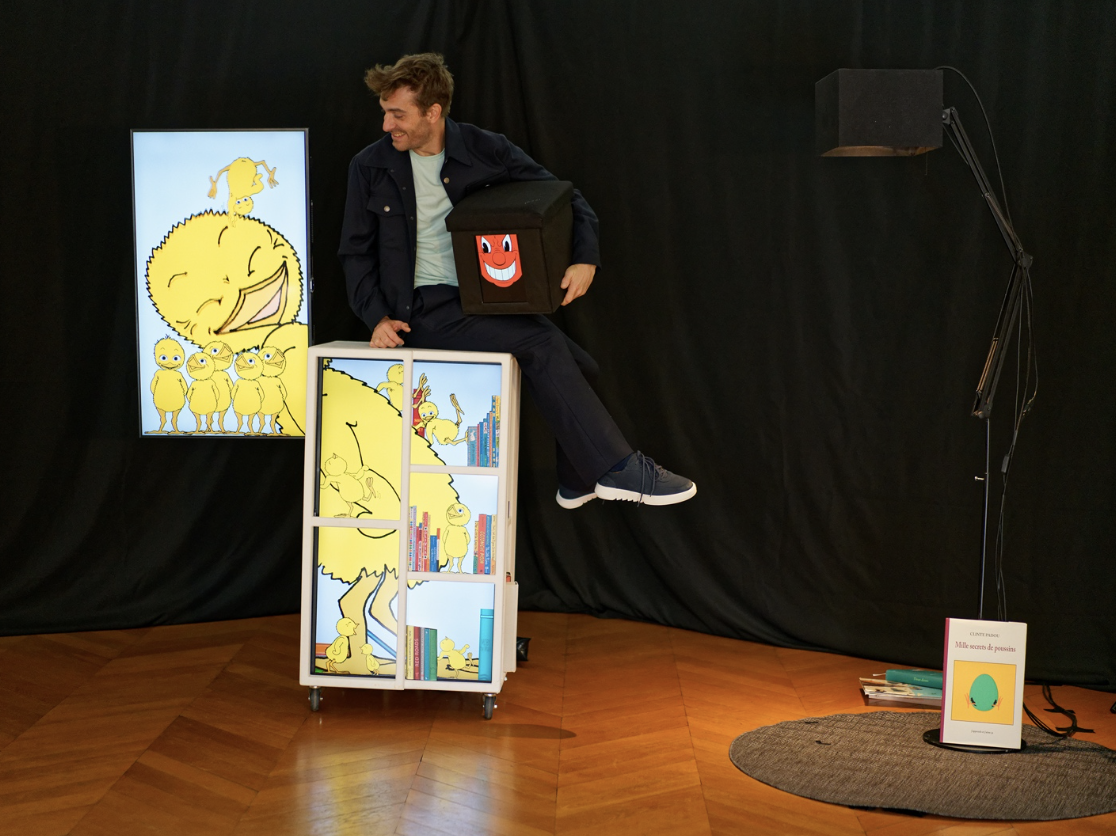
In “Mille secrets de poussins,” narrator Damien Saugeon sits atop a book cart made of digital screens, posing with the chicks that led him through a series of chaotic adventures. (Courtesy: N Guillemo)
It was story time at L’Alliance New York’s headquarters on East 60th Street on Oct. 24, where children as young as 3-years-old filed into Le Skyroom and took their seats on floor pillows. Damien Saugeon, the narrator, stood before them, flipping through different books on his library cart before he settled on French author and illustrator Claude Ponti’s “Mille secrets de poussins” (“One thousand secrets of chicks”). Suddenly, he was faced with every storyteller’s nightmare —blank pages. He smacked the book shut and rubbed his temples in disbelief. The words had been taken by the chicks, he told the audience in French, which was translated into English on supertitles and projected on a screen behind him.
Guided by chirping sounds coming from speakers, Saugeon found the chicks hidden inside another book on his library cart. This wasn’t any ordinary book, however. The pages were carved out to make space for a screen that depicted the animated feathered fiends making funny faces. The chicks doubled, then tripled in number. One boy in the front row giggled and waved at the chicks. The rest stared up at Saugeon and his book rapt, as if blinking might make the chicks disappear. Even the adults didn’t dare move.
The 25-minute performance by Collectif Quatre Ailes was part of the Crossing the Line festival and it seamlessly blended technology and storytelling. Colorful videos of loveable characters appeared alongside Saugeon on screens built into everything he touched—his library cart, books and stool—all accompanied by immersive audio of sound effects and cheerful music. The story followed chaotic chicks playing tricks on Saugeon as he desperately tried to take back control. For the children and adults watching with them, the show was at least a delightful sensory experience. It also expressed a perhaps grownup understanding that one can’t always control the chaos life brings.
For all the fun, the show also addressed some difficult feelings. One of the chicks, Blaise, wore a red devil’s mask and popped up on a screen from time to time to wreak havoc. At one point, he started a food fight that caused Saugeon to cower behind his cart. No real food was involved; Saugeon frantically dodged neon pink and yellow slops projected on the screens with loud splat sounds. The children laughed and Saugeon made a joke of his fear. But beneath the slapstick humor, the scene hinted at the overwhelming nature of anxiety as Saugeon failed to control what was unfolding around him.
Throughout the performance, Saugeon posed and answered a series of questions about the chicks. Some were simple: How do chicks eat? Do chicks wash themselves? Saugeon’s interpretations of more philosophical questions—what’s inside chicks? Do chicks die?––preserved children’s innocence with fantasy answers. With electrical waves flickering across the screen of his stool, Saugeon placed a book on top, transforming it into a make-believe X-ray machine. Saugeon showed the audience that chicks have entire oceans floating inside them, instead of typical organs.
He assured them that chicks don’t die, even if they are lit on fire or shot with a laser, as he demonstrated with video animations. Even when Blaise shot a chick with a slingshot, launching it out of one screen’s frame, Saugeon stood by to catch it within the screen inside his book. He showed the audience the chick, safe inside the pages, floating on a raft at sea, holding tropical juice in hand. Even the scariest moments in life may turn out all right, the rescue suggested.
Near the show’s end, Saugeon finally enjoyed a moment of calm as the chicks drifted to sleep. He explained that anyone can be Blaise as long as they wear the red mask. In a surprising final act of rebellion, Saugeon donned the mask, took a hammer to the library cart screen and woke up the birds. After spending the entire performance trying to gain control of the chicks, Saugeon became the instigator of chaos. Perhaps in that instance, Saugeon becoming Blaise was a nod to the inner child that some adults have learned to suppress. Even though his mask depicted the devil and his pranks could be destructive, there was an inherent playfulness to Blaise’s behavior. Saugeon’s actions as Blaise in the last scene showed the audience that embracing chaotic parts of life can even be a little fun.
Storytime didn’t go as planned, Saugeon admitted. He never knows what the chicks might have in store. “And that’s also why we love them so much,” he said.
About the author(s)

Autriya Maneshni is pursuing an Arts & Culture M.A., driven by her passion for telling human-interest stories.