




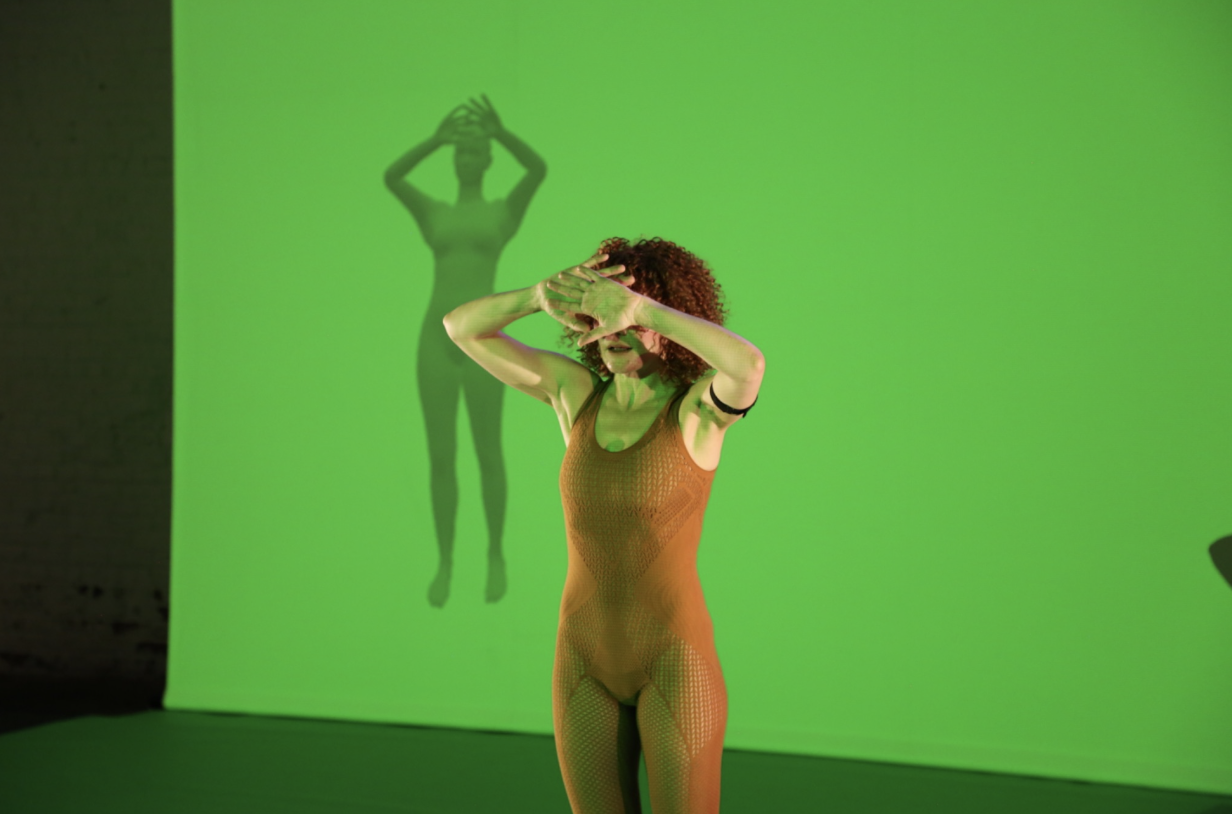
Liz Santoro performed in sync with an animated dancer moving through an AI-generated sequence made to mimic her own dance style in “This is Unreal” at the Chocolate Factory. (Courtesy image: Brian Rogers)
Dance and artificial intelligence don’t seem to have much in common. Dance is physical and expressive; AI is virtual and unfeeling. But to consider the pair more intently reveals an unlikely kinship: both exist in a liminal, intangible place until humans intentionally carry out their blueprints—whether choreography or an AI-generated set of instructions—to bring their ideas into reality.
“I dance for a living, which means I make objects that are invisible, except in 50-minute increments,” Liz Santoro told her audience in October during her latest work, “This is Unreal,” a performance memoir created with her long-time collaborator, Pierre Godard.
These particular 50 minutes brought dance and AI together onstage in a show that moved from human imagination to algorithmic hallucinations ranging from mundane to unnerving and back again. The result was an intentionally fuzzy reflection on the human relationship to machines that can only “create” by reforming whatever is given to them once audience members activate their blinking cursor. In other words, watching the show felt like being inside a chatbot.
The performance began with Santoro sitting cross-legged on the stage at the Chocolate Factory Theater in Queens, head bowed, like a machine yet to be powered on, as the audience found their seats. She wore an orange leotard that sprawled from her chest to her toes, surrounded by garments neatly laid across the stage. Flashing white numbers began to fill a chartreuse screen, jolting her into a dizzying blend of gliding ballet maneuvers and jerky, arrhythmic cavorting. The only sounds were the pads of her feet thudding against the floor. A few discordant notes accentuated her kicks until they amassed into a full-fledged cacophonous song, her sequence growing more urgent as the tune swelled and the numbers ticked up on the screen behind her.
Her captivating eyes registered a quiet panic, as if she was not in control of her body as her limbs spun through frenetic whirls. This was not a typical memoir, as the show’s title suggested—it was partly AI-generated.
Lights suddenly flickered, and Santoro shed her trance-like dance. “Hi,” she said, greeting the crowd, her words appearing onscreen as she uttered them. Santoro has paramnesia, she explained, a brain disorder that blurs real and false memories.
What followed in “This Is Unreal,” co-presented by the Crossing the Line festival over the third weekend of October, was a delirious elixir that stirred the genuine and synthetic together. The piece probed memory, authenticity, and imagination as she danced through stories that forged her perspective today: her childhood in Boston, her debut in the professional dance world in the 2000s, and her successes and failures as a dancer and mother.
Though she was the only speaking, dancing human body on stage, she was not the only presence. Santoro and Godard invoked artificial intelligence to help write and perform the show, and it appeared as Santoro’s spectral doppelganger on the screen, sometimes as text, sometimes as Santoro’s faceless shadow moving in near unison with her. It was never clear who was in charge at any given moment: Santoro or the algorithm. Were the projected words following or leading her speech? Was the shadowy figure mimicking or directing her movements? And were the memories she recounted—some from her life, some contrived by AI—even true? “This Is Unreal” turned the innate drive to unravel the distinctions between real life and imitation into a game that’s impossible to win.
Sometimes her stories were humorous, like one about a youthful tussle over donuts with her brother in the backseat of a car, or another about being fired for devolving into postmodern improvisation when she forgot her choreography on tour with Madonna. Others were far more serious: her experience being kidnapped, or of wading through the dark thoughts that crept into her head as a new mother. She changed clothes and dance style to demarcate the memories and emotions behind each scene, accompanied by shifting music styles and colors onscreen. She wore a doll-like tutu and balanced on one foot to a melancholic lullaby during her motherhood monologue, perhaps signifying the weight she carried, then replaced the tutu with an oversized suit and moved side to side during the kidnapping tale, as if restricted by the confines of a cage.
All but one of the anecdotes were difficult to identify as real or fake (the exception: “Last month I had coffee with Pina Bausch,” the choreographer who died in 2009). Even Santoro appeared uncertain about them. “My friends asked me, ‘Are you sure that happened?’” she admitted after recalling a fight on the street with her boyfriend that ended with him getting clipped by a bus. “It did. I think.”
The unsettling air never dissipated, but a sense of tranquility accompanied it, if only because audience members recognized that the confusion is all part of Santoro’s grand experiment. “This Is Unreal” forces the viewer to set aside the need to know. This part machine-powered, part brain-powered visual autofiction is far more effective in its foggy indefinability than it would be if it revealed which stories were true and which dance sequences were Santoro’s versus her algorithm’s. It compels the audience to embrace Santoro’s fascination with information, creation, and the thinning line separating humans from their tools.
In a world saturated with uncanny-valley artificial renderings and disarming deepfakes, Santoro’s intoxicating integration of the algorithm pushes us to confront how difficult it can be to distinguish between body and machine. “This Is Unreal” never came down on any side of the vigorous artworld debate over the place of AI in creative work. Instead, it felt more like an exploration of the machinations of memory. Santoro showed how the worlds that humans build can be asymmetrical and unreliable, with or without technology’s infections. The resulting question might not be about the role of the machine at all, but about the contours of human imaginations—for better or worse.
At the show’s end, Santoro revealed that the eight-minute silent opener was generated by an algorithm trained on her dancing style. She performed it again, this time, with an animated mannequin appearing on the screen dancing behind her. They moved together but not perfectly synchronized; sometimes Santoro was slightly ahead, sometimes behind, extending the elusive puzzle of who was leading whom.
The dancing mannequin eventually evanesced, but Santoro kept going for a few beats, until she brought her arms down for the final time, too. Just as the audience had settled into the ambiguity of where the body ended and machine began, this move might have signaled an answer: despite technology being part of modern existence, the machines ultimately in control are the human body and mind.
About the author(s)

Mariel Ferragamo is a journalist and current M.A. candidate in Arts and Culture at the Columbia Journalism School, specializing in cultural narrative storytelling.