




Sandra Gumuzzio during the performance. (Credit: Sophie McDougall)
Since 2021, Sandra Gumuzzio has performed the monologue from Los Niños Perdidos, a one-woman play interwoven with real testimony of unaccompanied migrant children who arrived alone at the border. The show has traveled to Italy, Connecticut, and Washington D.C. But on Thursday, Oct. 9th, she was back to perform in the theater where the show first began: ID Studio Theatre in the Bronx. The performance came just a day after an immigration agent shot a father only miles away, with his 5 year-old son sitting in the back seat.
In a small, dark room, Sandie Luna, the executive director, took the floor to preface the performance. “Since May, my community has been under attack by ICE,” she said, referencing U.S. Immigration and Customs Enforcement. “We are so busy surviving that we forget to go to the theater. But we deserve to have a life that is more than survival.”
The show was created years before ICE occupied the streets of cities across America. It all began in 2015, when Mexican novelist and writer Valeria Luiselli worked as an interpreter for unaccompanied Central American child migrants. Luiselli spent her days in the New York City federal immigration court, interviewing the children from an intake questionnaire. She listened and then translated their answers into English for court records.
Sitting across from her were children who had just made perilous journeys across the border entirely alone, forced to explain their experiences to strangers, often just to secure legal representation. And all of it boiled down into a 40 question survey that determined whether a child would be granted asylum, or deported.
Luiselli’s frustration and anger with the system, and her own experience trying to get a green card, led her to write Tell Me How it Ends: An Essay in 40 Questions.
During the pandemic, Linn Cary Mehta, board chair of the theater, proposed the idea to adapt the essay into a play. At first, Germán Jaramillo, artistic director, hesitated. He didn’t think such a chronicle was meant for the stage. But when he partnered with a friend at Unidad Latina en Acción, a New Haven organization that assists newly arrived immigrants, he gained access to 2018 recorded interviews with unaccompanied migrant children. That was when he decided to pair the questions from the book with the children’s real testimonies. Those 2018 interviews became the foundation for the play – the same footage used at each show.
Jaramillo, however, knew that, this year, the play needed an update. Immigration under previous administrations was different. “The original children had the possibility to be covered by the original laws and protected by the process of those laws,” said Jaramillo. Unaccompanied children today, face a much different situation.
A few months ago, Jaramillo filmed an epilogue of new interviews with children crossing the border in 2026. But in these, the children’s faces are not shown. They no longer can be. “The situation right now is so complicated,” said Jaramillo. “All of them are almost confronting a deportation process.”
In a small room with about 40 chairs, the actress, Gumuzzio, stood at the center with a screen behind her. She voiced her frustrations, sometimes falling to the ground with emotion, as she asked questions to the screen behind her. The children tried to answer: Two young sisters; a boy escaping gun violence and gangs; all of their futures, up to a questionnaire, as they struggle, all alone, to voice the experiences that brought them to the U.S.
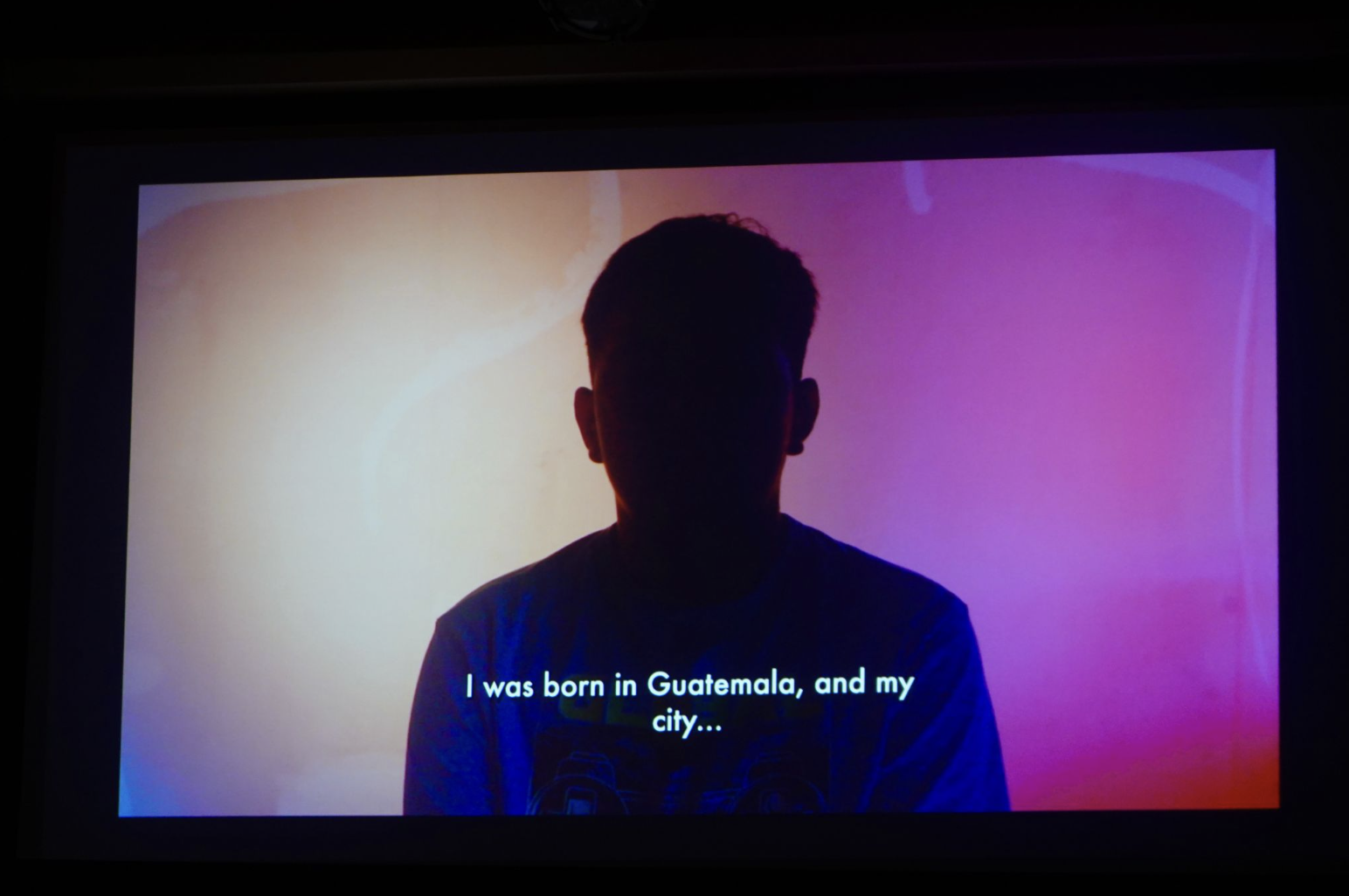
Footage of the epilogue in 2026, with the children’s faces no longer shown for safety purposes. (Credit: Sophie McDougall)
When the 2026 epilogue played, shadows covered the children’s faces. One of the boys tied a bandana around the bottom half of his face. As the performance ended, the crowd sat in stunned silence.
Gumuzzio said she has felt the play become more and more relevant these past two years. The night before the screening, she said, she was up until 2 a.m., watching the news about the shooting. “This happened 30 minutes away. This is affecting our immediate community,” she said after the show. “We really need to share.”
After her monologue ended, Luna sat alongside her onstage. The two of them led an audience discussion, encouraging everyone to share what they took away from the work. “I feel so much pain in my heart,” said one audience member.
It was meant to be a night of reflection and a milestone, marking the 25th anniversary of the theater, and the end of LatinX Heritage Month. But there was little joy across the audience.
“We have to remember that so many immigrants gave up their lives and bodies to be here,” said Luna. “If they hurt, we hurt.”
About the author(s)

Sophie McDougall, currently in the M.S. program at Columbia Journalism School, is a New York based journalist reporting on culture, education, and family.