




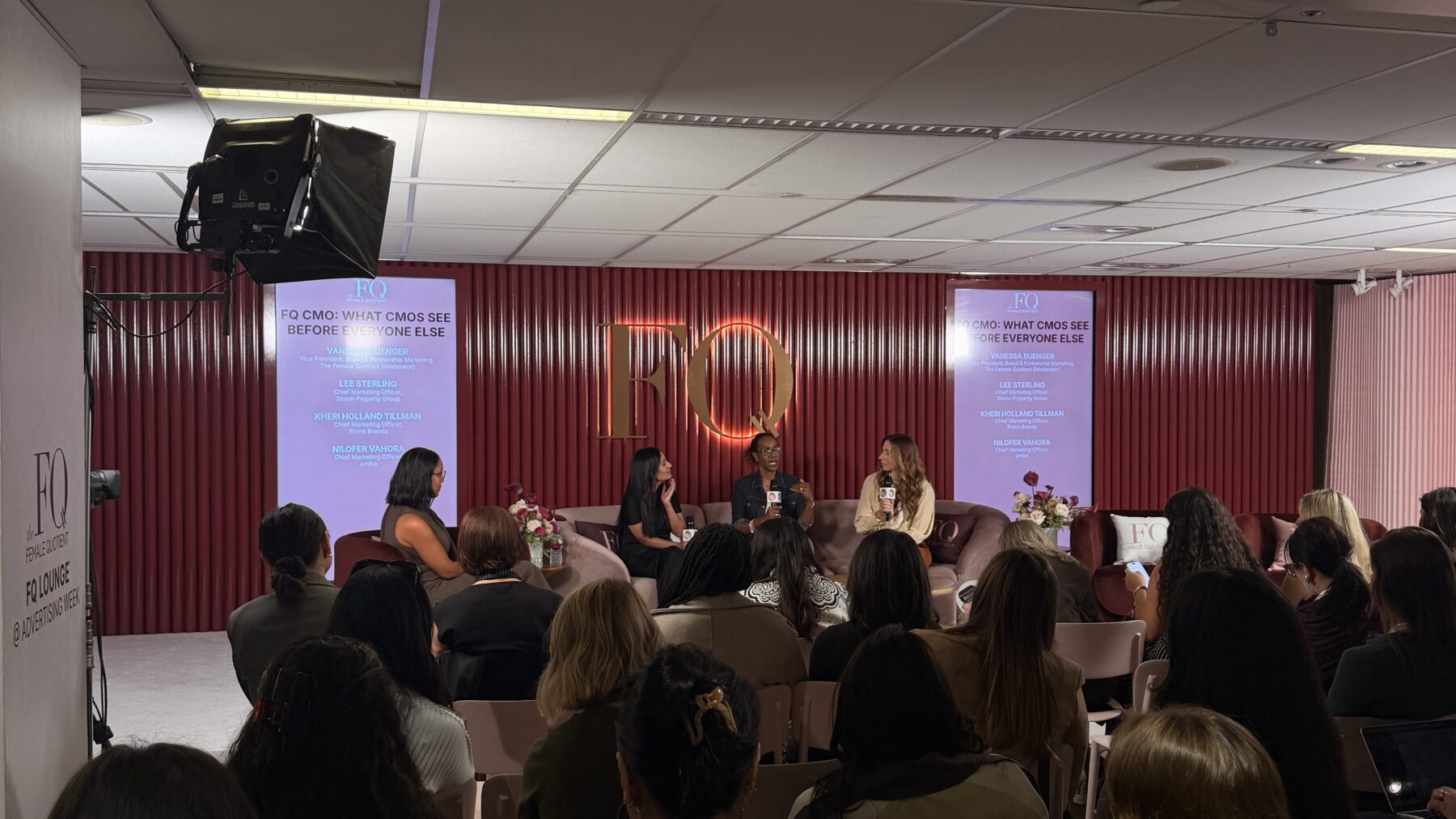
Brand chief marketing officers speak during a panel discussion at The Female Quotient Lounge during Advertising Week New York 2026. (Credit: Lucy Wu)
Advertising Week New York wrapped up on Oct. 8, and the primary topic of discussion among the 20,000 attendees was the disruptive potential and challenges created by artificial intelligence. Companies promised faster production and more personalized campaigns, even as some of those promoting the technology acknowledged there were questions about how far it should go.
The four-day conference at The Penn District, brought together thousands of experts and practitioners in the fields of advertising, media and technology. This year, conversations about AI dominated the conference, reflecting a shift from creative storytelling toward technology-driven marketing.
For companies like Admazing, an ad tech platform focused on connecting consumer brands with audiences using mobile games, AI has become part of everyday business. The company uses the technology to identify audiences and improve advertising decisions, helping brands avoid spending money on consumers unlikely to be interested in their products.
Brynne Sarsfield, president of client partnerships at Admazing, said that her company uses AI to help brands spend their money more effectively, such as finding the target audience in the right spaces instead of spending money on all audiences. She believes there is a difference between using AI for business and using it irresponsibly, particularly when it comes to the potential risks of excessive AI use among children.
“There needs to be something in place, a higher authority in place monitoring it,” she said.
Her sentiments echo discussions being held at a local, state and national level. On Oct. 5, the same day that Advertising Week began, the New York City Council held a hearing in which former employees of major AI companies warned about the technology’s rapid development, while lawmakers considered proposals for stronger oversight and safety regulations.
For others at the conference, the challenge is not just whether AI should be regulated, but how much advertisers should trust it.
Shane Mullane, vice president of sales at Swayable, said that his company uses AI to analyze advertising performance, but relies on real consumers to test campaigns. He argued that AI models can carry biases and cannot accurately reproduce the unpredictable ways people think and make decisions. He also noted growing public skepticism toward the technology compared with last year’s conference. “We don’t believe in using AI to replicate humans,” he said.
That uncertainty raises questions about an industry increasingly using artificial intelligence to understand the very people it is trying to reach. The pressure to adapt is also reaching younger creatives.
Several students in attendance expressed that they feel pressure to keep up with professionals already using AI. Simone Batiste, a student at Brooklyn College, started using AI to organize ideas and complete design tasks more efficiently. She sees how beneficial the technology is without losing the personal experiences and emotions that shape her creative work.
“AI cannot create the ingenuity that comes out of creatives,” Batiste said.
DiAnA McElroy, a wellness entrepreneur attending the conference, prefers to create her work by hand and believes technology should not replace the personal connections behind creative work.
“I don’t want to lose that essence of humanity,” she said.
About the author(s)

Lucy Wu is a Beijing-born, New York-based journalist and creative strategist passionate about multimedia storytelling and bridging cultures through meaningful communication.