




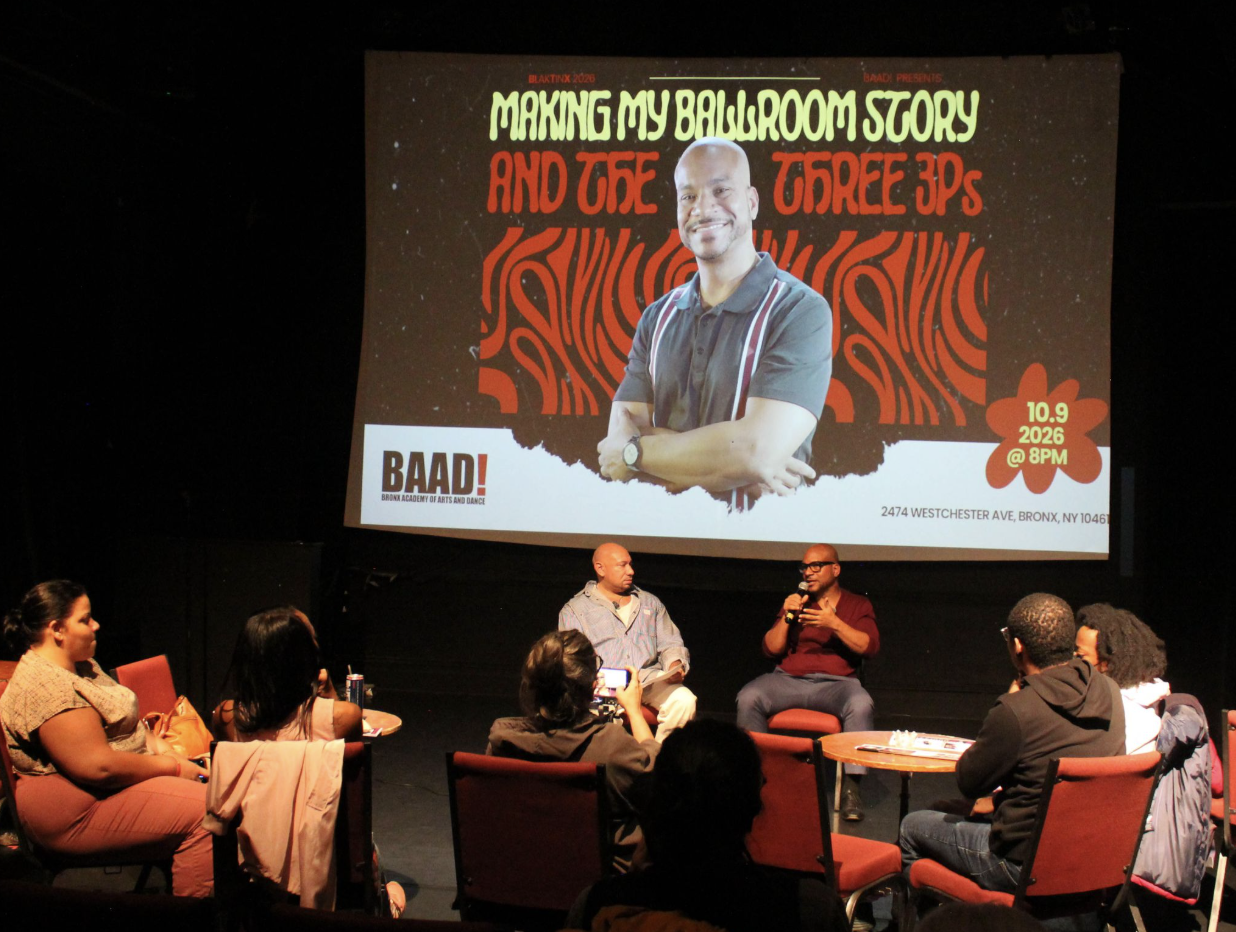
Director Felix Rodriguez in conversation with Calixto Chinchilla” Bronx Academy of Arts and Dance, Bronx, NYC Oct. 9. (Credit: Samantha Marshall)
For over three decades, Felix Rodriguez kept his camera fixed on New York’s ballroom scene. A sneak peek of “My Ballroom Story” opened that archive.
On Oct. 9, The Bronx Academy of Arts and Dance (BAAD!) screened a preview of the upcoming documentary about the evolution of LGBTQ+ underground balls in New York City. The footage, compiled and edited by Rodriguez, a 1990s ballroom veteran, highlights LGBTQ+ performers. It also explores Rodriguez’s own reconciliation with his identity as a gay, Black and Puerto Rican man.
In 1990, New York’s ball scene was in full swing. It was a Black and Latino underground culture that can be traced back to balls held in Harlem in the 1890s. The events are a place where LGBTQ+ members could perform, pose (or vogue) and compete to be crowned Queen. At the early balls, pageantry often favored white contestants.
In response to racism at the early balls, Crystal and Lottie LaBeija, two prominent figures in the scene, founded the House of LaBeija and began throwing events for Black and Latino LGBTQ+ members. Their group was the first “house” in the community, and over time more houses were established where contestants could join a chosen “family” to guide them through the ball contests.
The underground events started to gain mainstream traction after a 1990 documentary “Paris is Burning” was released that highlighted the scene in the 1980s, and when Madonna released a music video for the song “Vogue.” More recently, a 2021 series called “Pose” was released about the balls, and in 2022 Beyonce had started incorporating voguing in her Renaissance tour.
In Rodriguez’s documentary, scenes of dancers walking, posing and laughing contrast intimate scenes of his family in Puerto Rico. He narrates his journey to choose a family within the ball community, while maintaining a place within his nuclear family in Puerto Rico.
“I would purposely go [to the balls] because of the times that we were living, at the peak of HIV and AIDS. There were a lot of people in the community that were dying. So, as a mission for myself, I wanted to make sure that these talented individuals were commemorated,” said Rodriguez.
Twenty-five audience members sat in rapt silence as the documentary played, and the room erupted with applause as the house lights came up. After the screening, Rodriguez was joined by Calixto Chinchilla, executive director of New York Latino Film Festival, to discuss the enormous task of piecing together more than three decades of archival footage.
Evan Brown, a 28-year-old audience member who had never been to a ball, said he thought the documentary came from a place of love, reconciliation and acceptance.
“He describes the ball of being a place of freedom and of just being yourself and not even fully understanding your identity, but still just being free,” said Brown.
Elaine Polanco, a Bronx resident, has been going to balls for more than 20 years. “This is very important because there’s a lost art in the ballroom scene,” she said. “And this kind of puts a face to a lot of the names that I’ve heard of. It’s beautiful.”
Charles Rice-González, co-founder and executive director of BAAD!, said the film grappled with stereotypes of how members of the ball community are, and stereotypes associated with Rodriguez’s own identity as a gay Black and Puerto Rican man. He said these stereotypes can paint an incomplete picture of an entire community.
Rodriguez and his team said they hope to have the documentary premiered within the next year.
The documentary was previewed at Live Nation last week.
“I’m hoping that by sharing the story, people that can relate to how I feel and what my life is at home will be able to look at this and be inspired to change as well,” said Rodriguez.
About the author(s)

Samantha Marshall is a journalist focused on politics, climate and culture.