




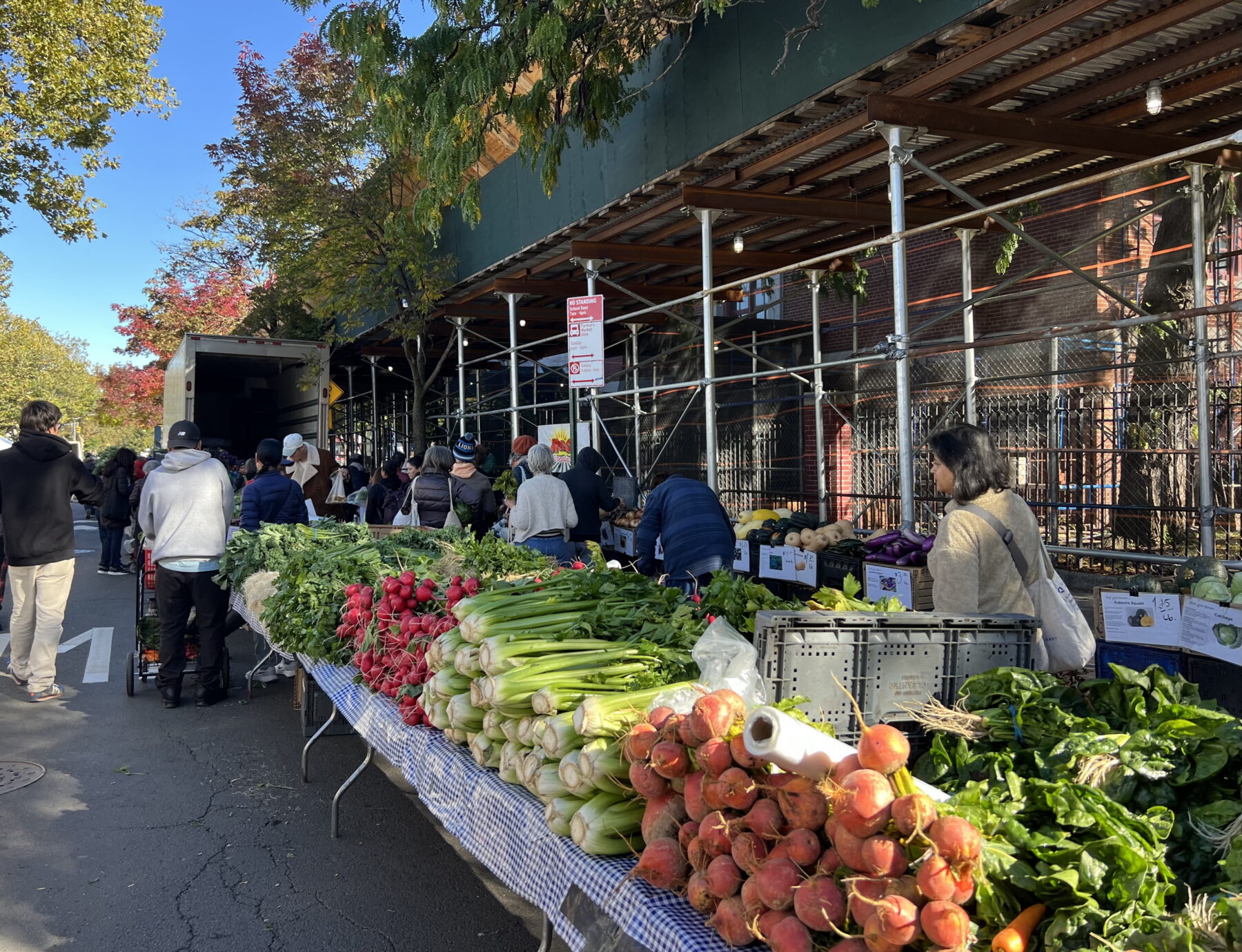
The Jackson Heights Greenmarket, organized by Grow NYC, takes place every Sunday. New Yorkers can use benefits, such as SNAP and WIC, to purchase eligible grocery items. (Credit: Whitney Lynn)
Voces Latinas, a non-profit in Queens that provides services to the immigrant community, recently conducted an Instagram poll in Spanish: “Do you know what public charge is?” Seventy-nine percent of respondents replied no, said Nathaly Rubio-Torio, the organization’s founder.
Most respondents are too overwhelmed to follow every change to immigration policy, she said. “Our population is very much on survival mode,” Rubio-Torio said.
Public charge is an assessment made by immigration officers about whether an applicant for a green card or visa is likely to become dependent on public benefits, such as Medicaid or food subsidies that help low-income families afford groceries.
On Sept. 18, U.S. Citizenship and Immigration Services issued new guidance that gives officers broader authority to deny green card or visa application. The use of most public assistance programs can now be grounds for denial. In some cases, benefits used by citizen family members of the applicant can be factored into officers’ rulings.
“I really can’t stress enough how harmful the effects of this rule will be,” said Luisa Cuautle, health campaigns associate at Make the Road NY, an organization that serves immigrant and working-class communities. “This is a really dangerous ruling because it really creates a lot of ambiguity and a lot of confusion.”
Many experts are concerned about potential widespread disenrollment in healthcare and food assistance programs in mixed-status households—homes where at least one resident is a citizen or legal permanent resident and one resident is undocumented. The rules could be particularly devastating in Queens where 372,200 people live in mixed-status households, according to the Center for Migration Studies.
“People are so fearful right now that any kind of letter from any of their benefits, they’re assuming that it’s saying that they have to get off,” said Rubio-Torio.
She said she recently met with a woman who brought her an unopened letter from Medicaid; after hearing about the public charge change, she had assumed the agency was notifying her she was losing her healthcare. Disenrollment in Medicaid and the Children’s Health Insurance Program (CHIP) among recipients living in mixed-status homes could range from 1.4 to 4.1 million, according to a study by KFF.
Undocumented immigrants are not eligible for most public benefits. U.S. citizens and legal permanent residents who have been in the country for a minimum of five years can receive assistance like Section 8 Housing Vouchers and Supplemental Security Income, which is calculated based on income and financial resources, an evaluation called “means-tested.”
Attorneys will have a better understanding of the impacts of the change in about eight months when clients who submitted adjustment of status applications begin receiving decisions, said Stefi Bastiaensz, an immigration lawyer. “Public charge isn’t new, USCIS officers have always factored it into their review. What’s changed is how prominently they are incorporating it into the adjudication,” said Bastiaensz.
Lisa, who requested anonymity due to safety concerns, is applying for a green card with her husband, after living in the U.S. for more than 20 years. She was working in a hospital, but the couples’ Temporary Protected Status was cancelled over the summer, making them unable to work.
“It’s very difficult and frustrating, not working. You stay at home all day all night without doing anything,” said Lisa. “You have your bills to pay, your children to take care of, so it’s very, very frustrating.” Now, she and her husband are concerned about being labeled public charges by USCIS officers because of their unemployment. Lisa and her lawyer must prove self-sufficiency.
Similar regulations were enacted in 2019 by the Trump Administration but enforcement was suspended in 2021. While the rule was in effect, it had significant impacts on children living in mixed-status homes. The number of children receiving Temporary Assistance for Needy Families, Supplemental Nutrition Assistance Program benefits, and Medicaid fell twice as fast among children in mixed-status homes compared to children in homes with only citizens, according to a study by the Migration Policy Institute.
The public charge rule is one component of a larger plan by the Trump Administration to downsize social safety net programs. SNAP enrollment in Queens has decreased by over 25,000 during the last year due to funding cuts in the “One Big Beautiful Bill Act.”
New York, in coalition with 21 states and D.C., filed a lawsuit on Sept. 14 challenging the public charge rule, but some legal experts said that even if the rule is overturned, the administration will have achieved its goal.
“People are getting off their benefits. People are confused. People are reconsidering filing legal claims to attempt to correct their status,” said Bastiaensz. “The destabilization is part of the success of the Trump Administration.”