



The Climate Week NYC panel “Science, Democracy and Climate” explored the complex connections between climate science and politics.
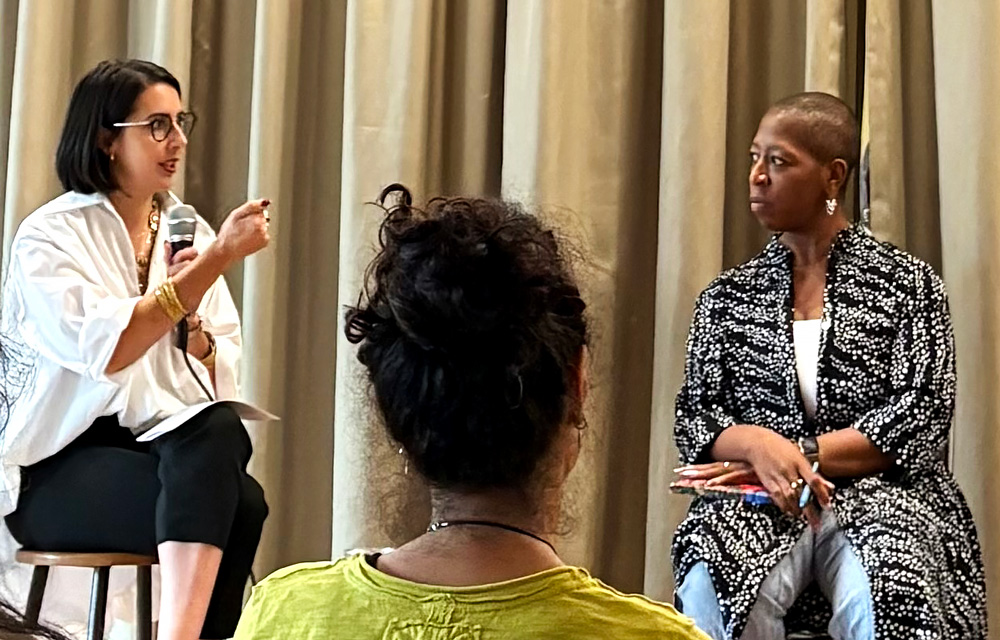
Stand Up for Science CEO, Dr. Colette Delawalla with panelists Dr. Ticora Jones and Dr. Michael Mann. (Credit: Maddie Hengerer)
As climate science continues to be suppressed and ignored by politicians, remaining silent is no longer an option. Speakers at a recent Stand Up for Science event said that political activism and advocacy may be the key to solving the climate crisis.
“The path forward is taking ownership of our politics,” said panelist Michael Mann. “The obstacles are not physical, they’re not technological, they’re political.”
Stand Up for Science (SUFS), a science-focused American political advocacy organization, was founded in 2025 after the Trump administration significantly reduced the funding of federal science programs. Through volunteer activism, outreach campaigns, and public education, SUFS works to protect scientific integrity from political interference.
The discussion took place on, Sept. 23 in Midtown and featured two speakers: Ticora Jones from the Natural Resources Defense Council, an international nonprofit group for environmental advocacy, and Mann from the University of Pennsylvania. Colette Delawalla, CEO and founder of SUFS, moderated the conversation.
The conversation centered around how democracy impacts climate science through policy decisions and the individual interests of politicians, underscoring the necessity of science without biased partisan interference. “Science for a public good is a foundation for how things happen,” said Jones.
The panelists stressed a need for collective action, political advocacy, and public pressure in the fight against climate change.
“We are facing this grave planetary threat. No question about it. But it’s not too late,” Mann said after the panel. “It’s a matter of us, and whether we fight for a livable future. It’s not too late to do that.”
While political figures repeatedly attempt to censor climate science, the speakers encouraged attendees to demand climate action in democratic contexts.
“People often think about the repercussions of the climate crisis, and what that means in the context of the planet being unlivable,” said Delawalla. “But I don’t think that enough people are talking about what it means for democracy.”
Some attendees left feeling inspired to take action.
“It’s a lot to get people to engage and not be reticent about making noise,” said attendee Natalie Patasaw, New York State chair of the NAACP’s Environment and Climate Justice Committee. “So, this is kind of like good trouble. How do we disrupt the misinformation?”
For many climate advocates, that “good trouble” is what keeps the fight alive.
“It would be difficult to be out there every day, advocating for action, speaking out, doing interviews if you didn’t think it made a difference,” said Mann. “I feel like it does make a difference, and I’m hopeful that we’re about to veer back in the right direction.”
About the author(s)

Columbia News Service