




Amani Toomer, Jasmyne Spencer, and Lee Whitwell explained during Climate Week why their platforms could help protect the waters and fields where they play.
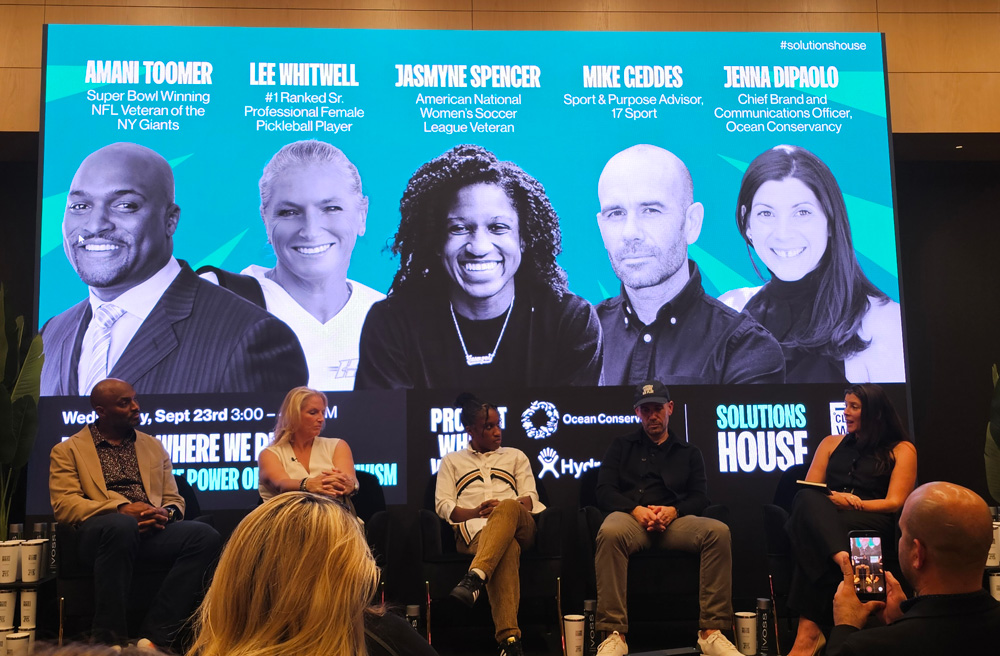
The “Protect Where You Play” panel during Climate Week. (Credit: Valeria Cortés)
It seemed an unlikely trio: an NFL veteran, a former National Women’s Soccer League star, and the world’s top-ranked senior pro female pickleball player. United, not around a game, but for the ocean.
The three athletes—Amani Toomer, Jasmyne Spencer, and Lee Whitwell—spoke at a Climate Week panel on September 23 about using their platforms and influence to raise awareness about environmental issues. Toomer, Spencer, and Whitwell are part of the Ocean Conservancy’s “Protect Where We Play” initiative, which seeks to involve more people in caring for the oceans.
“Every second breath comes from the ocean,” Whitwell said. “We need to do a lot more to protect it, to preserve it.”
Since its launch in February 2025, the initiative has partnered with sports leagues and venues, including the Seattle Seahawks, who won this year’s Superbowl. One of the campaigns aims to prevent single-use cups from entering the waste stream at arenas across the country.
Toomer, former New York Giants wide receiver, said environmental issues affect the sports fields, water bodies and other spaces where kids and sportspersons train.
“I didn’t go to UCLA when I was growing up or USC because I knew about how poorly the air quality was down in Southern California,” he said.
Spencer is also a member of EcoAthletes, a network of more than 260 Olympians, pros, and college athletes who use their social platforms to become climate leaders.
“Being in these Zoom calls and coffee chats with climate scientists and other athletes has been an incredible opportunity to learn,” she said.
Some attendees said athletes could drive greater involvement because they influence large numbers of people.
“Different leaders across the sports and entertainment industry can really make a notable shift that we need within the climate movement,” said Diana White, a recent Columbia Climate School graduate.
Whitwell shares that view.
“It’s a privilege being an athlete. And with that privilege comes responsibility,” she said. “If we collectively care as one big voice, then change can happen.”
About the author(s)

Valeria Cortés is a digital journalist and a student in the M.S. in Data Journalism program at Columbia Journalism School.