



Politics and sequins rarely go together. But at Someday Bar in Brooklyn in late September, three drag queens gathered to prove otherwise. PFLAG NYC, hosted “Drag Is Political: Queer the Vote!” to encourage voter registration ahead of the midterm election. PFLAG NYC is the founding chapter for PFLAG, one of the nation’s largest LGBTQ+ advocacy organizations, dedicated to supporting LGBTQ+ people and their loved ones.
Before breaking out into song and dance, the queens sauntered over to the makeshift performance area of the bar, taking a load off their stompers and sitting for a panel discussion. The backdrop of the panel was the bar’s intricate Halloween decorations of creepy cobwebs and towering tentacles. The queens – Nancy NoGood, Junior Mintt and Reina NoBuena – took turns addressing issues which, according to a 2023 McCourtney Institute for Democracy poll on political self-censorship, more than half of Americans would deem scarier than the plastic severed limbs hanging from the ceiling. Gender identity, transgender rights and discrimination against queer people were just some of the issues the queens touched on throughout the panel. Many of the Americans surveyed in the poll said the current political climate doesn’t allow for fruitful conversation, especially when discussing controversial topics. They also mentioned fearing disagreements with family and co-workers that can lead to further polarization.
Nia Alvarez-Mapp of Common Cause New York, a nonpartisan organization dedicated to protecting voters and upholding democracy, was the panel moderator. She posed questions on a variety of topics ranging from the importance of voter registration to the persistence of partisan division. Nearly 30 people packed into the bar, listening to the queens’ urgent message on why New Yorkers need to fulfill their civic responsibility. They were encouraged to take note of important resources for combating potential voter intimidation.
Alvarez-Mapp mentioned Common Cause’s nonpartisan election protection campaign, “Hands Off Our Vote/NY Election Protection,” during which volunteers help voters navigate the electoral process without fear. She also mentioned the election protection hotline “1-866-OURVOTE” that voters can call during early voting or election day with any questions or concerns as they cast their ballots. The panel also asked the audience to make any changes to their registration status if necessary, before important deadlines pass. The queens also reiterated the need for continued allyship and how ignorance and an unwillingness to be open-minded, especially about drag, adds fuel to unproductive political debate.
NoGood said that drag performance is a vital aspect of civic engagement. Creating a community, uplifting those on the periphery and encouraging others to embrace their differences are all at the heart of drag, NoGood said.
Mintt, a transgender drag queen, added that artists take on an influential role the moment they don their wigs.
“I view drag artists as no different than any other celebrity,” said Mintt. “They are people who bring community together. They are people who help people who are disenfranchised to see not only someone like them, but also to see that there is a path to be blazed.”
NoBuena, who is also transgender, said her identity has motivated her to get involved in politics; she noted that other trans people might not speak up, fearing possible repercussions.
While the Nov. 3 midterm vote looms, the queens didn’t name candidates or specific propositions they plan to endorse. Instead, they said, they are casting their ballots to defend noncitizens, for reform on nationwide deportation operations, and for protecting the queer community in less queer districts.
The “Drag Is” series was originally planned as a one-off. Nancy NoGood who, outside the wig, is Philip Calabro, PFLAG NYC’s community education and outreach program coordinator, combined drag and religion for a first event that was called, “Drag is Spiritual.” PFLAG hosted the part-panel, part-show in August, bringing together queens of different faiths and a local reverend to address the stigma around queerness and religion. Afterward, several colleagues encouraged NoGood to produce recurring events around different themes. NoGood was already hosting a weekly drag show with NoBuena, along with occasional guest artists, so she said organizing additional events seemed like a no-brainer.
“I wanted to tell my audience who come here that their voice matters outside of the bar,” said NoGood. “It matters in the community, it matters in the neighborhood we do this show, it matters in New York City and beyond. I want them to recognize that and to see how powerful their voice can be.”
The panel and show were free to attend. Both NoGood and Alvarez-Mapp emphasized the importance of making events like these accessible to audiences of all walks of life. Alvarez-Mapp added by removing barriers, they hope to increase voter participation.
“Once you get them in, educate them, understand what is happening right now, then we can activate them by getting them registered to vote,” said Alvarez-Mapp, who is the organizing manager at Common Cause.
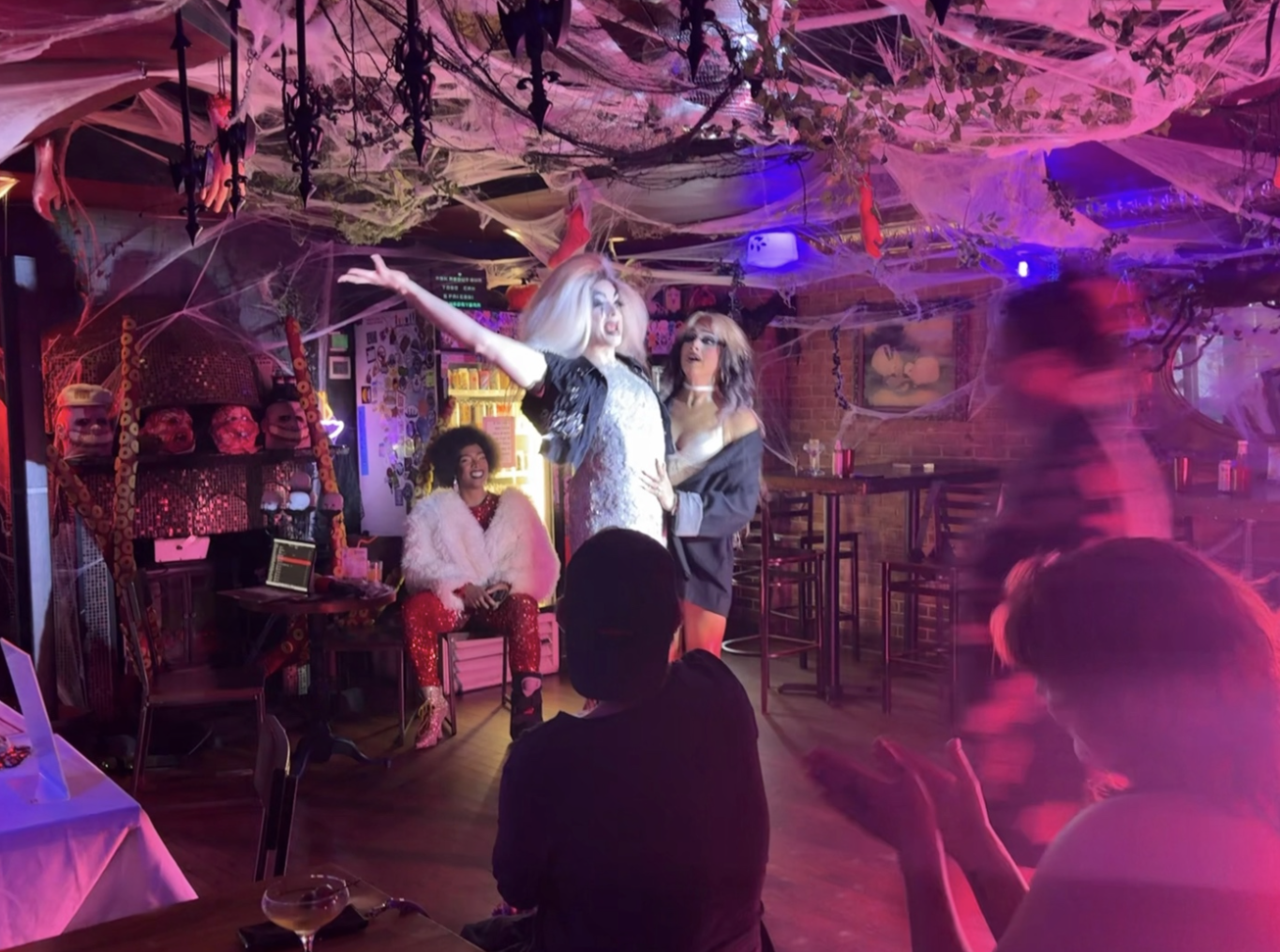
Nancy NoGood (left) and Reina NoBuena (right) perform a drag show at Someday Bar in Brooklyn. (Credit: Autriya Maneshni)
The drag queens acknowledged that it’s gotten harder to powder their faces, wear extravagant outfits and participate in the art form over the last several years, ever since a “drag panic” entered American politics. As part of an uptick in anti-LGBTQ+ messaging by conservative politicians in 2022 and early 2023, highlighted in a report by the Human Rights Campaign, drag has been maligned, with zero evidence, as a method for pedophiles to “groom” children, invoking a decades-old trope about LGBTQ+ people presenting a danger to youngsters.
For example, a 2022 campaign ad by then-Senator Marco Rubio targeted Drag Story Hour, a program in which queens in dress-up read age-appropriate books to children in libraries and similar spaces; Rubio called such programs “sexualized” and an effort “to turn boys into girls.” Six states have passed laws banning or restricting drag performance, and this year, such laws have been proposed in 18 states.
Instead, it’s drag queens who are in need of protection. There were more than 161 reported protests, bomb threats and violent attacks targeting drag, including the firebombing of an Oklahoma doughnut shop that had hosted a drag event, a mass shooting at an LGBTQ+ nightclub in Colorado Springs and the vandalizing of the office of a New York City Council Member who supported a drag story hour in his district, according to the Anti-LGBTQ Extremism Reporting Tracker (ALERT) Desk at GLAAD, an LGBTQ+ advocacy organization.
That number dropped to 83 in 2025, but physical and rhetorical attacks against the queer community continue. At a midterm rally in Georgia on Oct. 16, President Donald Trump rallied supporters, promoting the false claim that schools are subjecting children to gender-altering procedures.
According to Teagan Bradway, a professor at SUNY Cortland and an expert in queer studies, conservatives have used a combination of fear and a valorization of patriarchal religious values to mobilize voters. Bradway said that by branding drag as a threat, some right-wing politicians offer the censoring of queerness as a solution to constituents’ grievances.
“It’s kind of easy to point to people in dramatic outfits, doing spectacle and to scare people and to say, look, they’re trying to turn your children trans or to turn them queer,” she said.
NoBuena called the negative rhetoric a “tired take,” and objected to conservatives blaming drag without taking time to educate themselves on the art form.
“If they’re wanting to be mad because there are queer voices that have a microphone, boohoo,” she said.
NoGood said that the hostility toward drag is more than politics—it’s also personal.
“It’s definitely painful for me because drag has always brought me joy, freedom and a stronger understanding of who I am,” said NoGood. “To see people meet drag with such a visceral reaction, once I get past the fact that I am confused why they do it, it’s sad.”
About the author(s)

Autriya Maneshni is pursuing an Arts & Culture M.A., driven by her passion for telling human-interest stories.