



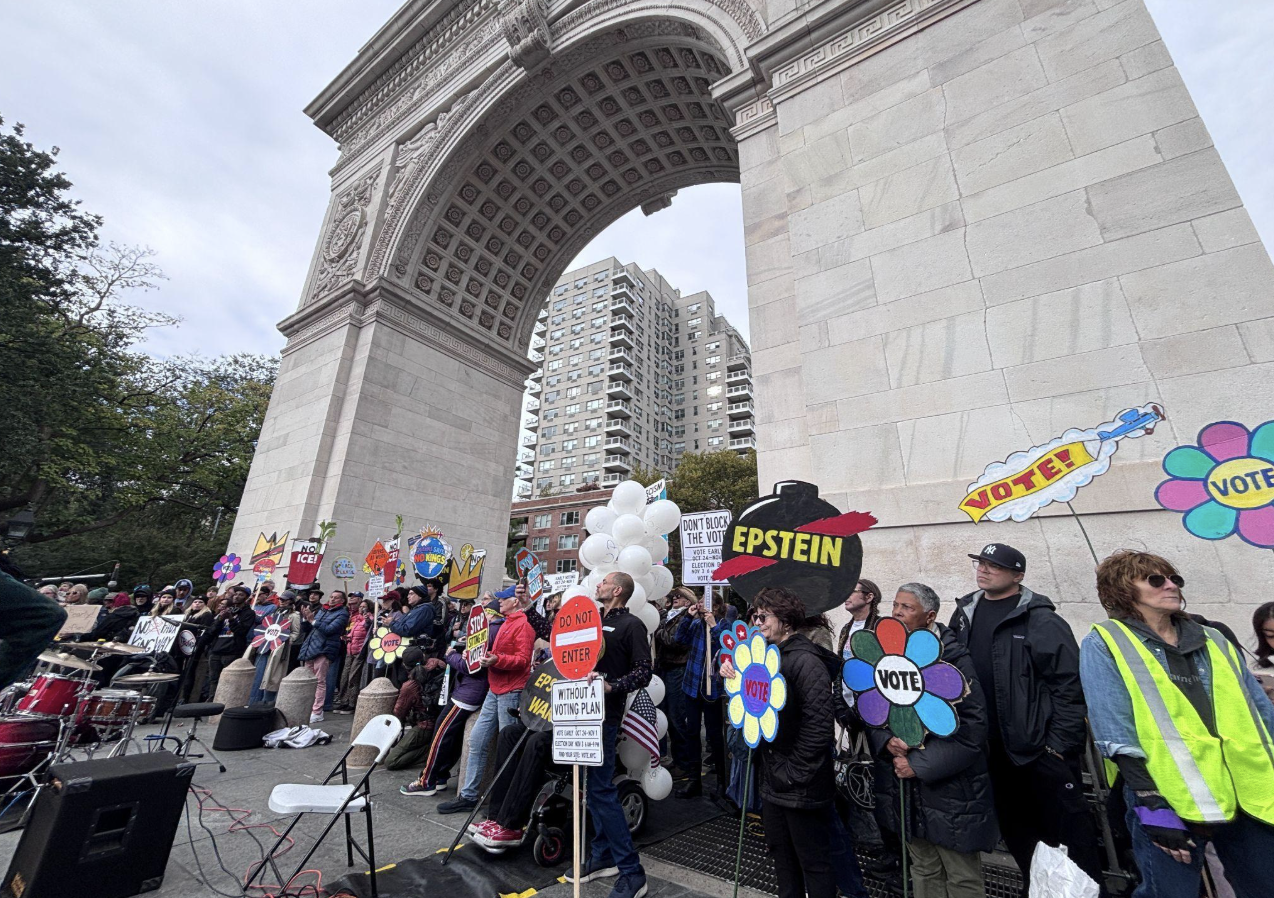
The crowd at VOTEFEST NYC carried creative signs, some of which participants made at a Queens Says No Kings art build. (Credit: Diana Fonte)
Slam poet Za’Riah Jones, a high school junior from South Ozone Park, Queens, took to the stage in Washington Square Park on Saturday, Oct. 17, to stake a claim for her generation in the upcoming midterm elections. “If they keep telling us, ‘We are the future,’ then let me correct them,” she declared. “We are not the future. We are the present with consequences attached to it. We are the generation that will inherit every decision made while we were told we were too young to understand.”
Jones was just one of the potential new – or future – voters to participate in VOTEFEST NYC, an afternoon of live music, poetry, art, and political organizing aimed at energizing turnout at the polls. The organizers made a point of platforming an intergenerational lineup of speakers and performers. Jones brought up her honorary grandmother, Aracelia Cook, president of the 149th South Ozone Park Civic Association. Cook stood proudly next to the young poet. “We are the grassroots!” she cried.
Cook looked out at a swelling crowd that stretched from the arch to the central fountain, congregating for this local contribution to the national No Kings Day of Action. Under the arch, festivalgoers held up vibrant signs: cut-out Bloody Mary glasses with “NO ICE!” written across them, rainbow cardboard flowers with “VOTE” stamped across the center, and “No Standing: VOTE EARLY” makeshift street signs.
Queens-based grassroots coalition Queens Says No Kings (QSNK) organized VOTEFEST NYC, with the support of funding from the nationwide progressive grassroots movement, Indivisible. Comprised of over 2,000 local chapters focused on defending democracy and resisting the Trump agenda, Indivisible focused this year’s No Kings day of action on bolstering early-vote mobilization efforts. Alyce Wittenstein, QSNK founder, created VOTEFEST earlier this year and hosted two iterations in Forest Hills before bringing the celebratory format to Greenwich Village, with the collaboration of Team Get Off the Couch (TGOC), a parallel group based in Manhattan. “If you can get this message to five people today, help them confirm their own registration, make a voting plan, vote early, and bring a friend, you’ve done a lot,” TGOC’s leader Jennifer Reingold urged from the stage.
When Wittenstein spoke at the podium, she joked about the satirical sci-fi films she used to make about authoritarian technocracy. Maybe they were more prediction than warning, she said.
Wittenstein’s impetus to start the group in 2024 came from a fellow part-time grassroots activist in Queens, Doctor Ida Messana of Let’s Talk Democracy. QSNK started out meeting at the Queens Public Library, then moved to a room at the First Presbyterian Church of Forest Hills. Pastor Jeff Courter, an early cornerstone of QSNK, recalls lending the group the Church’s Zoom meeting rooms, outraged at the executive overreach and growing Immigration and Customs Enforcement (ICE) presence in his community, and in service of promoting the values of any good samaritan. Two years later, Courter overlooked a sea of people while he offered an interfaith blessing on the morning of VOTEFEST.
Wittenstein was inspired to set up VOTEFEST by her daughter, Nova Wittenstein-Brent, a Brandeis University junior who created Vote Deis, a club that seeks to make voting more accessible for college students. Just a month earlier on Sept. 19, Wittenstein-Brent flew to Boston for the East Coast Voting Summit, hosted by Harvard University for Boston-area universities every two years. She and another Vote Deis member were there to present on innovative voter-engagement campaigns. At Vote Deis, the group famously brought a goat onto campus to draw attention.
“We call it the Vote Goat; it’s a big hit. You can check your voter registration status, request an absentee ballot, and you can take a picture with the Vote Goat,” Wittenstein-Brent said during an interview.
Wittenstein’s former film co-director and art partner, Steve Obringer, develops designs for QSNK projects. Obringer hosts art builds in which participants can make whatever they want for upcoming QSNK marches, he said, adding that he enjoys the surprising images they come up with when allowed free rein.
Many signs had defiant messages, and some attendees came costumed as the Statue of Liberty, Uncle Sam, and Marie Antoinette.
The goal was to use art and celebration to convince those who felt lukewarm about voting that it is worth their while to fight for their rights, and to do so through the power of their vote. This joyful approach is termed by Ezra Levin, co-founder and co-executive director of Indivisible, as “laughtivism” or strategic frivolity, a hallmark of effective anti-authoritarian organizing.
“Authoritarians want you to be scared. They want chaos. They want you to doubt your ability to show up fear-free. [Engaging] in festivals, in comedy, in ridicule, in big public displays of joy, it’s one of the most powerful things you can do,” Levin told Columbia News Service.
Artists who performed on stage included Daso y El Grupo Cemí, a Lower East Side-based folkloric Puerto Rican dance troupe, which presented Latinx salsa stylings, and the Resistance Revival Chorus, which sang Civil Rights-era hymns, swapping lyrics in to align with the No Kings message, like “I’m not gonna let no fascist turn me ‘round.” The crowd sang along.
The Curtis Watts Trio played a medley of peaceful protest songs like “Come Together,” followed by the crowd cheering back “Vote!”
At the podium, civil rights activist Reverend Al Sharpton reminded the audience of the history of voting restrictions.
“I come out of a movement where people died to get the right to vote,” he said. ”Just like several decades ago, right here in Greenwich Village, people stood together, from Allen Ginsberg, to Gloria Steinem, to Shirley Chisholm,” he said. “[We’re] gonna hold up now like they held up then. No kings.”
Then, Jumaane Williams, New York City public advocate, took the stage. He quoted civil rights leader and Baptist pastor Adam Clayton Powell Jr.‘s classic sermon, “What’s in Your Hand?” Williams addressed the assembled crowd with the rally cry, “What’s in your hand?” The crowd shouted back a resounding, “Everything!” His 4-year-old daughter clung to his side as Williams’s voice boomed through the crowd, echoing the message of responsibility to subsequent generations.
“In your last breath, point the direction to justice for the people behind us,” he said, “and those young people will look and say, ‘Job well done, I’ve got it from here!’”
Sandwiched between Williams’s speech and a surprise address by Manhattan Borough President Brad Hoylman-Sigal, young people shone.
“Even before I could vote, I would always tell my whole family, ‘make sure you guys are voting,’” Jones said. “They’ve been so annoyed with me this past month.”
Young activists not yet of voting age directed their speech to fellow young people, encouraging an early interest in civic duties.
“I am not old enough to vote, but that does not mean I don’t have a voice,” said Manuel Flores, a Forest Hills High junior and a youth civic leader. This summer, Flores built a public awareness campaign about immigration statistics through his involvement in the first Queens-based youth leadership summit, Youth Talk Democracy.
Young people shared the fresh approaches they’ve developed to make voting information more accessible. At a tabling station, Caleb Adelman, a recent graduate of Miami University in Ohio, promoted his app Pillars, which uses an interface that resembles sports brackets to provide information on candidates and their policy positions. Adelman, who majored in emerging technology, created the app out of his own frustration with trying to find out about the people running for office, he said.
“Why do I know more about athletes than the people making decisions for us?” he asked.
At another table, HeadCount, a nonprofit that holds voter-registration drives at music festivals, concerts, and cultural events, promised that anyone who stopped by to check their voter registration would be entered into a sweepstakes for tickets to the upcoming Olivia Rodrigo tour.
As they walked through the park, Teagan Ngo and Isabella Bucci, Northeastern University freshmen at the New York City campus, said the festival piqued their interest. They talked about their plan to vote.
“We didn’t know this was happening today, but we are voting,” said Ngo. “It’s parents’ weekend this weekend, so our parents are bringing our ballots.”
About the author(s)

Diana Fonte is a Master's student at Columbia Journalism School specializing in Arts and Culture Journalism.