




Passengers board a B41bus from the center-running bus lane on Flatbush Avenue. (Credit: Ana Murillo Quiñones)
At a new center-running bus stop on Flatbush Avenue, between Atlantic and Fourth Avenues, riders face a choice: wait for the B41 and B67 buses, or hail a passing dollar van.
Flatbush is the first of five rapid-bus corridors projected for completion by 2030, Mayor Zohran Mamdani has said. The project is part of the $882 million city-state initiative “Next Stop: Fast Buses, Better Service.” About 69,000 riders on six MTA bus routes use the northern stretch of Flatbush Avenue each day, where buses move as slowly as 4 mph, according to an April 2026 briefing from the New York City Department of Transportation (NYC DOT). The DOT argues that physically separating buses from private vehicles, via a bus-only center lane, is the best way to protect pedestrians and improve overall efficiency.
The intersection outside Atlantic Terminal is one of the busiest transportation hubs in Brooklyn, according to NYC DOT. The Long Island Rail Road, nine subway lines and two malls converge at this intersection, and Barclays Center, home to the Brooklyn Nets and the New York Liberty, sits just 900 feet away. Now, southbound riders board from concrete islands in the middle of the street, instead of the sidewalk.
Some longtime riders like Lynette Shepherd say that the new stops are a welcomed improvement. Shepard recalled waiting for the bus without protection from the elements and pointed to the Times Plaza Control House, an above-ground structure across the street, behind the new bus lane that once served as a subway entrance.
“We had to stand there in the summer heat and winter cold,” said Shepherd, a Brooklyn resident who has relied on transit along Flatbush Avenue for more than 20 years. “It’s much better with this redesign.”

The Times Plaza Control House across Flatbush Avenue’s new center-running bus lane. (Credit: Ana Murillo Quiñones)
Despite the improvements for accessibility and efficiency, it does not necessarily make the bus the easiest option for everyone. On two recent afternoons at the intersection, “dollar vans,” privately-owned minibuses that offer an alternative to public transit, usually in underserved communities, repeatedly pulled into the bus-only center lane to collect passengers. Some people waited for buses; others chose a van. The decision often came down to time.
“I do think it’s faster with the vans,” Shepherd said. “And they stop anywhere you want,” she added.
Andrew Leonard, a lifelong Brooklyn resident who primarily relies on the subway to get around, said that “MTA does their thing,” acknowledging the changes that the institution is making to meet rider needs. But bus service, he said, is more consistent on weekdays than on weekends. “On paper, it takes half an hour, but it ends up being 45 minutes to an hour,” he added. While interviewed, Leonard hurried off to catch a dollar van rather than wait for the bus.
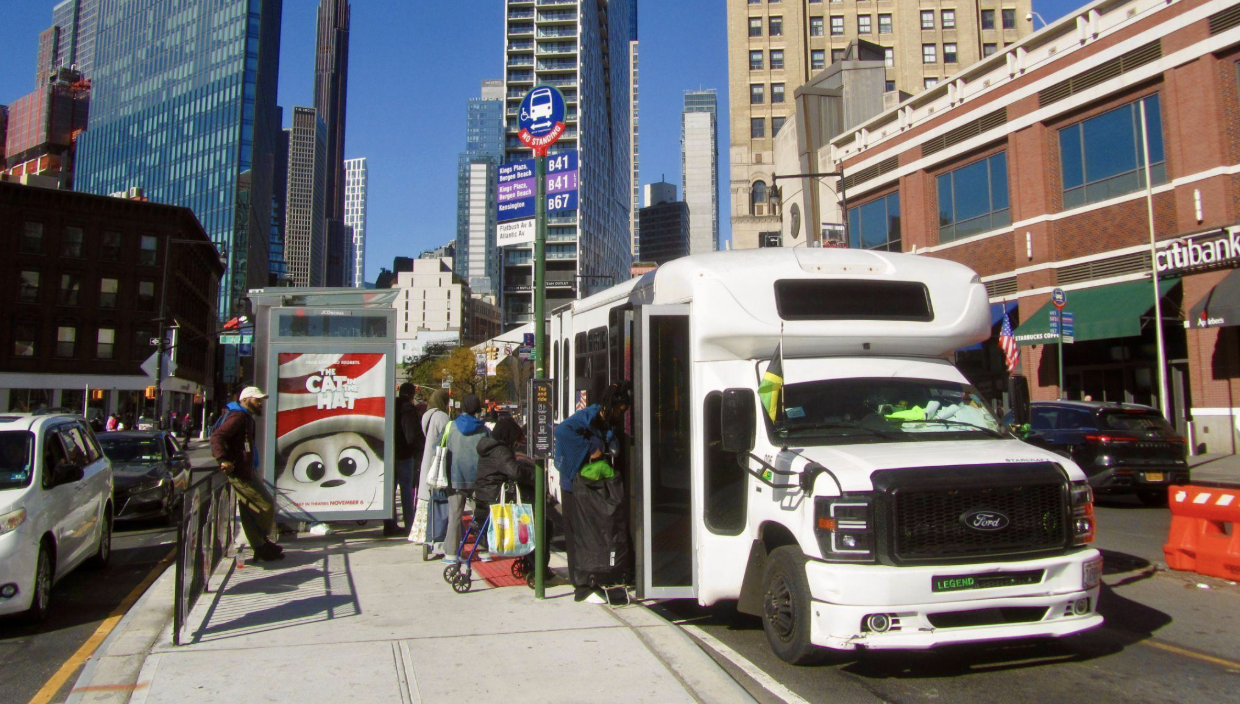
Passengers board a dollar van from the center-running bus lane on Flatbush Avenue. (Credit: Ana Murillo Quiñones)
For riders who choose the bus, the lower fare and free transfers can make it worth the wait. A 67-year-old rider who declined to give her name said she prefers the bus, which costs her $1.50 as an eligible senior under the MTA’s Reduced-Fare program. Dollar vans, she said, are “not even a dollar anymore,” with some charging $2 to $3. Unless she is pressed for time, she prefers to wait for the bus.
The redesign has also raised concerns about safety. During visits to the intersection, it was apparent that several pedestrians, including people using wheelchairs or canes, struggled to cross before the signal changed. As vehicles approached, some remained in the roadway.
“It’s difficult for elderly people,” Patricia Hayes said, a regular B41 bus rider. She said it was a challenge to cross the street to move to and from Atlantic Terminal, especially during peak traffic hours.
Carmela Joseph, 64, has ridden buses along Flatbush Avenue for decades, and believes they are moving somewhat better since the bus-only center lane was implemented. But she also wants more local service stops and worries about dollar vans cutting in front of buses.
“I don’t trust them,” Joseph said, of the vans, despite having two bad knees that make standing for long periods difficult. No matter the inconvenience, she would rather wait for the bus.
That wait could soon decrease substantially. According to a September 2025 announcement, once permanent lane markings and signage are installed, the city DOT plans to enforce the bus lanes with stationary cameras alongside the MTA’s Automated Camera Enforcement program. The goal is to keep unauthorized vehicles out of the lanes, potentially changing how dollar vans operate along the corridor.
About the author(s)

Ana Murillo Quiñones is a New York City-based journalist and documentary filmmaker covering culture, politics, and migration.