




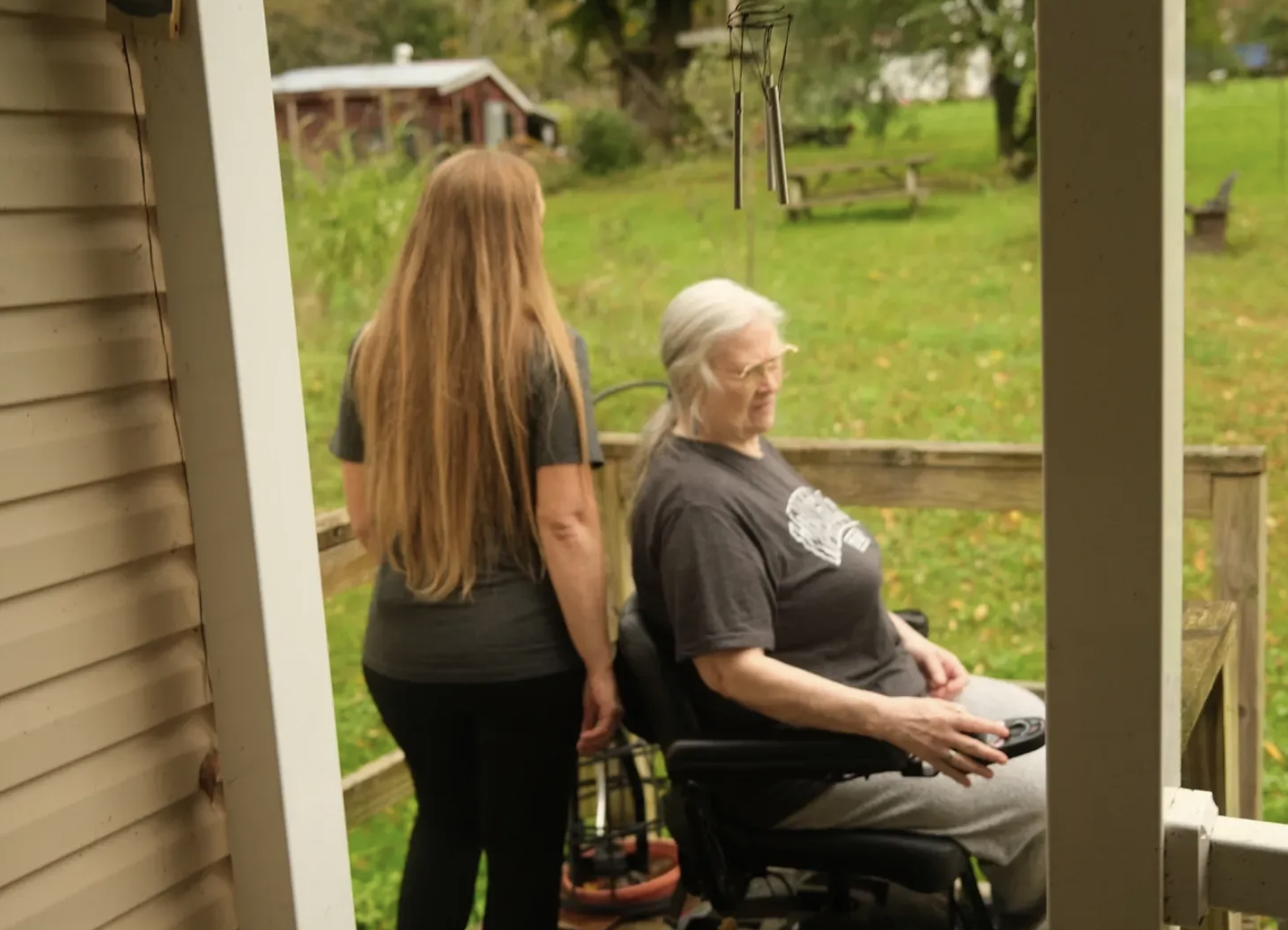
Cynthia Crandall, right, and her caregiver, Chris Pagano. (Credit: Matthew Herskowitz)
In 2002, Cynthia Crandall went to the hospital for what was supposed to be routine surgery for diverticulitis, an inflammatory bowel disease. But the operation went awry, leaving her paralyzed and wheelchair-bound. For more than two decades, she found a way to navigate around her physical limitations. But last year, a change in New York state policy that is aimed at reducing fraud has complicated her life, as her aide deals with slow payments and a labyrinthine customer-service system.
For 14 years after the surgery, Crandall’s husband took care of her, preparing her food and helping her with bathing and medical needs. He died suddenly in 2016, and without children able to take care of her, Crandall became reliant on home health care aides.
In 2016, she was introduced to Chris Pagano through another nurse, and for the decade since, Pagano has become what she calls her “guardian angel…. She’s more like my best friend,” Crandall said. “I totally trust her.”
But the past year has been a maelstrom of stress for the two: unpaid hours, abysmal customer service, and financial difficulties that have strained Pagano’s ability to care for Crandall the way she would like to.
Crandall is one of hundreds of thousands of disabled New Yorkers who rely on CDPAP, or the Consumer Directed Personal Assistance Program, which enables them to choose caregivers to take care of them at home rather than living in a nursing home or assisted care facility. For many years, Crandall paid Pagano seamlessly through Committed Home Care, an agency in upstate New York.
Then, in April 2025, Gov. Kathy Hochul swapped out the roughly 650 home-care agencies that handled CDPAP payroll and substituted a single company: Public Partnerships LLC (PPL), a private equity-backed home-care financial services company operating in 18 states. The state pitched the consolidation as a way to cut costs and fraud in the fast-growing program. In the process, it moved hundreds of thousands of home-care workers under one company in the first three months of 2025.
The switch was a response to rampant fraud. Between 2012 and 2018, the home-care industry exploded in New York, from 58 agencies to more than 600 – far more than any other state. Those companies had powerful incentives to sign up as many people as possible, and the results were disastrous: An audit in 2024 by the state comptroller found that New York had paid $14.5 billion in claims — 44% of all home-care claims that year — that couldn’t be verified. Meanwhile, civil and criminal Medicaid recoveries numbered in the hundreds of millions of dollars.
The state’s remedy was consolidation. James McDonald, commissioner of the Department of Health, told the state Senate in August 2025, “The transition to a single fiscal intermediary was crucial to ensuring long-term viability for the New Yorkers who rely on this care.”
The consolidation has been a success, according to PPL. In an interview with Columbia News Service, Tara Himmel, the partnership’s chief marketing officer, said, “ We have more history managing the program and more, frankly, claims information about people who elect the insurance. I think it’s looking positive, it continues to improve.”
But patients and aides say the transition has been rocky: Calls go unanswered, hours get cut, wages go unpaid. Last July, PPL agreed to settle a wage-theft class-action suit for $162 million for workers in New York City and Long Island.
Regarding the settlement, Bonnie Vaughn, PPL’s chief growth officer acknowledged no wrongdoing, “ Sometimes as a business, you have to make the decisions even though you know you didn’t do anything wrong. It’s very distracting and very costly to the organization,” Vaughn said.
The speed of the switch stirred controversy. Senate Health Committee Chair Gustavo Rivera, who represents District 33 in the Bronx, introduced legislation last year to stop the transition. The bill never made it past the Senate committee, leading Rivera to lament that “resulting service gaps will lead to unnecessary hospitalizations and may force many New Yorkers out of their communities and into more institutional settings.”
Hochul stood by the switch, and last January, 10 months after the program began, she claimed that more than $1 billion in annual savings. Some legislators were skeptical.
The state points to a concrete change: PPL’s administrative fee is $68 per patient per month, officials say, compared with as much as $1,000 a month under some of the old intermediaries. The Fiscal Policy Institute, a think tank analyzing government spending in New York, found about $500 million of the claimed savings did come from lower administrative costs, but said the source of the rest is unclear.
For some patients, the switch has meant fighting a confusing registration system, with tens of thousands unable to enroll just days before the April 2025 deadline, according to Politico.
Unresponsive customer service is a throughline in conversations Columbia News Service had with six patients receiving Medicaid-covered home care around the state. In a February press release, however, PPL touted a survey showing satisfaction with its customer service, with consumers rating the company 4.31 out of 5.
The move to PPL was difficult for Pagano and Crandall. Crandall’s insurance company sent a nurse to assess her one day in April 2025, while Pagano was working at another job. The nurse determined that Crandall didn’t need as much care as she was getting, and cut her billable hours from 54 hours a week to 30.
“That did a number on us financially, and 30 hours is just not enough to provide quality care, you cannot shower somebody every day a week, cook three meals a day, get them to their doctors, get them dressed, take care of their home,” Pagano said.
Pagano requested a hearing, but the state has a year to schedule one, “and they take that whole year,” Pagano said, referencing the hearing window. The hearing finally took place last April, and in early August – about 16 months after the nurse’s visit – Pagano’s hours were restored back to 54 hours a week.
Meanwhile, for reasons that are still unclear, Pagano stopped receiving paychecks entirely between June through mid-September of this year.
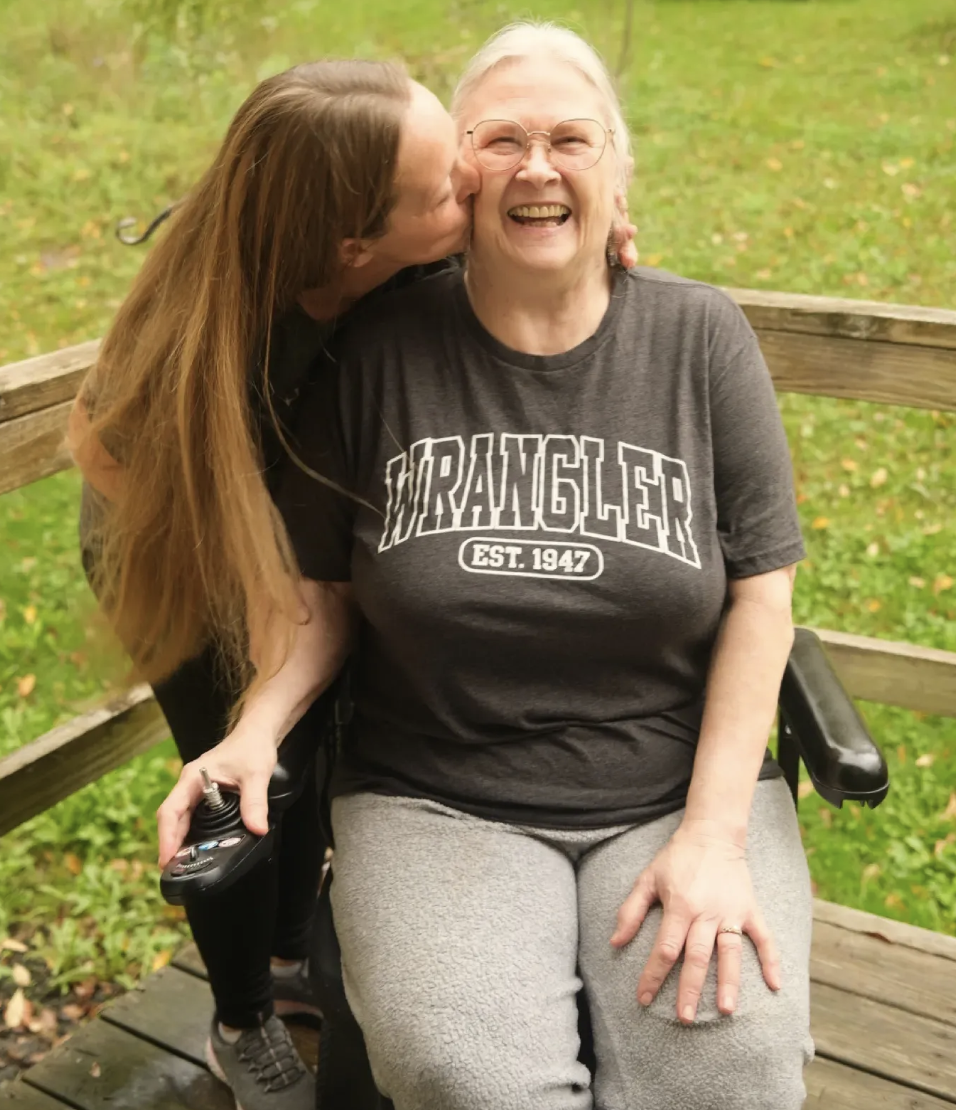
Pagano and Crandall (Credit: Matthew Herskowitz)
To continue caring for Crandall, Pagano said, she refinanced her Subaru Crosstrek and borrowed $5,000 from her mother and $3,000 from Fresh Air Manufacturing Company, where she worked as a retail manager. Though she began receiving checks mid-September (at the 30-hour rate), Pagano said she still hasn’t had her back pay restored.
Some patients and aides have had it worse, according to Caring Majority Rising, an advocacy group that represents home care workers and patients. Since PPL took over, the group says, 90,000 of the original 280,000 patients have left the CDPAP program, while 150,000 of the original 400,000 caregivers have also departed. (Some patients need multiple aides.)
PPL executives blame the difficulty in transferring enrollees on outgoing fiscal intermediaries that wouldn’t cooperate, and suggested that some of these companies told patients not to take part in the transition. “It was very abnormal to have companies actively advertising to their people that they are supposed to take care of not to participate in the program,” said Vaughn, adding that the timeline transition “was mandated by legislation, so it wasn’t adjustable.”
Vaughn also rejected the numbers Columbia News Service provided of caregivers who have left CDPAP since the transition, saying they were “not accurate” and that “there hasn’t been a huge drop-off in participation.” She argued no fair comparison was possible because there was “no central data point… to understand who the caregivers were before the transition.”
***
Allegations of withheld wages have been widespread. In the wage-theft suit that PPL settled for $162 million, home-care workers in New York City and Long Island sued over late, missing and underpaid wages. At the time, a spokesperson denied the allegations in the lawsuit, and said that the deal reflected no admission of wrongdoing. A similar lawsuit brought by caregivers against PPL for withheld wages is awaiting mediation upstate.
Hugh Baran, a partner at Katz Banks Kumin LLP, the law firm representing the plaintiffs in the PPL settlement, viewed it as a victory for homecare workers. “Part of what lawsuits like this can do is deter future conduct that people allege violates wage and hour laws,” Baran said.
***
T.K. Small, a 61-year-old disabled lawyer living in Brooklyn Heights, said that the cost of the transition shows up in his own bank account. Small has spinal muscular atrophy, a degenerative muscular disorder. While he was with Concepts of Independence, the home care agency that he used for years and once worked for as director of policy, new aides were paid to shadow his regulars and learn to use his ventilator, his tracheostomy and his cough assist. On certain holidays, aides were paid double time and a half, said Small.
Under PPL, basic training is typically paid, but T.K. says that the specialized training he provides his workers – for example, operating a Cough Assist, a machine for removing phlegm from his lungs – is not covered like it was under his old agency. So he covers the difference himself, roughly $5,000 a year by his estimate, up from about $1,000 before.
“PPL has made a complicated situation more complicated,” he said.
From his apartment in Brooklyn Heights, he recruits, trains, schedules and supervises his own aides. “I train them,” he said. “Not the union, not PPL, not some social worker for an insurance company.”
For now, his consulting business enables him to cover the costs of training himself. If his health or his income changes, he doesn’t know what will happen.
He doesn’t measure the program in savings or administrative rates. “The measure of whether my workers are doing the job is whether I’m alive or not,” he said. “If they don’t do the job, I’m dead.”
About the author(s)

Matthew Herskowitz is a journalist based in New York City with work featured in VICE, The Nation, Air Mail, Slate, GQ, and more.