




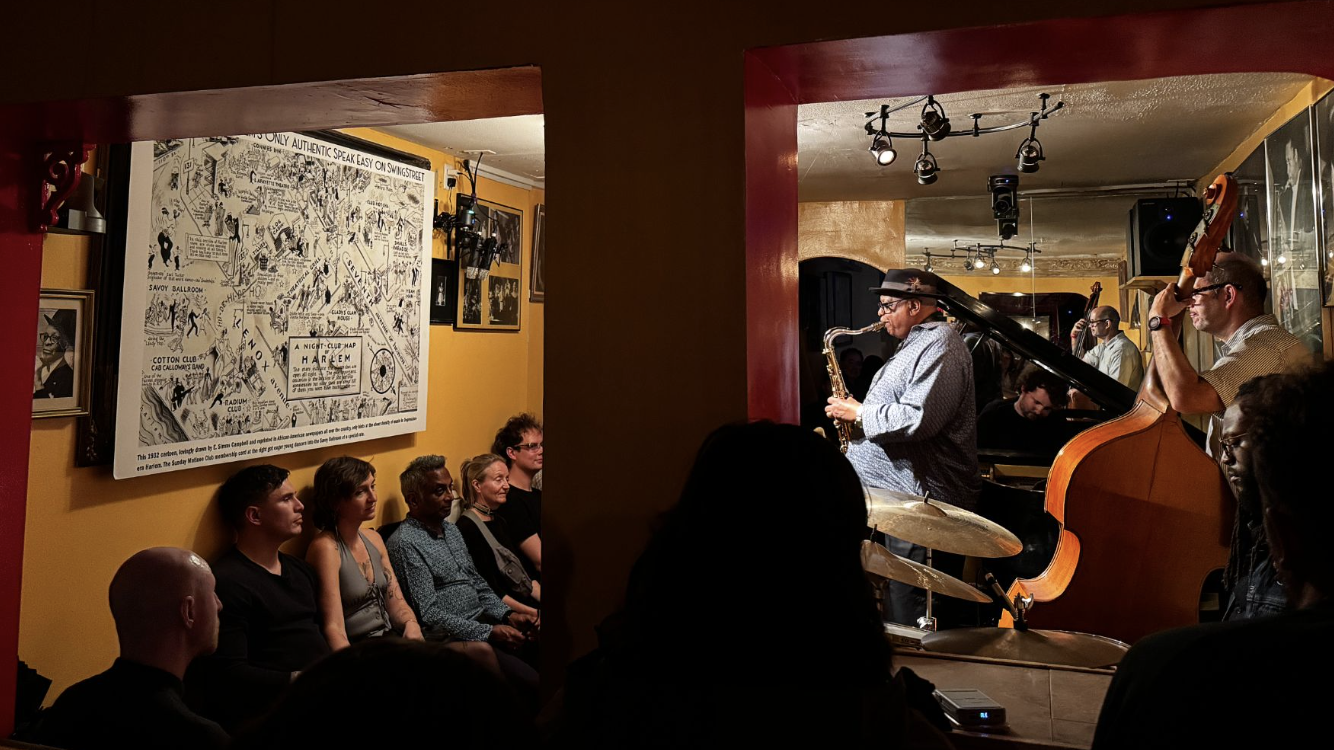
Bill Saxton plays the saxophone facing 1932 cartoon of Harlem streets replete with clubs. His is now the last authentic jazz club in the area.(Credit: Ana Federica Wallis)
It was 1958, the Golden Age of Jazz. On the steps of a Harlem brownstone, the giants of this uniquely American art form stood still just long enough to be captured by a camera. Count Basie, Dizzy Gillespie, Thelonious Monk. The photo became iconic, as legendary as the musicians themselves. And this past May, Sonny Rollins, the legendary saxophonist – in the photo, three rows back, to the right of the stairs – died, and with him, a link to the generation that built modern jazz. Rollins was the last surviving musician of that 1958 photo. He was 95.
Harlem is the place that pushed jazz into the world. Over the next several decades, musicians from all over the country, and the world, would come to study its language, but the historic night clubs where these musicians learned jazz have been disappearing for years: iconic venues like Lenox Lounge, Minton’s Playhouse, St. Nick’s Pub have all shuttered. The historic Baby Grand on 125th Street was replaced with a Krispy Kreme in 2020. Rising commercial rents have made operating a jazz club financially unworkable for most owners. Many musicians find themselves playing in restaurants now, venues where music is no longer the central attraction.
But one club in Central Harlem still runs on jazz alone: Bill’s Place on 133rd Street. Bill Saxton, a saxophonist, owns this red-walled room, which is big enough to hold 30 people at most. A small stage faces a map of neighborhood jazz clubs that no longer exist. Saxton’s club, where he performs every weekend, is the last one projecting jazz out onto Harlem’s streets.
When Bill’s Place opened two decades ago, admission cost $10 and it was a struggle to draw audiences. Now, Saxton says, the club pays for itself. “I wish more musicians would think of owning their own place,” he said. It’s not easy, but Saxton thinks it’s the best way to hand the music down.
“I feel a responsibility,” Saxton said, of younger musicians. “To teach them, to show them how to tell their stories so that when people walk away, they have something that goes with them.”
Yet, even as the historic club scene fades, the music continues to find other ways to reach its audience.
“It’s significant that the generation of innovators is gone,” said Will Glass, program director for the Jazz Foundation of America. “But what they created is a living, breathing entity that is very much thriving.”
Some 30 blocks north of Bill’s Place, in a building where Sonny Rollins spent part of his childhood, Marjorie Eliot has turned her living room into a jazz club of her own. Every Sunday for 35 years, it has filled up with jazz lovers from New York and across the world who come to hear her band play against a backdrop of old photographs and newspaper clippings that narrate the history of the room, and the country. “It was the highlight of our time in New York,” said James Cooper, a New Zealander visiting for the week. Somehow, despite having no advertising and accepting only donations, the room is never empty. “We don’t even know how they get here,” said Rudel Drears, Marjorie’s son. “But they get here.”
It isn’t just audiences, but musicians too, for whom the streets that gave birth to jazz still hold a special meaning. “I still play in Harlem, and I make it a point to play in Harlem,” said James Carter, a saxophonist. “There’s a movement that’s here, and as long as that’s happening, just like the saints going in, I wanna be part of that number.”
About the author(s)

Ana Federica Wallis is a Venezuelan journalist who is passionate about covering culture and politics.