




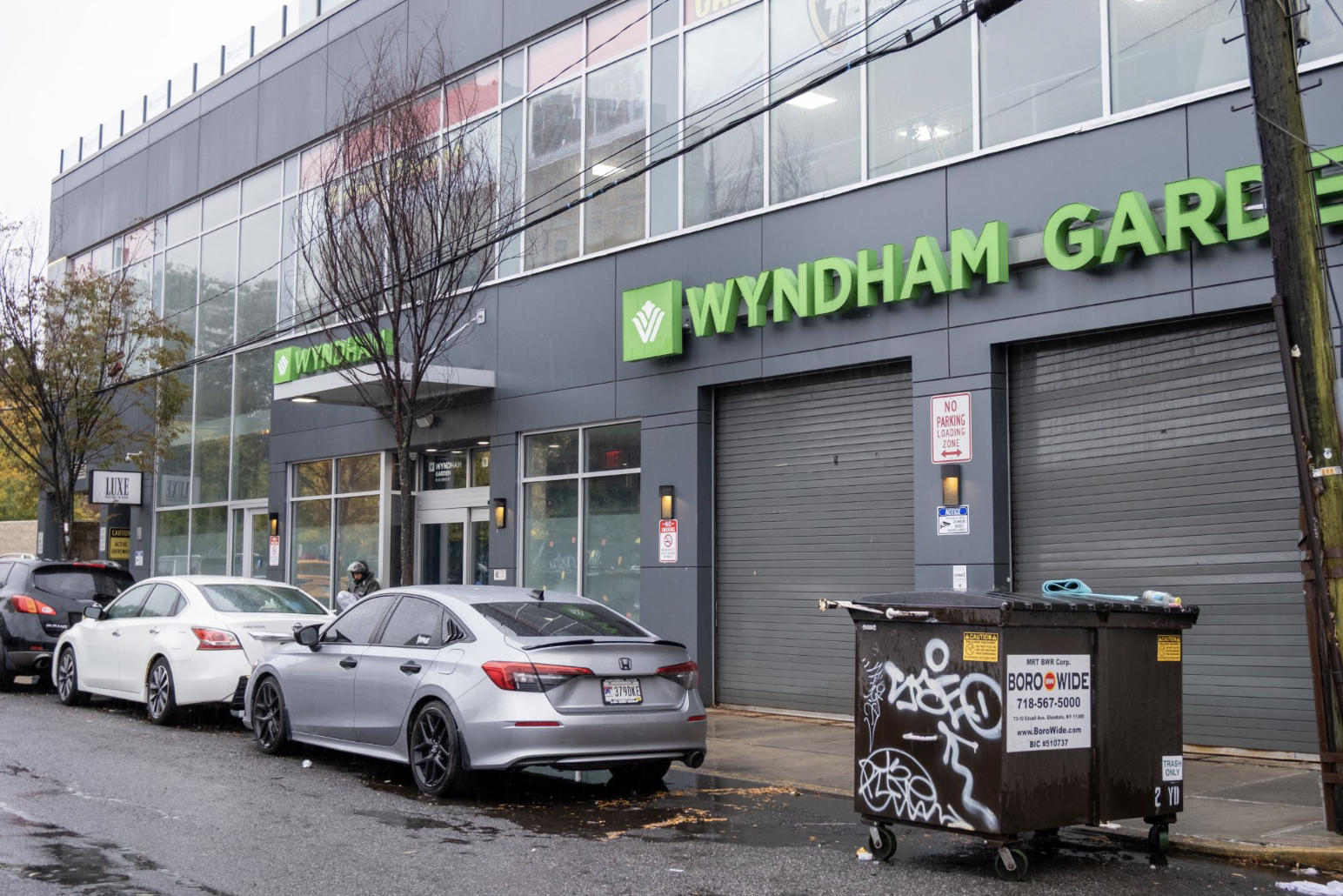
Wyndham Garden homeless shelter’s facade. (Credit: Francesca Di Muro)
At 61-18 93rd Street in Rego Park, Queens, the sign still reads “Wyndham Garden.” Until early 2024, the building was a hotel between JFK and LaGuardia airports, full of travelers who stayed a night and moved on. Now, the building houses 100 men who have nowhere else to go.
From the sidewalk, no one would ever know. Beside the entrance, a sign advertises the Luxe Bistro. Only inside, behind the obscured windows, does the building reveal what it has become.
In January 2024, the city announced it would turn the hotel into a shelter for 100 homeless men. Many neighbors said they had been given little warning, and in February they marched against it. The shelter opened anyway in March 2024, run by a nonprofit under contract with the city. More than two years later, the protests have faded, and so, in a way, has the shelter. No one walking nearby seemed to have heard of it. The fight over whether it should exist has given way to a quieter question: whom does its invisibility serve? An advocate says anonymity protects the men inside. Others wonder whether it also keeps away neighbors who might donate food and clothing, or simply offer a welcome.
Shelters sometimes face this kind of tension, said Sudhir Venkatesh, a sociologist and urban ethnographer at Columbia University. Everyone around a shelter, he said, is “nervous about different things.” Residents may worry that attention will expose the informal work they pick up nearby, while shop owners may worry that a visible shelter will drag down property values. Visibility can bring donations and support from neighbors, but also risky exposure.
Robert S. has lived at this shelter for a year and nine months (he asked that his full name be withheld, out of concern that being identified could affect his job and his housing). He works for the city’s parks department and hopes to rent an apartment in Queens by December, he said. “You have to find your own way out of here,” he said.
The nonprofit Community Housing Innovations runs the shelter for the city’s Department of Homeless Services under a $37.2 million contract that extends through June 2028, according to city procurement records. That is roughly $83,000 per bed a year, or about $227 a night.
It is one of 14 city contracts the company holds, worth $405 million in all, mostly for city shelters and housing services. The group presented the project to Community Board 6 in January 2024, promising three meals a day, weekly case management, job-search help and 24-hour security, according to meeting minutes.
Robert S. called the building clean but said services have declined: caseworkers for about 100 residents have dropped from four to two. The food isn’t very varied and the quality is low, he said, and men without jobs have little to fill their days.
What puzzles him most is the sign. “Every other shelter you pull up in the five boroughs, Bronx, wherever it is, it shows up. It says shelter. This one doesn’t,” he said. Robert S. would rename it the Wyndham Gardens Men’s Shelter. “I don’t see what’s the point of hiding.”
Fetima Perkins, a Rego Park resident whose mother lives in LeFrak City, across from the shelter, agreed. “Many people want to donate, but they can’t, since they do not even know the shelter is here,” she said. “It seems they totally try to make it invisible.”
Many shelter residents, Venkatesh said, earn money informally in the neighborhood. “A bodega might hire somebody who lives in the shelter for $5 a day,” he said, to stand outside and deter shoplifting. Neighbors know about these jobs, but outsiders don’t. “If we’re not in the neighborhood, we don’t see that economy,” he said. More attention could put these arrangements at risk, especially for workers afraid of losing their benefits.
Advocates worry about a different kind of exposure. David Giffen, executive director of the Coalition for the Homeless, wrote in an email that people living in shelters can face harassment and violence, noting that “there are, sadly, many people who hate the idea of shelters and who target people for being homeless.”
Many residents, he added, have disabilities or mental illnesses “that make them subject to victimization and discrimination.” Location matters, especially for women.
“A large number of women in shelters are fleeing domestic violence, and so it’s important to keep the location of shelters confidential,” Giffen said.
He also cited “newer concerns, like ICE agents who are looking for undocumented people in shelters.” Robert S. said immigration agents have already come to the shelter, “so the anonymity has not protected anyone,” he added.
That fear has grounds. Federal immigration officers entered city shelters at least 23 times between January and May 2025, up from none in 2024, Gothamist reported; at least five times, staff let agents in without a judicial warrant. Last year, City Council member Julie Won proposed a bill barring the city from publicizing the addresses of migrant shelters. It died without a vote.
Community Board 6 members see the shelter’s low profile as a sign it is working. Asked why so few neighbors know it exists, chairperson Salua Baida credited the residents themselves. “I think it’s because they have fit in as neighbors,” she said. District manager Christine Nolan said shelters don’t usually advertise themselves. But a review of 10 other shelters in Queens and the Bronx, drawn from a Department of Homeless Services building list, found that all of them are listed as shelters on Google Maps, while the Rego Park building still appears as a Wyndham Garden hotel. The Department of Homeless Services, which could say whether it has a signage policy, and Community Housing Innovations did not respond to requests for comment.
Byron Lopez of Rego Park United, who protested the shelter in 2024, remains opposed to the shelter. He said the neighborhood is unsafe, citing assaults and robberies. “All the things we feared before it opened have materialized,” he said. “This is not the location for an only-men shelter. And keeping the sign shows that they clearly know this as well.”
Neighborhood data offer a more mixed picture, though they cover the entire Rego Park-Forest Hills district, not just the blocks around the shelter. Serious crime there fell slightly after the shelter opened, from 7.4 per 1,000 residents in 2023 to 7.1 in 2025, well below the citywide rate of 12.3, according to NYU’s Furman Center. Violent crime did rise, from 1.4 to 1.7 per 1,000, its highest level since 2006.
Hiram Monserrate, a district leader who helped organize the protests, sees the old name as deliberate. “The city many times hides this, brings it up at the last minute because they don’t want the community to organize against it,” he said. “No one is against them,” he added. “Those men deserve an opportunity.”
Some motives are economic, Venkatesh said. Property-pricing algorithms “may value a property at a lower rate if they see a visible homeless shelter in the area,” he said, so local store owners may prefer the hotel label.
Deliberate or not, the invisibility has a cost. A sign that keeps opponents from organizing also keeps away the neighbors who might bring food, clothing or simply a welcome.
“Sometimes they donate food,” Robert S. said, “but if they don’t know, they can’t do anything like that.”
About the author(s)

Francesca Di Muro is an Italian data journalist working at the intersection of politics, economics and social justice.