




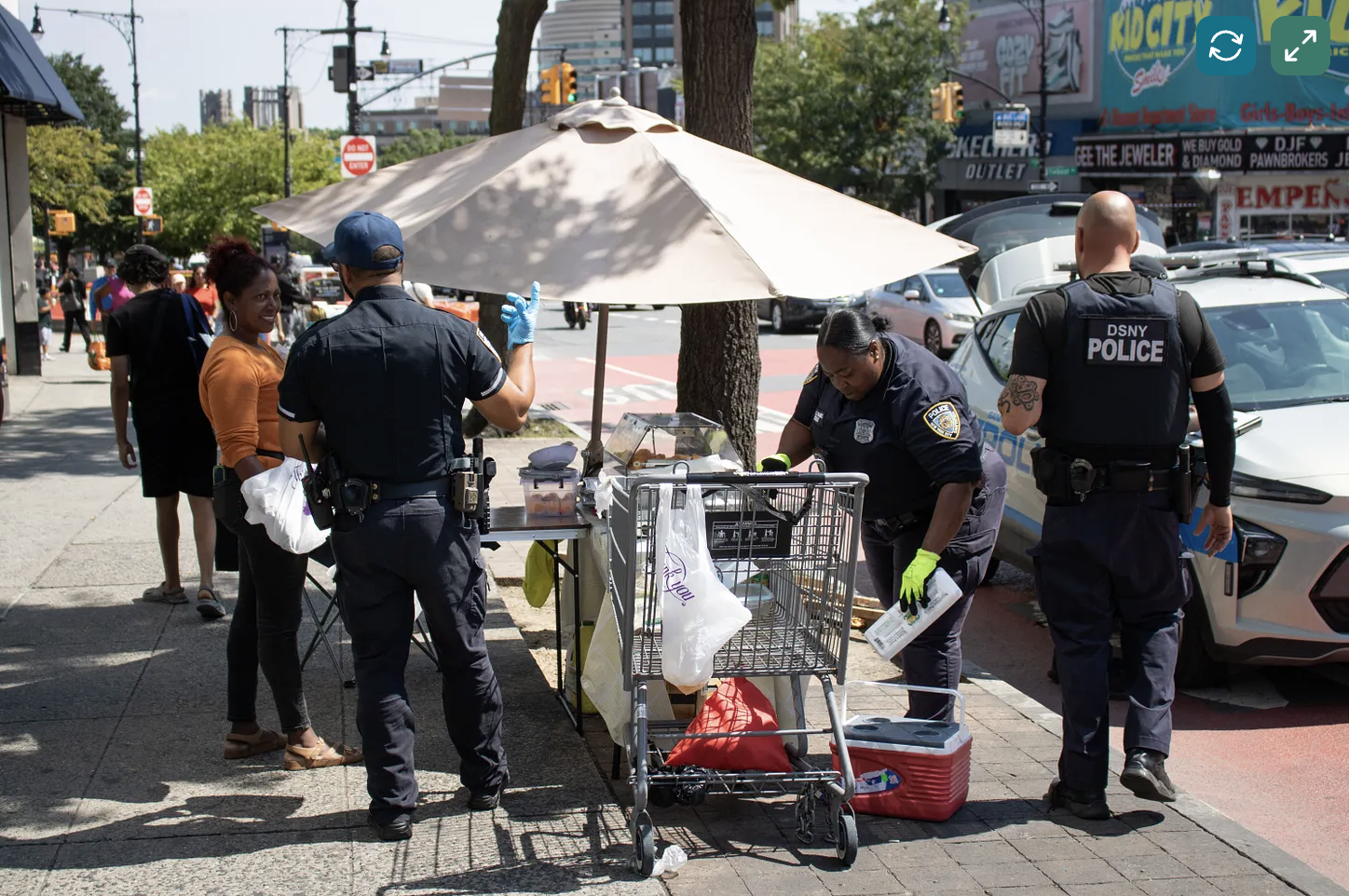
Sanitation police confiscate Vilma Guevara’s empanadas and arepas on September 3, 2026. (Credit: Nicole Williams Quezada)
Editor’s note: Quotes from vendors were translated from Spanish into English by the reporter.
The alert came in from Fordham Plaza, four blocks south. On a recent afternoon, vendors there warned in a WhatsApp group that Sanitation police might be headed north.
With that in mind, Vicente Veintimilla pulled a strap tight over the blue tarp on his cart.
“¡Cayeron en la plaza!” They came down on the plaza! He said it twice into his phone in the lilt of a pregón, the sing-song call vendors use to draw customers in, loud enough to cut through the wheeze of brakes releasing, the rumple of buses and people shuffling past.
Four blocks is enough.
Veintimilla was gone in 20 seconds, down a side street. Another vendor followed, dragging a plastic folding table while shoving bottles of deodorant and shampoos into black crates. Across the street, four vendors pulled their carts off Fordham Road entirely.
The messages kept coming through: “Vienen pa’riba!” “Nissan negro!” “Recojan, se van arriba!” They’re going up! It’s a black Nissan!, Pick up, they’re coming!
But back on Fordham Road, one vendor didn’t get away. Vilma Guevara had just begun selling empanadas and arepas two weeks earlier, and she wasn’t in the WhatsApp group.
Veintimilla left Ecuador 25 years ago. Now, he sells Crocs, tote bags and charms. He says he has been selling for eight years in the Bronx, without a license.
This year, for the first time in four decades, vendors like Veintimilla have a path to a license. A new waitlist for general-merchandise vendors opens in November, and the first licenses are set to go out in January. Some vendors have been waiting since 2016.
It isn’t the only change in the system. The city downgraded unlicensed vending from a misdemeanor to a violation in March, removing jail time and a criminal record. Meanwhile, enforcement has ramped up. In the Bronx, vending-related citations have quadrupled since 2021, while total citywide citations in 2025 were eight times higher than the number in 2021.
Until they can snag a license, these Bronx vendors rely on a WhatsApp group with 266 members. They report sightings of the city’s Department of Sanitation officers, who are empowered to enforce rules on vendors. The members send hundreds of messages a day, trying to give each other time to pack up before officials can ticket them or seize their merchandise.
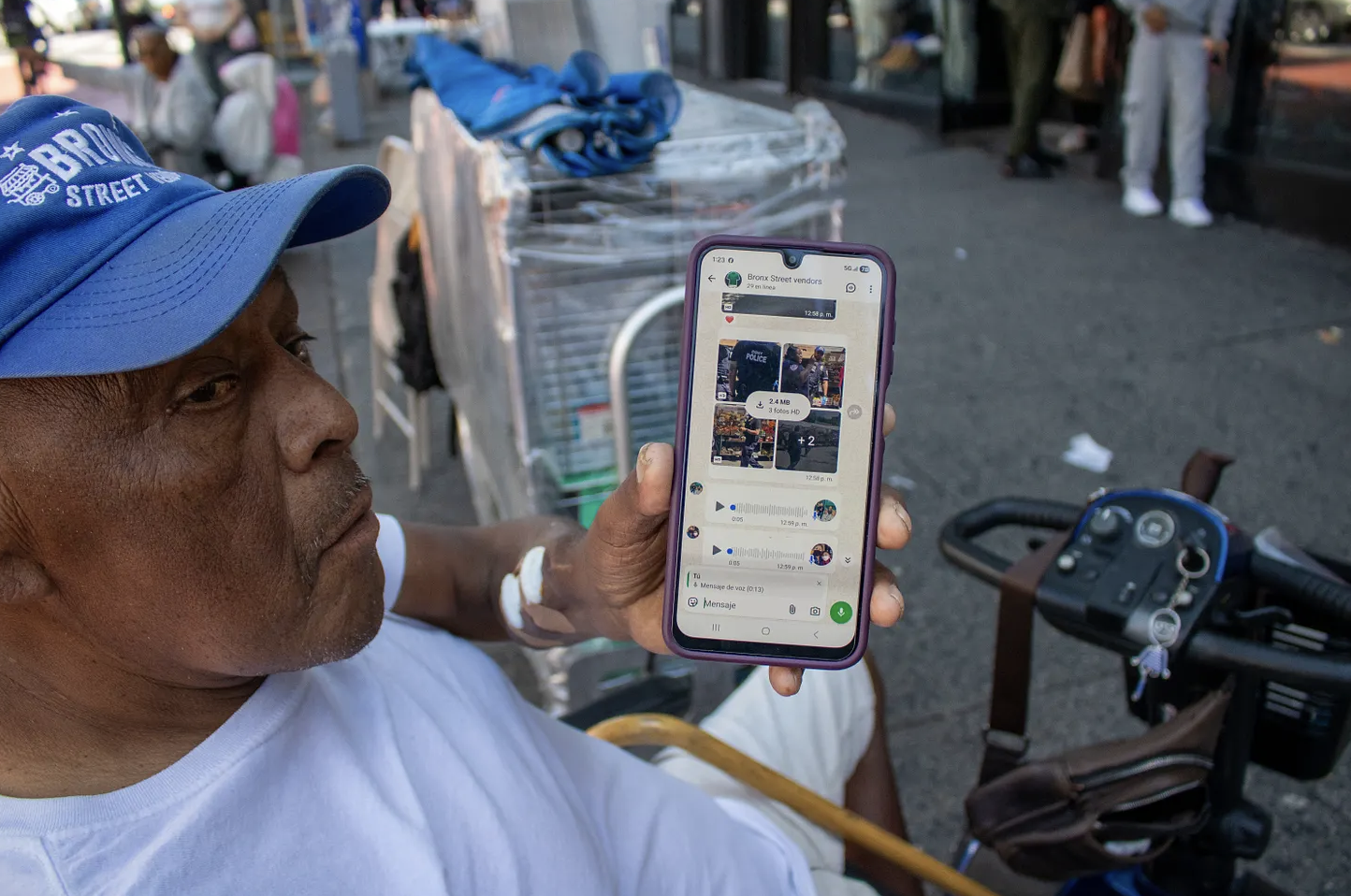
Armando Garcia shows the Bronx Street Vendors chat that alerts vendors, on Sept. 3, 2026. (Credit: Nicole Williams Quezada)
When a sighting comes through on this stretch of Fordham Road, Armando Garcia, a disabled vendor, is often the one who goes to check. He moves along the corridor on a motorized cart and will verify a license plate or ask inspectors why they are there.
Garcia doesn’t have to worry. He sells coins, comic books and foreign currency – items that are considered First Amendment materials, for which he does not need a license to sell.
The WhatsApp group “is the only weapon we have to continue to put bread on the table,” said Veintimilla.
Guevara, who didn’t know the WhatsApp group existed, watched as officers confiscated her things.
She said she moved to New York from Colombia two years ago and began selling corn empanadas and arepas for $3 each. “I saw an opportunity to work for myself, and to help my family,” said Guevara.
She had no license or permit to sell food.
Guevara said the Sanitation officers gave her two options: She could get a ticket and then retrieve her items at a Brooklyn impound lot. Or she could forgo the citation, but also watch as her food, a cooler and a $150 portable stove get confiscated. She opted to take the loss and no ticket.
The Sanitation Department has been the city’s lead agency on street-vendor enforcement since April 2023, when former Mayor Eric Adams moved that authority away from the Department of Consumer and Worker Protection. At the time, Adams called unregulated street vending a quality-of-life concern, citing the need to keep sidewalks clear.
Vincent Gragnani, a spokesperson for the department, said in an email that Sanitation officers enforce vending laws to ensure cleanliness and pedestrian access. Many enforcement actions are in response to complaints and community feedback, he said.
Mario Silvas, manager of a Beauty Zone shop on Fordham Road, said vendors often take up more space than they should, interrupting pedestrian traffic and cutting into the store’s business.
“They sell the same things we do–and cheaper,” said Silvas, who has worked at the Fordham Road location for 30 years.
Mike James, manager of nearby Magic Sneakers, said that some vendors close to his shop sell counterfeits, while his store does not. But he thinks his customers can spot the difference, so he doesn’t see the vendors as competitors.
Vending-related civil citations in the Bronx have surged over the last five years, from 91 in 2021 to 387 last year, according to city data. Through Sept. 27 of this year, the borough has already recorded 371 citations. Citywide, vending-related citations reached 11,093 last year, more than eight times the figure in 2021.
Garcia has seen the enforcement uptick. In 2024, an officer wrote Garcia four summonses within 11 minutes, ranging from a $25 violation for vending near a crosswalk, to an unlicensed vending charge carrying a maximum penalty of $7,750.
Garcia said he did not attend the hearing due to a medical emergency and hasn’t paid the fines. Each summons contains the same warning: If he does not pay, he might lose his ability to get a city license.
While citation data reflect one part of the picture, vendors say that Sanitation sometimes treats them the way Guevara says she was treated: They may seize merchandise without issuing a ticket. Those seizures generate no summons and don’t appear in city data.
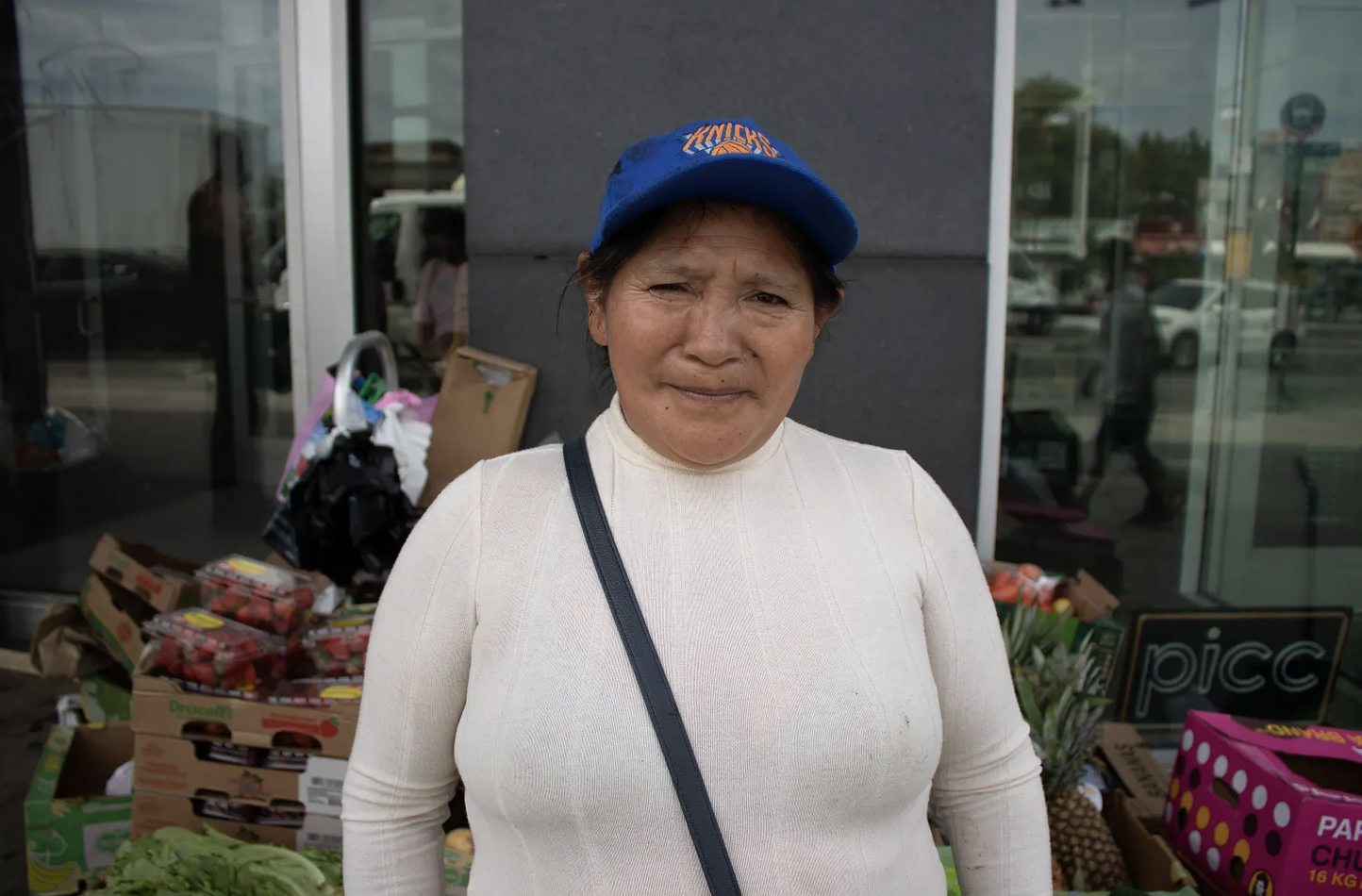
Maria Chimbo on Sept. 10, 2026. She said she has sold produce in the Bronx for three years without a license. (Credit: Nicole Williams Quezada)
Maria Chimbo said she has never received a ticket in her three years selling produce, but estimates that she has lost more than $30,000 in fruit and equipment from seizures during that time. Sanitation has taken 10 of her rolling carts, she said, each worth around $400.
Gragnani said that officers usually first give warnings, then issue summonses and finally confiscate items when setups are found abandoned or when vendors decline to provide an ID. Confiscated material is tracked, he said.
But Guevara was standing with her cart when officers took her stove and cooler. Chimbo said she has also been present each time sanitation took her carts.
Chimbo moved to the city three years ago from Ecuador, after her husband died. She recalled one day last year when her grandmother was in the hospital — a day that Sanitation came and confiscated everything.
“That day they took the most from me,” said Chimbo, her voice loud and fast. She was not able to send any money home that day.
“They treat us like criminals,” Chimbo said. “I’m tired of the constant looking side to side, to see if they’re coming.”

Vicente Veintimilla on Sept. 10, 2026. (Credit: Nicole Williams Quezada)
Veintimilla and Chimbo hope to get on the waitlist for a license in November, and Guevara has begun the process of getting a mobile-food license.
During the legislative process to expand vending licenses, Gragnani said, the department was clear that an increase in licenses should be matched by an increase in enforcement resources. He said that Sanitation has hired additional officers to inspect vendor setups for compliance.
“We don’t want Sanitation to stop coming,” said Veintimilla. “We want there to be understanding. Many of us have never been able to get a license.”
Until then, the Whatsapp group will be active.
About the author(s)

Nicole Williams Quezada is a bilingual journalist and M.S. candidate at Columbia Journalism School's Stabile Center for Investigative Journalism.