




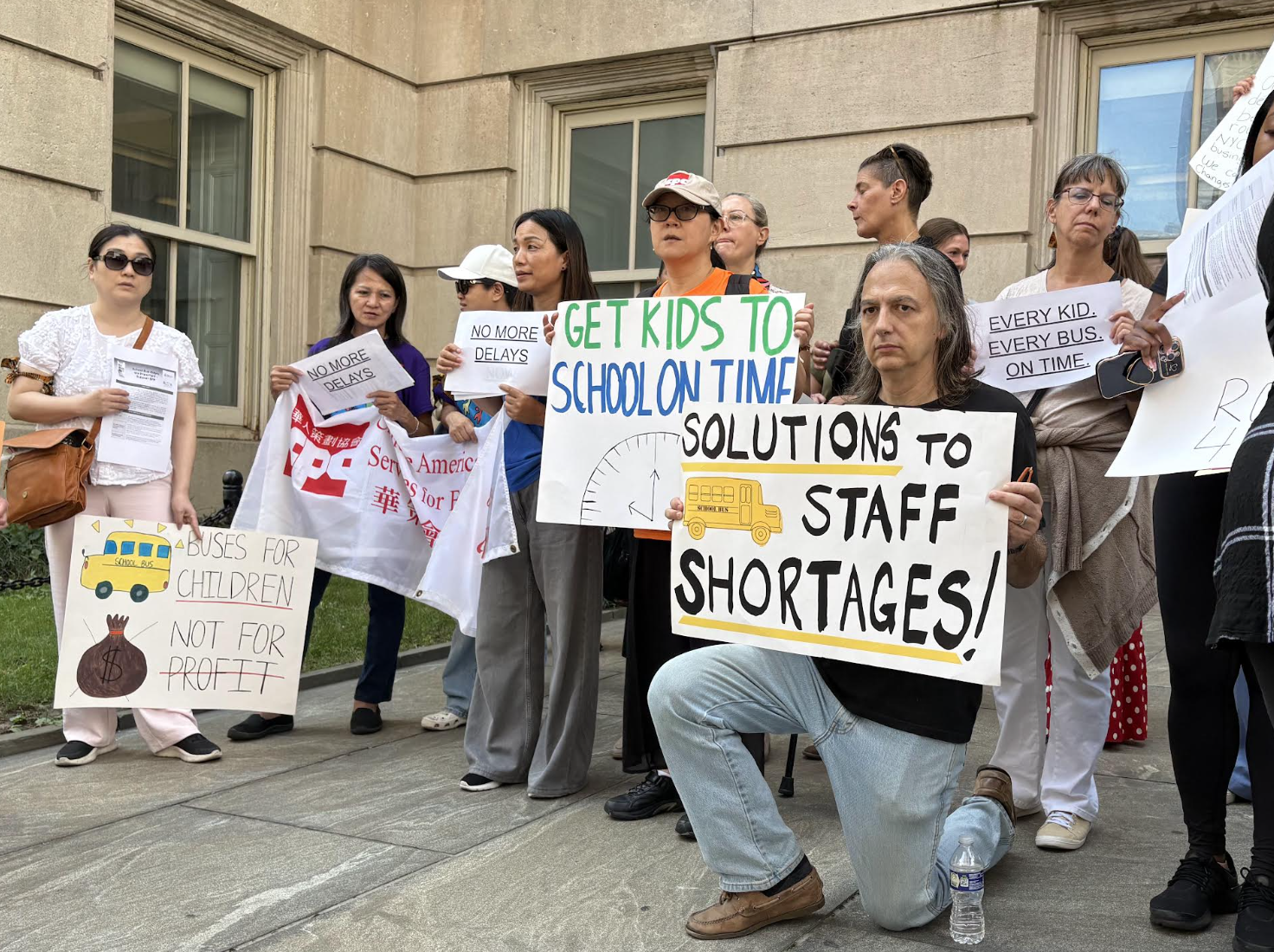
Three dozen parents and advocates call for better school transportation outside Tweed Courthouse on Thursday, Sept. 17. (Credit: Theo Scheer)
The school bus is part of a carefully maintained morning routine in Cathy Moss’ family. Knowing that her 11-year-old son, Stefan, who is nonverbal and autistic, won’t go to school any other way, Moss made sure to call the bus company in advance to confirm they were on a route this year.
But on Sept. 10, on what should have been Stefan’s first day at a new special education school in Bellerose, Queens, the bus didn’t show up at their home in Fresh Meadows at the scheduled pickup time. It wasn’t there 15 minutes later, either. Or 30.
After an hour and 15 minutes, she told Stefan to take off his shoes. He wouldn’t be going to school that day. Stefan, upset, repeated the word “bus” over and over.
Moss, who has since been assigned a bus, is one of many New York City parents who had to work around delays, cancellations, and no-shows during the first week of school this year. It’s a perennial problem in New York City, where 145,000 students, including 65,000 with special needs, rely on a network of contracted private busing companies to get to class. But this year, as federal directives on immigration shrink the available pool of drivers authorized to work, some parents say it was worse.
When asked, the city did not provide data on how many students are currently without a bus route, only that the “vast majority” are now routed. But Isabella Rieke, senior communications manager for Advocates for Children of New York, which has been in contact with the New York City Department of Education (DOE) about the issue, said the organization’s understanding is that “hundreds of students are still waiting for bus service.” That’s an improvement from when the school year officially started on Sept. 10 and thousands were without a route, she said.
The city has been scrambling to fill the gaps. Since the school year started, DOE officials say they have hired over 90 new drivers, purchased an additional 20 buses and 10 vans, and reduced waiting times for calls to the department to an average of 11 seconds. Logan Bus Company, a major school bus provider, also increased its capacity and took on over 132 additional routes this year, according to owner Michael Tornabe.
“We are working around the clock on immediate fixes including procuring additional buses and training new drivers, and are also working toward long-term solutions, so that families are not facing these same challenges year after year,” Dominique Ellison, associate press secretary at the DOE, said in a statement.
The city is offering affected families OMNY cards and vouchers for rideshares. But children with special needs aren’t always able to use city transit alone, and many working parents can’t accompany their children on a rideshare, as they are required to do.
Noah Popp, a lawyer, requested a rideshare from the school after his 8-year-old autistic son’s school bus was abruptly canceled days before school started. But the car picked them up minutes before class started and they arrived half an hour late, he said.
Popp ultimately did get a bus assigned for his son, but the route doesn’t start until Oct. 7. For now, they’ll take the subway, he said.
The pickup time for Gina D’Ambra’s 9-year-old daughter this year was originally set to 6:15 a.m. to account for increased capacity on its route from their home in Brooklyn to a special education program in Staten Island — too early for any child, but especially hers, she said. Long commutes can trigger D’Ambra’s daughter, who has epilepsy, an intellectual disability, ADHD, and autism.
“I don’t want any seizures happening,” said D’Ambra, a teacher. “God forbid.”
She had been compensating a family member to drive her daughter before learning that the pickup time would be pushed back. Even still, she said it was “pathetic” it took so long.
Buses serving special education students, which pick up each child directly from their home rather than from stops, consistently face transportation issues, according to a 2022 report by the City Council. In June, the advisory group Citywide Council for District 75 —a district serving children with special needs— released a survey conducted between 2023 and 2026. In the study, a third of parents reported their child missing school because of “no bus pickup or no service.”
At a news conference outside Tweed Courthouse on Sept. 17, more than three dozen parents and advocates backed state legislation they say will ease the issue by letting the city renegotiate decades-old contracts directly with bus companies. But the bills —which, in their current form, don’t have the backing of the bus workers’ Amalgamated Transit Union Local 1181— wouldn’t take effect for years, and a similar effort was vetoed in 2020 by former Gov. Andrew Cuomo.
It’s “unconscionable” to put more strain on families of neurodivergent children, said Eric Black, a children’s TV producer whose 18-year-old son’s special education school started earlier this month. It was two weeks into the school year before a bus was assigned, Black said. He had to cancel a trip to see friends so he could drive his son himself.
Janiece Cogle, a stay-at-home mom, said she had to walk her 6-year-old son 14 blocks to school last week after the bus didn’t show up on time. Her son is autistic and doesn’t take well to changes in routine, she said. As Cogle explained the situation during a phone interview, her son overheard the word “bus” and let out a cry.
“See?” she said.
About the author(s)

Theo Scheer is a master's student in the Stabile Center for Investigative Journalism at Columbia University. He graduated from Michigan State University in May.