



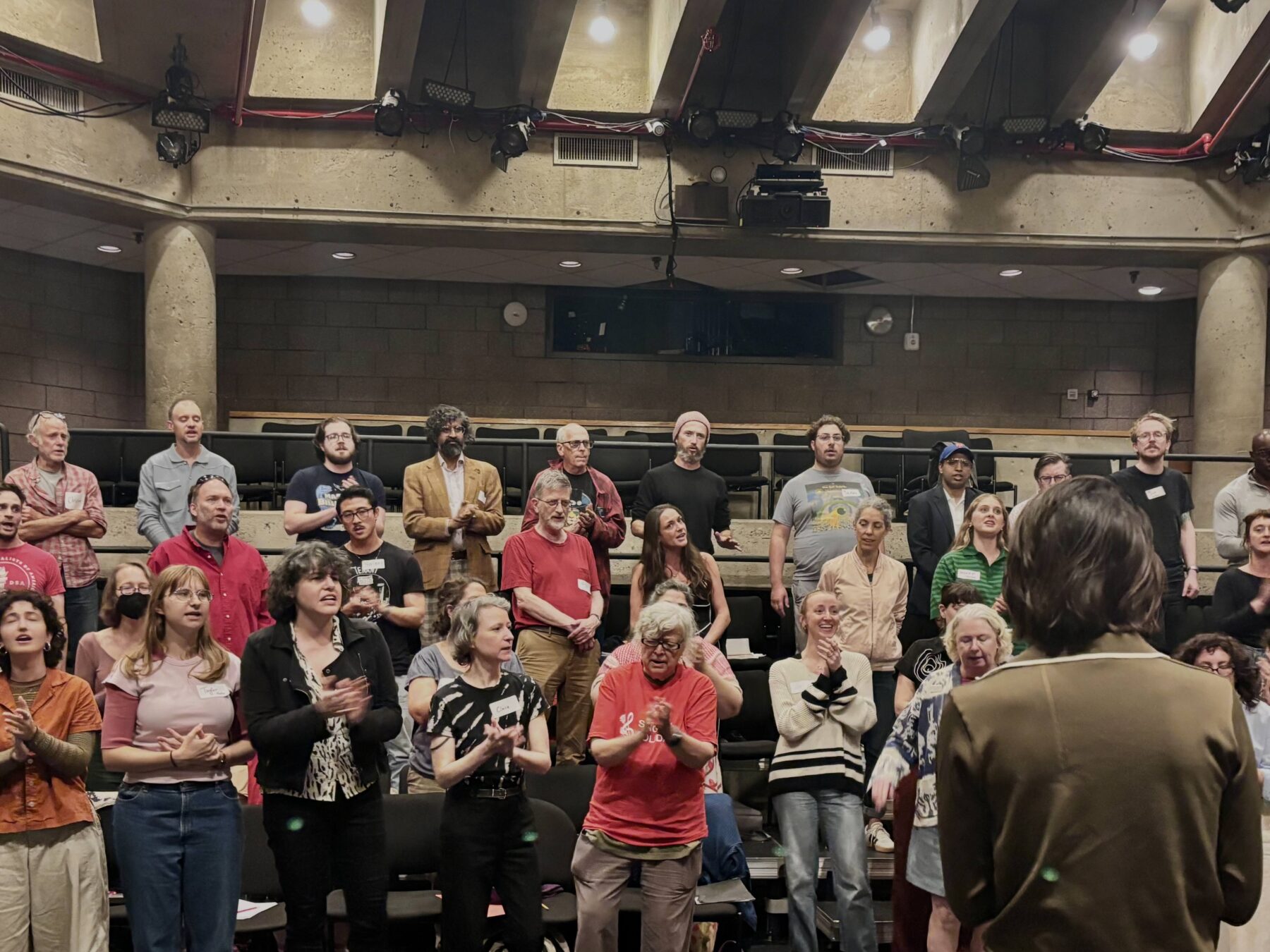
The Sing in Solidarity choir performing “When the Saints Go Marching In”, September 2026. (Credit: Sarah Moran)
If passersby overheard the muffled tune from the street outside, they might be confident they knew the lyrics. But in the basement of Abrons Arts Center on the Lower East Side in late September, 50 people sang “When the Saints Go Marching In” with new lyrics, cycling through choruses of “When the revolution comes,” “When Palestine is free,” and “When there’s healthcare free of charge.” At a rehearsal for Sing in Solidarity, the growing choir of the New York City branch of the Democratic Socialists of America (NYC-DSA), the tradition of political organizing through song was marching on.
“Pretty much every left-wing struggle that’s ever existed has had some sort of artistic or musical expression,” said Pablo O’Connell, the choir’s music director. Many pieces in Sing in Solidarity’s repertoire come from the Little Red Songbook of the Industrial Workers of the World (IWW), a labor union founded in Chicago in 1905. When the Salvation Army’s brass band competed with the IWW’s street corner labor protests, union members invented radical parodies of the band’s tunes so their protests could not just be heard over the music, but would be accompanied by it. American labor songs were revived and popularized in the 1940s by musicians like Pete Seeger and Woody Guthrie, and in the 1950s and ‘60s, the Civil Rights Movement practiced collective singing with protest songs including “We Shall Overcome” and “We Shall Not Be Moved.”
While the choir’s mission statement suggests a recent decline in political singing in the U.S. due to “years of austerity and right-wing backlash,” Sing in Solidarity co-founder Annie Levin said that the group has been bringing the tradition “roaring back to life” since its inception in 2018.
At the choir’s second rehearsal of the season, organizers added new chairs to the front row to accommodate the growing group. The choir broke into four vocal parts – sopranos, altos, tenors, and basses – and O’Connell led the members through a warm-up. O’Connell has sleek black hair past his chin, a moustache, and an easy command of the room despite his slim stature. He looks the part of a revolutionary leader: if a new arrival entered as a non-singer or non-socialist, he gives the impression that could sway interest in both.
Before each song the choir sang, O’Connell provided some brief historical context. “El Derecho de Vivir En Paz,” for example, was written in 1969 by Chilean leftist Víctor Jara in protest against the Vietnam War. O’Connell has added new verses to commemorate Refaat Alareer, a Palestinian poet killed in an Israeli airstrike in 2023.
After O’Connell clarified the harmonies and Spanish pronunciation, a choir member jumped in. “Can I just make sure everyone knows who Víctor Jara was?”
She gave a rundown of Jara’s activism and murder at the hands of Augusto Pinochet’s military in 1973, and another choir member added that Jara’s fingers were broken during his torture. She suggested that his power to resist the military was rooted in his ability to create music. With this idea hanging in the air, the choir launched back into the song with full piano accompaniment; the rendition was rousing, imbued with the confidence that music can be a powerful force of resistance.
According to sociologist Daniel Faber, co-editor in chief of the journal Capitalism, Nature, Socialism, music is “the heartbeat of any popular democratic movement.”
“It brings movement participants together into a larger community working for a common cause,” he said. “In this respect, music provides the ‘glue’ that binds us to one another – creating a shared identity that compels us to act as one.”
Sing in Solidarity’s leaders are aware of this binding power.
O’Connell said the choir is “kind of like a microcosm of what organizing a political movement is. Everyone has to do their own thing and excel in what they’re good at and also work together to be part of something.” What’s more, he added, “Especially around the world, left-wing movements have choirs because singing is a very accessible form of music making.”
Earlier this year, singing as a form of mass protest boomed in Minneapolis in the wake of Renée Good’s killing by U.S. Immigration and Customs Enforcement agents. Days after her death, a handful of local activists formed Singing Resistance to protest ICE through song. They were soon joined by hundreds of people who wanted to voice their objection to ICE raids in this collective and peaceful way. Today, more than 300 Singing Resistance groups are in operation nationwide.
Sing in Solidarity offers New Yorkers a chance to participate in this revived tradition of uniting through song. Socialist ideas, which are focused on universal healthcare, affordable housing, and strong unions ahead of the midterm elections, might still be seen as a taboo in some of the U.S., but in a Sing in Solidarity rehearsal they’re the norm.
While some members boast a deep knowledge of socialism and greet one another as “comrade,” attendance is open to all, regardless of singing ability or political affiliation. Levin noted that Sing in Solidarity can be an entry point into socialism for some attendees.
“We have had a number of people who showed up because they like to sing and they like the people, who then became socialist,” she said. “So it really is a radicalizing space.”
Beyond the historical context of the repertoire, discussion in the rehearsal primarily focused on the immediate task at hand: singing. During a run-through of the socialist anthem “Solidarity Forever,” someone asked O’Connell to clarify whether they should pronounce it “solidari-tee” or “solidari-dee.” O’Connell decided on “solidari-dee.” An English-language rendition of “Solidaritatsleid,” a working-class revolutionary song written by Bertolt Brecht toward the end of the Weimar Republic, inspired the most questions from the singers, who wanted to know which lyrics were to be sung staccato, and wanted to make sure everyone was coming off the final note accurately.
Since President Donald Trump’s reelection at the end of 2024, membership to the DSA’s New York branch has doubled. Over the course of DSA-member Zohran Mamdani’s campaign for New York City mayor, membership in the organization nationwide similarly spiked from 50,713 to 92,912.
Faber said that repeated failures associated with neoliberalism and authoritarian right-wing populism are changing the way Americans view democratic socialism, a system, DSA’s website states, in which “ordinary people have a real voice in our workplaces, neighborhoods, and society.” In opposition to the exaltation of corporate and finance capitalism, the movement favors radical reforms like single-payer healthcare and a Green New Deal.
“An increasing number of Americans have lost their faith in both political parties, and are looking for a new path forward,” Faber said. “For many, DSA and democratic socialism presents an opportunity for their voices to finally be heard, and for their concrete material needs to be met.”
Ballots for the midterm election in New York list several DSA members, including New York City congressional candidates Claire Valdez and Darializa Avila Chevalier.
“For the general election, there’s some enthusiasm, everybody’s going to go vote,” Levin said. “But it’s a done deal in New York City for the most part.” The building momentum of the DSA is instead directed toward a potential 2028 presidential candidate, Levin said, as DSA-member Alexandria Ocasio-Cortez weighs up a bid for the White House.
The choir stood up for the first time to sing “When the Saints Go Marching In,” the last song of the rehearsal. It sounded unlike any of the others the choir sang that night, as the members’ voices were fueled with passion and intention. Singing as a group doesn’t just sound good, it feels good, with studies showing that collective music making improves social bonds and feelings of connectivity. The good news for Sing in Solidarity is that those positive feelings are even more apparent at scale, so as membership continues to grow, the more powerful their collective voice becomes.
About the author(s)

Sarah Moran is a journalist specializing in arts and culture currently pursuing an MA at Columbia University's Graduate School of Journalism.