




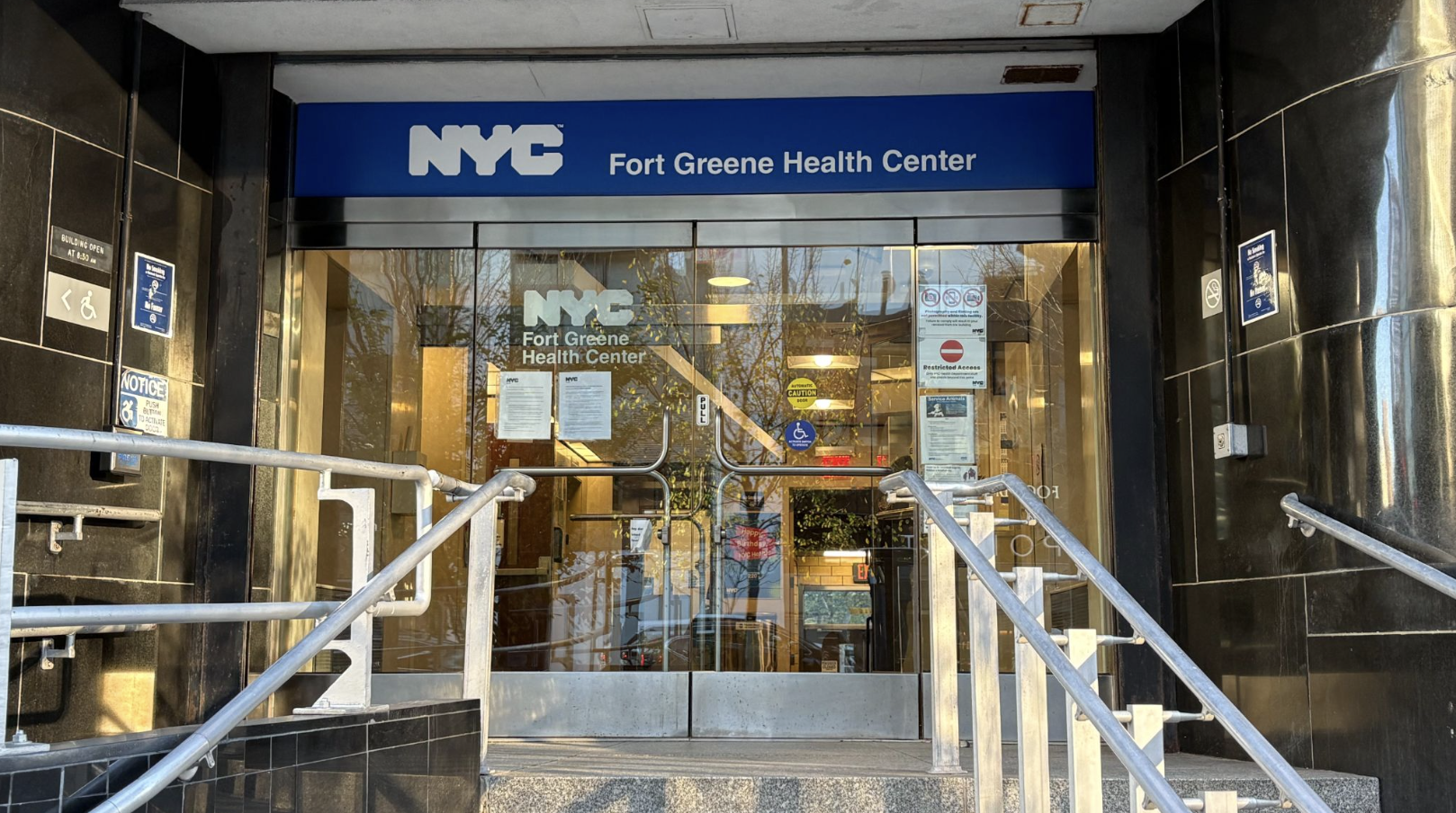
Fort Greene Health Center, one of the remaining city-run sexual health clinics in Brooklyn. (Credit: Suchita Thepkanjana)
Justin Miller, a Crown Heights resident, had a simple errand six months ago: get a sexually transmitted infection (STI) test, ideally at a free clinic within walking distance. Such a clinic, he discovered, did not exist. His choices were an expensive nearby medical center or a low-cost clinic almost three miles away.
Miller opted for the medical center, where he said he was charged $300. He has not been back. “I just stopped looking in Crown Heights,” he said. “I wouldn’t roll the dice again.”
Three low-cost or free sexual health clinics have closed within the last five years in and around Crown Heights, neighborhoods that have some of the city’s highest rates of chlamydia, gonorrhea, syphilis, and HIV.
“It used to be the Bronx, and now Brooklyn is infected, so you know something is wrong,” said Paulette Murray, senior health educator at the Caribbean Women’s Health Association. The problem “is not getting any better.”
The city health department’s most recent data, which are from 2024, show that Bedford-Stuyvesant and Crown Heights rank fifth, seventh, and eighth out of 46 areas in gonorrhea, chlamydia, and syphilis prevalence.
According to calculations based on prevalence data and census data, this means that roughly 2,730 residents may have been diagnosed with gonorrhea, 4,584 with chlamydia, and 340 with syphilis. Left untreated, these diseases can lead to pelvic inflammatory disease, infertility, and, in the case of syphilis, mental illness.
Bedford-Stuyvesant and Crown Heights also had the city’s fifth highest rate of new HIV cases in 2024: between 118 and 186. Without treatment, HIV can be lethal.
These STI rates have remained constant since 2022. Some health professionals said the high rates could reflect, in part, the lack of affordable sexual healthcare.
“I definitely think that the closing of facilities that provide free or accessible services definitely contributes to STI rates,” said Said Jasmiry Encarnación, case manager at Brooklyn Plaza Medical Center. “It’s one of the social determinants of health, where people are struggling to get access.
The city-run Crown Heights Sexual Health Clinic closed during the COVID-19 pandemic, and has not reopened. At a June meeting, health commissioner Alister Martin declared reopening the clinic a top priority, but there have been no updates.
According to Rachel Vick, health department Assistant Press Secretary, said decisions about reopening each clinic are “based on feasibility and need,” and that the department is continuing to “discuss and assess options that could serve the Crown Heights community.”
In April last year, two clinics in Fort Greene and Brownsville run by nonprofit Public Health Solutions closed as well. This was due to “chronic staffing shortages, increasing operation costs, and reductions in critical funding” from state and federal sources, said the company’s Ivy Fairchild in a press release.
The three clinics provided contraceptives, and STI testing and treatment to lower-income individuals.
Encarnación said that low-cost STI clinics are few and very dispersed, requiring patients to travel for treatment. There are currently eight city-run sexual health clinics—the only two in Brooklyn are in Fort Greene. Of these eight, two are “express clinics,” which are exclusively for routine STI testing but do not offer consultations or treatment. This is down from nine sexual health clinics in 2017, according to the New York City Health website.
Searching “low-cost sexual health clinic” in Google Maps shows that the nearest option for Crown Heights residents is in East New York, more than two miles away. While medical centers exist in the area, they may charge much higher prices—as Miller discovered. This can mean that residents have to spend more to travel less or spend less and travel more.
Miller, 36, had opted to stay local, and pay more. Now, he takes the train to a clinic near Barclays Center whenever he needs a routine check-up.
Former Crown Heights resident Samuel Lin-Sommer, 31, chooses to “schlep” to downtown Brooklyn, where he said more affordable choices are available.
For many residents, travel could deter them from getting sexual healthcare at all. “If I’m someone who lives [here], why would I go…someplace else to get tested? So I just give up,” said Murray, the educator with the Caribbean Women’s Health Association.
Patients might then abandon preventative care or only seek treatment when their infections are severe, said Samuel Friedman, a professor at New York University.
According to experts, receding healthcare in areas that need it most is common. Although rates of STI have fallen nationwide for three consecutive years, they remain high in many underserved areas.
Friedman and fellow NYU professor Maria Khan said that minority communities have the highest STI rates and the fewest public health services. The Crown Heights population is about 40.8% foreign-born and 51.9% Black, according to the Furman Center.
“It’s a historic pattern,” Friedman said. “Those are always the areas that are gonna be cut first…It’s a brutal process, and the people who are making these decisions often don’t care very much.”
Reluctance to seek care can be amplified by additional factors in some areas, such as cultural stigma, said Khan.
Crown Heights has a Caribbean diaspora, with Jamaica, Trinidad and Tobago, and Haiti being the most common birthplaces of foreign-born residents. According to Encarnación, Caribbean culture can have strict rules and shame associated with sexual activity that may make some people “less likely to seek medical care [for] STDs and STIs.”
Murray, who is from Jamaica, said many Caribbeans, especially from older generations, do not talk about sexual health, which makes the presence of local clinics even more important. “What’s happening now…that’s a sin,” she said. “It’s cruelty, closing down these centers for people who have problems.”
About the author(s)

Suchita Thepkanjana is an M.S. Journalism student who reports on local communities, culture, and social justice.