




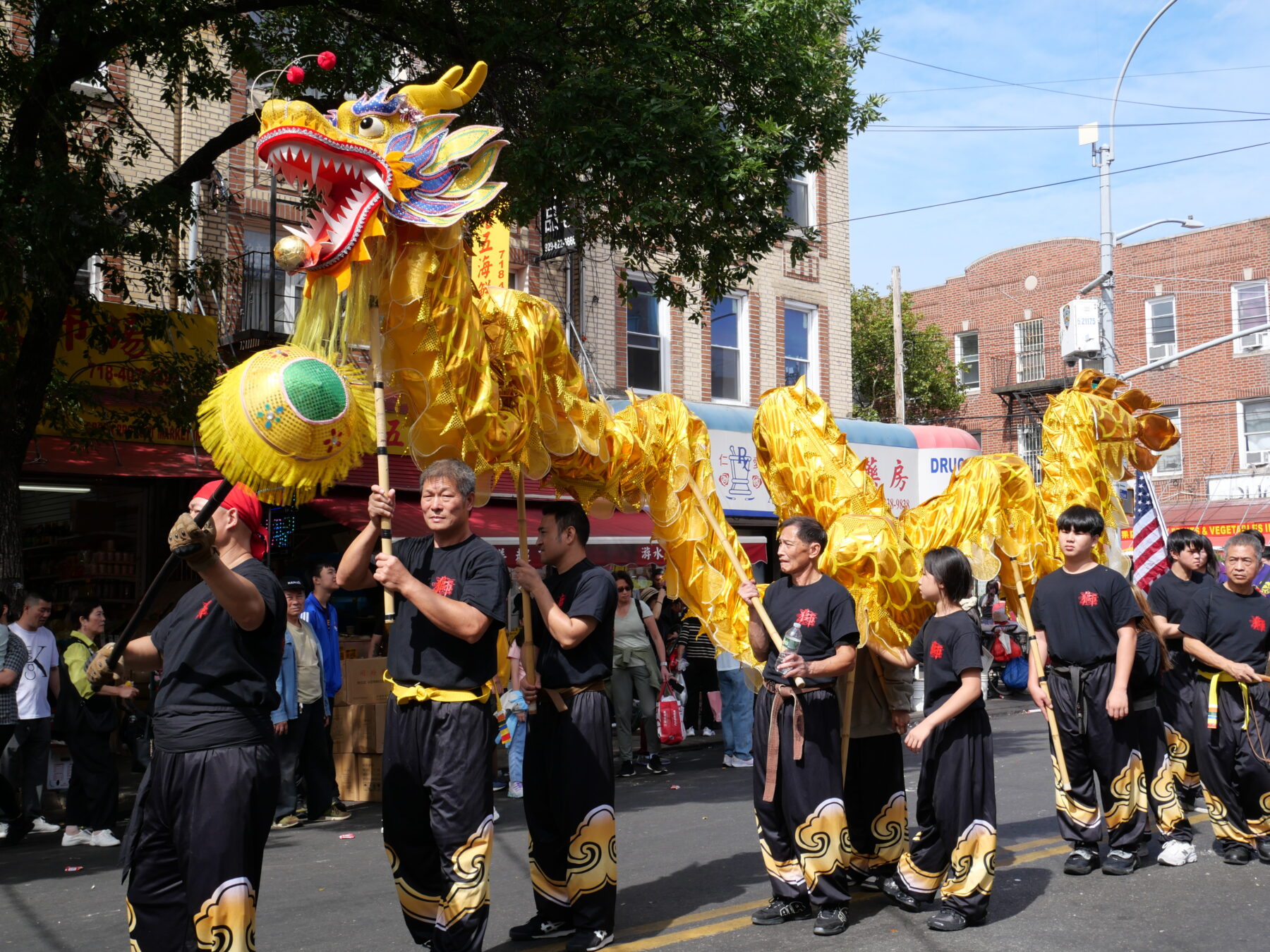
The parade featured a dragon dance troupe, shown marching down 8th Avenue. (Credit: Kim Nguyen)
In Brooklyn’s Sunset Park, community celebrations for the Mid-Autumn Festival began before the official holiday. On Sept. 19, the greater Chinese community gathered for the third annual Mid-Autumn Parade in Sunset Park. Under a clear blue sky, a 10-block stretch on 7th and 8th avenues was barricaded off that afternoon for the parade, and the streets were filled with festivities.
The parade was organized by the Better Brooklyn Association, which primarily serves the Chinese communities around Sunset Park and Bensonhurst. Police presence along with festival volunteers helped out with crowd control by directing both car and foot traffic so the event would run smoothly.
Peter Lustig lives in the Bronx, but came to Sunset Park to play in the parade’s marching band. “We call it Chow’s Band because Chow’s the leader,” he said, gesturing his trombone towards the front. “I got a call to be at a certain place at a certain time, and that’s about all I [knew]. All the people, all the pageantry — it’s all so exciting,” Lustig said, just as the parade began and the band fell into formation.
This year, the Mid-Autumn Festival fell on Friday, Sept. 25. Second only to Lunar New Year in importance, variations of the holiday are celebrated by East Asians, Southeast Asians, and their diasporas around the world. The festival marks the arrival of the full moon on the 15th day of the eighth month in the Lunar Calendar, in celebration of the autumnal harvest and honoring the moon goddess, Change’e.
Customs vary by region but generally involve making offerings to gods and ancestors alike, spending time with loved ones, and gifting mooncakes, an intricate dense cake traditionally made with a lotus and bean paste filling.
At the parade, there were sounds of people happily chatting in different dialects of Chinese. Rainbow confetti popped in the background as children, dressed in traditional Hanfu, threw firecrackers, and families watched the parade on the sidelines as lion and dragon troupes danced through on foot shortly followed by different parade floats.
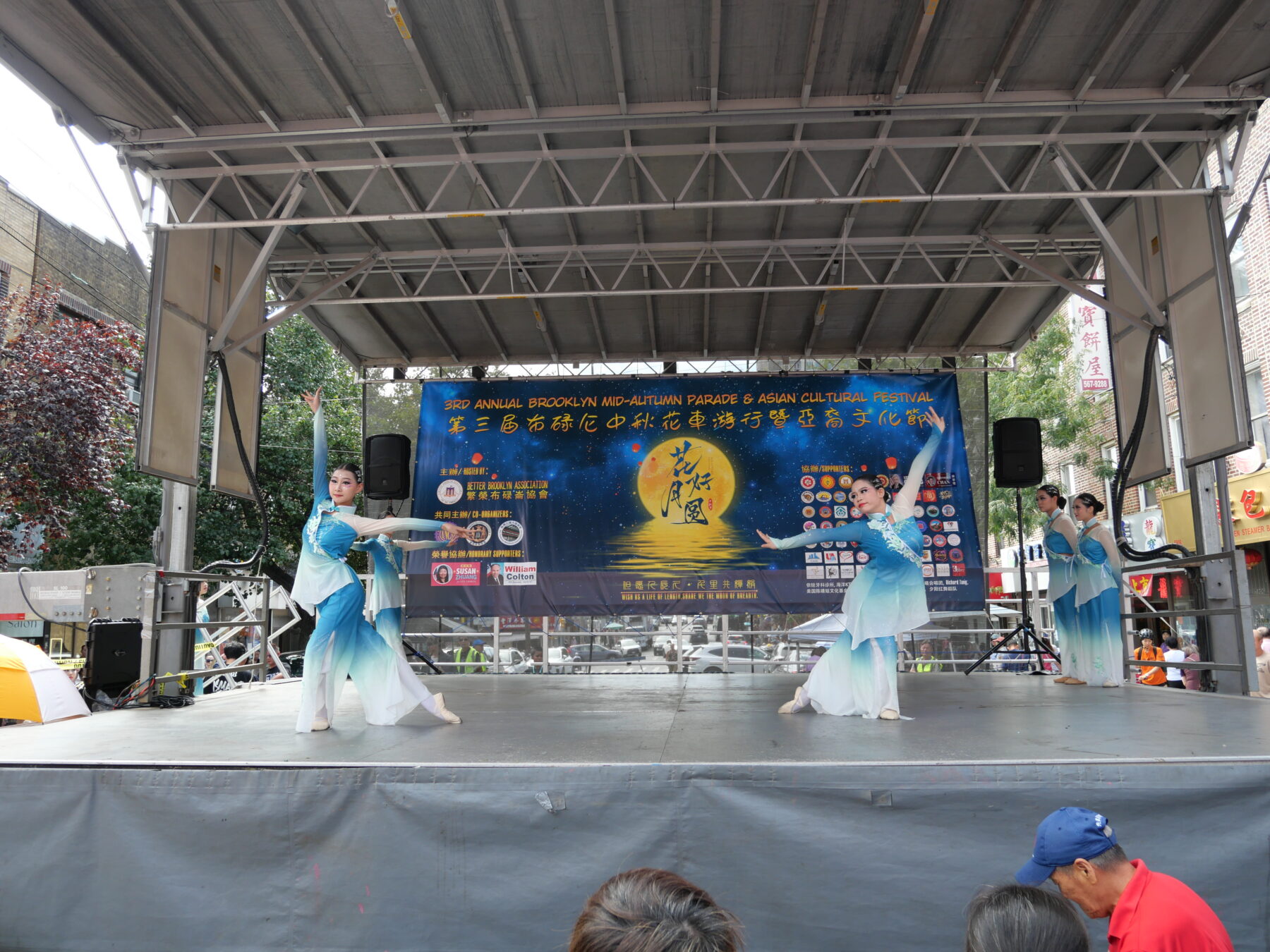
Children perform a folk dance performance on stage. (Credit: Kim Nguyen)
There was also a live stage set up at the intersection of 8th Avenue and 59th Street. Speeches and well-wishes were offered by officials, including the commanding officers in the 72nd Precinct, District 47 Assembly member William Colton and Council member Susan Zhuang. Youth performances followed, and ranged from traditional folk dances, K-pop choreography routines, and pop-punk band covers of songs including OneRepublic’s “Counting Stars.”
Some attendees were pleasantly surprised by the parade’s level of production. Alan Jiang and his cousin, Eric Jiang, are locals and grew up in the Chinese communities of Sunset Park. They initially planned to meet up with Alan’s girlfriend to pop by the parade, but the group wasn’t expecting the turnout. “The whole plan was to find some food to grub on,” he said. “But we got sidetracked, like we saw this concert and thought you know what? Let’s participate in this nice music festival.”
Eric agreed, noting community events like this bring everyone together.
“I think it makes everybody feel more connected to Chinese culture,” he said.
“I haven’t been to China in a really long time, and my grandma always used to show me videos of the Chinese parades in China. [This] reminds me of the videos she used to show me.”
Ray Huang is a long-time resident of the neighborhood and serves as the chairman of the Better Brooklyn Association. This year’s festival drew more civic and community leadership compared to last, but this level of participation wasn’t always the case. “Ten years ago, nothing was Chinese,” he said. “But because it’s their own community [the leaders] have to be involved.”
He believes that the purpose of the Mid-Autumn Parade is twofold; while the parade allows younger generations to connect to their cultural heritage, it also provides a way for new immigrants to integrate into American society. There are differences between the two mentalities and it becomes a balancing act to maintain a unique cultural identity against an American one.
“Chinese culture is more passive. You do your job and say ‘not my business,’” he said. Huang understands the old way but believes the Western mindset allows people to help themselves, granting more opportunities to improve their lives. “The American way, we educate differently. [It’s more active], you have to work up,” Huang said.
About the author(s)

Kim Nguyen is a data graphics journalist and MSc. candidate at Columbia's Journalism School.