




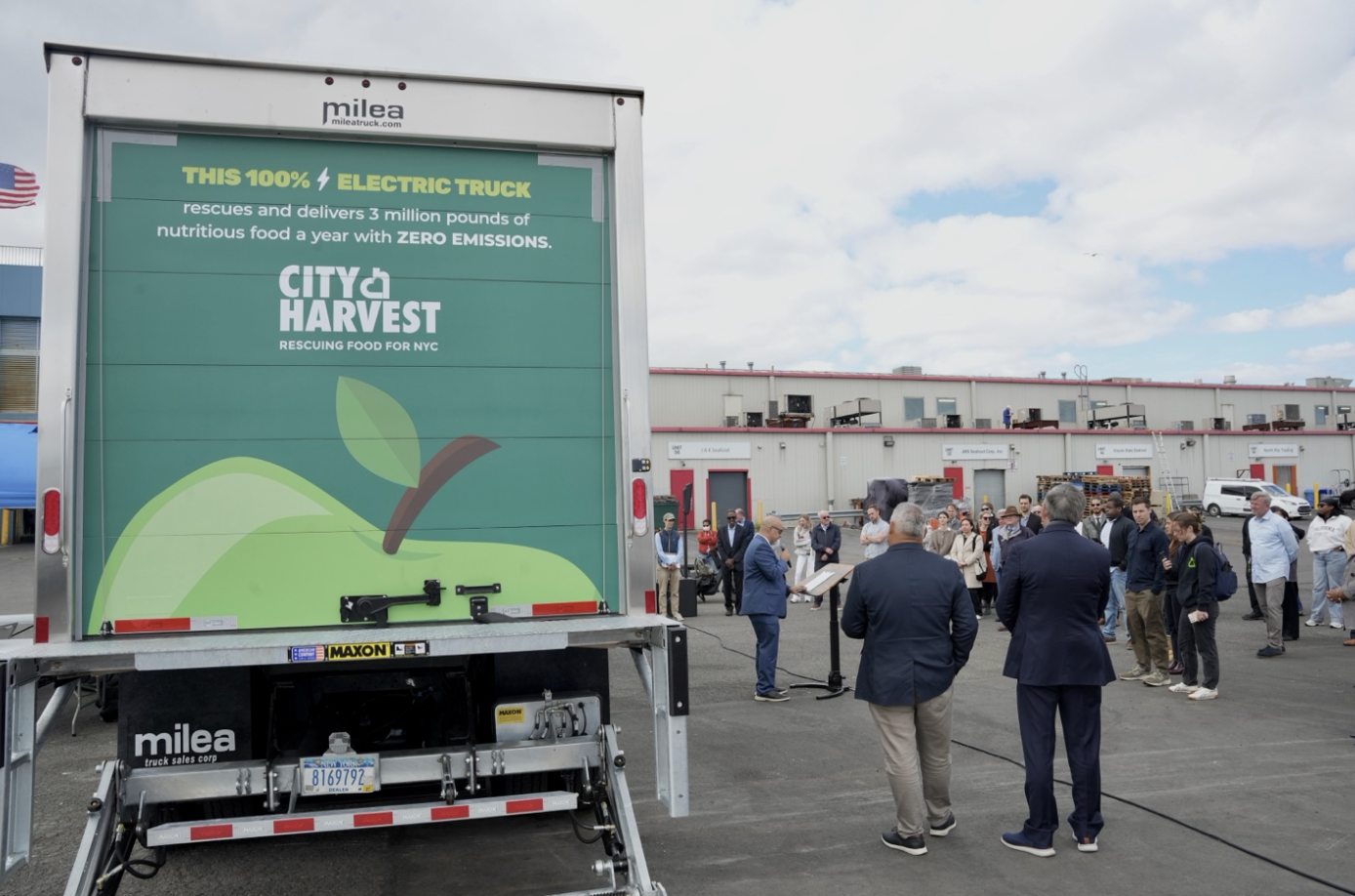
A Volvo VNR electric truck that will become a part of City Harvest’s fleet. (Credit: Zachary O’Connor)
Earlier this fall, Volvo donated three electric trucks to City Harvest, an organization dedicated to mitigating food insecurity, at the Fulton Fish Market. The market is part of the Hunts Point Food Distribution Center in the South Bronx, where some 15,000 diesel trucks travel daily, and where rates of asthma are among the highest in the city.
These are some of the first electric trucks to be used at Hunts Point to transport food around New York City, and the first few steps toward fleet electrification in the area.
Widespread use of electric trucks could reduce levels of pollutants from diesel exhaust. But for that to happen, Hunt’s Point EV infrastructure needs to be expanded, according to people familiar with the area. And distributors at the market would need to adopt EVs, which many seem hesitant to do.
“The technology is here. The challenge ahead is to get drivers, fleets, and company owners to adopt it,” said Don Eversley, executive director of the Greater Hunts Point Economic Development Corporation.
The South Bronx is known as “Asthma Alley” because residents suffer from asthma at about two to three times the citywide rate, according to the New York City Environment and Health Data Portal.
Asthma hospitalizations for adults in Hunts Point were 25 percent higher than the Bronx average. For children, asthma hospitalizations are a primary cause of missed school days.
Four years ago, the New York Clean Transportation Prizes initiative, created by the New York State Energy Research and Development Authority, awarded Volvo $10 million to develop technology for refrigerated electric trucks that could transport produce without emitting the pollutants that cause asthma. The company partnered with Bronx is Breathing, a coalition of nine community organizations in Hunts Point.
“Designing the truck to be ready for a scope of work that was still developing was a challenge. We’re in the early days of ramping up battery electric trucks in the U.S.,” said Keith Brandeis, head of policy at the trucks technology and industrial division at Volvo. “Another challenge, of course, was getting charging stations here. Without charging there is no way for these trucks to be operational in a fleet.”
Electricity is a limiting factor at the site, agreed Matthias Preindl, director of the Center of Advanced Electrification at Columbia University. “When we talk about increasing reliance on electric vehicles, we also must talk about ecosystem building,” he said, noting that electric truck sales rose 75% globally in the first half of this year. “In Hunts Point, specifically, access to electricity is posing a big challenge.”
Community leaders with Bronx is Breathing said that the adoption of EVs by businesses in the food distribution center is the next step in transforming the area, including the quality of life for residents.
“Environmental justice for everyday residents of Hunts Point is thinking about how asthma affects them. In our local elementary school, PS 48, the number one reason kids are absent from school is because of asthma attacks,” said Amanda Septino, Assemblymember for the 84th district, and who grew up in Hunts Point. “We do need the food moving through our city, but we shouldn’t have to pay the price for that with a very human cost.”
But some food distributors are concerned about vehicle prices, EV maintenance, and charging access.
“Right now, I can go to an auto shop here and ask them to fix something for me. If they give me a price I don’t like, I can go to another one across the street,” said Benjamin Boadi, a small business owner who distributes Ghanaian food. “If I have an electric vehicle, I can only get serviced by one or two companies.”
Others support the shift to electric vehicles but question whether there is a proper ecosystem for it.
Julian Medina, another distributor said, “EVs are inevitable and they are necessary, but there is a problem of infrastructure and access.”
Bronx is Breathing said it is trying to address these concerns. The group is supporting the development of a charging hub that will add 42 publicly available chargers to the existing 59 ports in the food distribution center.
The coalition is also offering technical training in EV operation and maintenance, said Jonah Kasdan, program manager at Empire Clean Cities, an organization that is a part of Bronx is Breathing.
The City of New York is expanding local charging infrastructure too. Last year, the city announced plans for the first “gas station” for electric vehicles in Hunts Point. The charging station, which is specifically designed for freight trucks, will include 32 direct current fast chargers.
“With direct current fast charging, an electric truck like Volvo’s can have batteries of up to about 80% within an hour and a half or so,” said Brandeis. (An iPhone takes about 40 minutes to reach 80% battery).
At least eight of those 32 chargers will be able to support Class 8 vehicles – the heaviest commercial vehicles on the road, according to the U.S. Department of Energy.
“Businesses have to see the experience, cost, and efficiency to consider purchasing these trucks,” Eversley said. “They need to feel confident that their battery won’t run out or they won’t be stranded. A lot of people are still concerned about range.”
Residents of the South Bronx have been suffering from a higher burden of asthma for some five decades, noted Assemblymember Septino. She said that the steps toward electrification will begin to fulfill a promise to communities that have been disproportionately burdened by negative health outcomes as a result of previous flawed policy decisions.
“We’re hoping for the best. It’s a slow process and a generational project. Diesel and EV trucks are going to co-exist for a while,” said Eversley. “But what a thrill to think the lives of residents over the next couple of decades have a chance to involve cleaner air than the folks who came before them.”
About the author(s)

Jenna Jarrah is a student at Columbia University Graduate School of Journalism where she is specializing in audio journalism.