




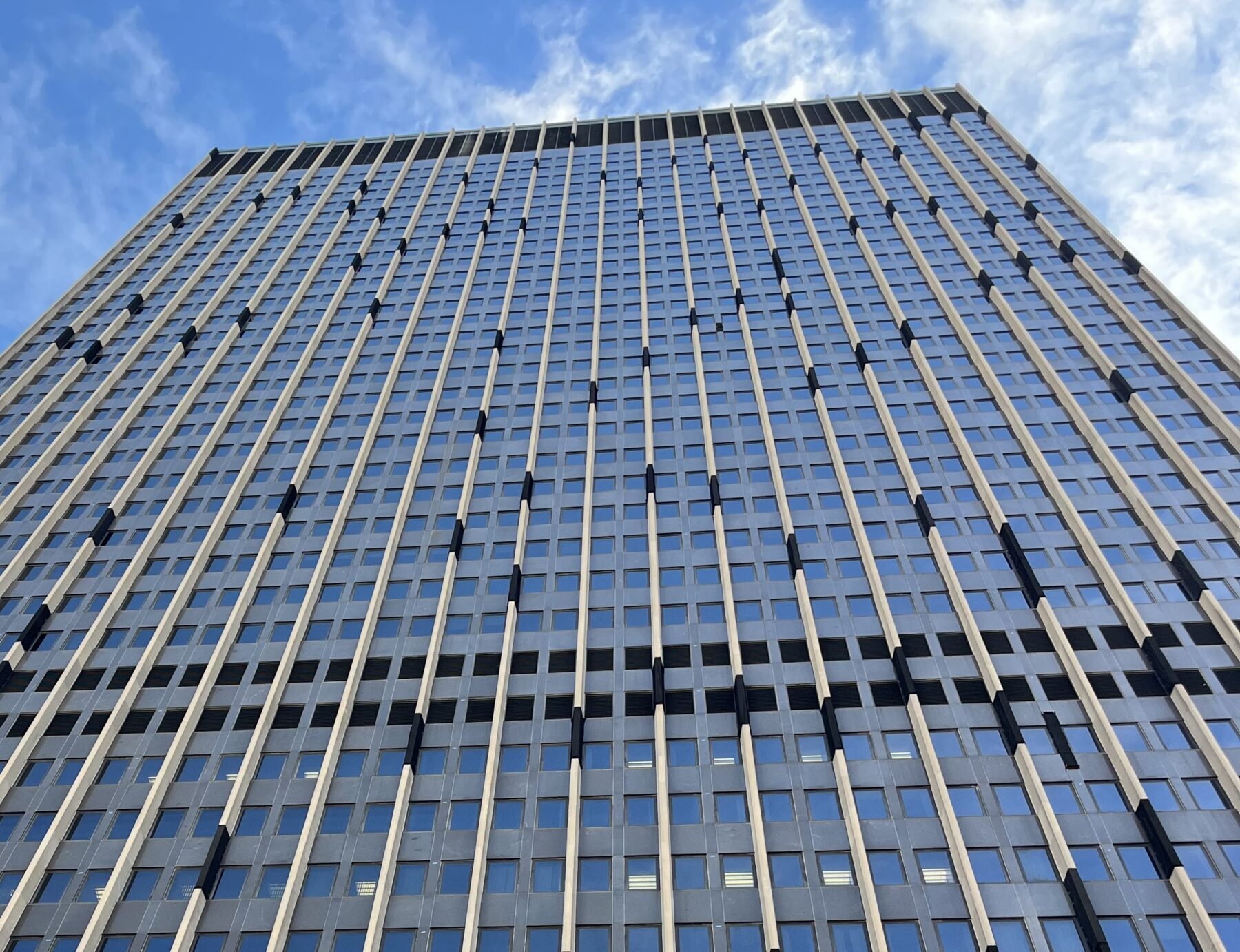
The New York-Federal Plaza Immigration Court on Oct. 12. 2026. (Credit: Charlie Wohlgemuth)
New federal immigration judges appointed by the Trump Administration’s Department of Justice are rejecting asylum seekers at an unprecedented rate. Combined with recent court rulings that have narrowly defined persecution to exclude non-state actors, the overhaul is empowering Trump’s deportation machine.
Judge Linda Hristova was one of 42 new federal immigration judges appointed by the Executive Office of Immigration Review (EOIR) in March. Of the 132 asylum claims that she has ruled on since her arrival at New York’s Federal Plaza Federal Immigration Court in March, not a single one has been granted in full, with only two individuals receiving any type of relief from the court. Over the same time period, the national average rate of asylum denial was 62.9%, while in New York’s Federal Plaza Immigration Court it was 47.7%.
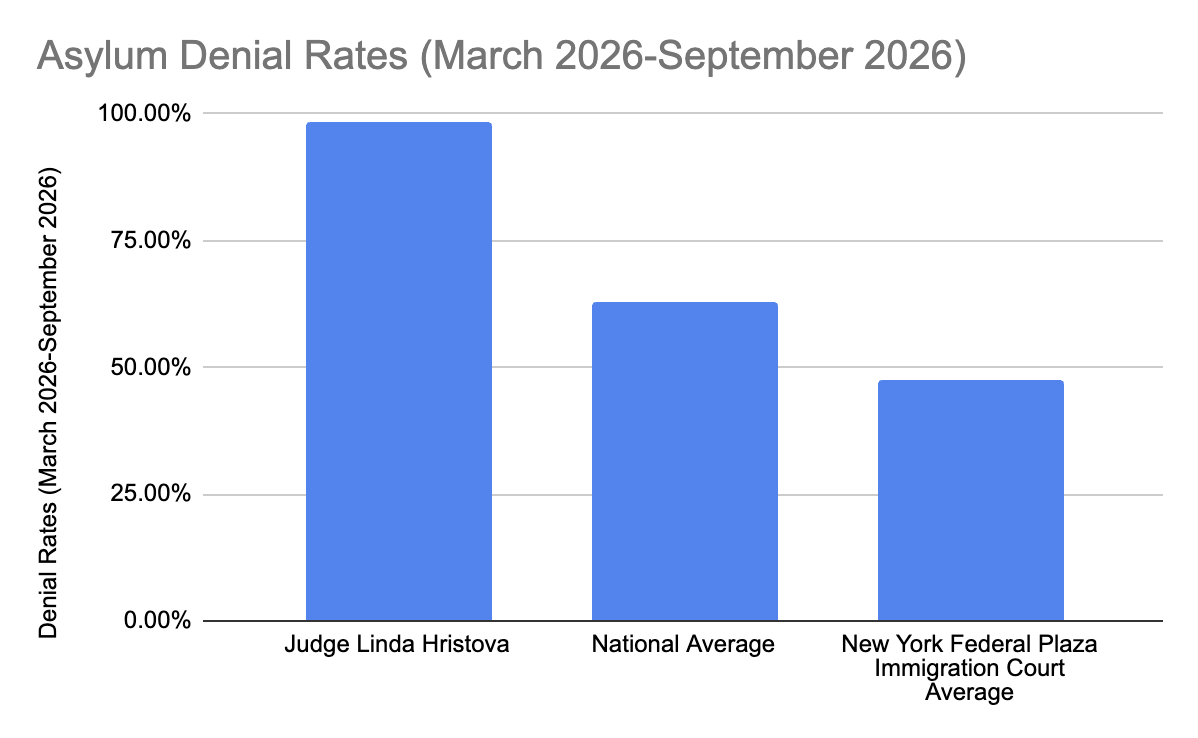
Data source: Trac Immigration
U.S. asylum law has changed a lot since its beginnings. After decades of an ad hoc approach that heavily favored refugees from communist countries during the Cold War, the 1980 Refugee Act codified internationally-recognized standards for asylum established in the 1948 UN Declaration on Human Rights, 1951 Refugee Convention, and 1967 Protocol. This standardization of asylum procedure in the U.S. enshrined five potential categories of refugee status: race, religion, nationality, political opinion, or membership in a particular social group—for which at least one of which all successful asylum applications must provide sufficient evidence. Since 1980, subsequent administrations and court decisions have transformed many parameters of the asylum process related to these five protected grounds.
On April 21, the Department of Justice’s Board of Immigration Appeals (BIA) issued an interim decision on a landmark case about a mother and her child seeking asylum from gang violence in El Salvador. The ruling established a precedent that “disapproval or opposition to criminal gangs” is an insufficient basis for asylum claims based on “political opinion,” increasing the evidentiary burden for all immigrants citing persecution from non-state actors.
Tibisay Ballestero Naranjo fled from Mérida, Venezuela because of persecution from Tren de Aragua—a criminal organization with a documented history of systematically exploiting Venezuelan migrants. On Sept. 29, in a tense, intimate courtroom at New York’s Federal Plaza Federal Immigration Court, Judge Hristova cited the BIA’s April 21 interim decision to rule that Tibisay’s claims did not meet the criteria for persecution based on “political opinion,” despite her reports of a constant threat of violence from gang-infiltrated local authorities.
“They threatened me—they killed my neighbor,” Tibisay said.
Since the 1990s, persecution from non-state actors has become an increasing driver of human rights abuses that lead to migration, yet the trend in US asylum law has generally been towards restricting claims to refugee status on this basis. Under Trump’s first term, this process was accelerated by a number of court decisions that made it more difficult for migrants fleeing non-governmental violence to receive asylum. In 2021, Former President Joe Biden’s Attorney General Merrick Garland vacated the key Trump-era ruling on the issue (Matter of A-B), but the Biden White House then went on to issue a slew of executive orders that imposed new difficulties on migrants seeking asylum. In Trump’s second term, both the executive branch and the courts have doubled down.
The new legal precedent established on non-state persecution came on the heels of a broader political cleansing of immigration courts of which the EOIR’s appointment of 42 new judges in March was merely a part. Between February 2025 and May 2026, following the firing more than 100 experienced immigration judges, 156 allegedly underqualified immigration judges were recruited by Trump’s DOJ to serve as what was advertised as “deportation judges”.
“They fired every judge that saw their role as being neutral,” said Jeff Chase, a legal scholar specializing in asylum law. The new judges are being recruited by an arm of the Trump administration’s DOJ (the EOIR) to rule on cases that the DOJ itself is prosecuting, and are thereby unsurprisingly amenable to the Trump administration’s preferred legal philosophy. “They looked for the type of recruits that would follow their agenda,” Jeff said.
It is hardly a secret that these “deportation judges” were appointed to advance the political aims of the Trump administration. In her announcement about the EOIR’s March judicial overhaul, then Attorney General Pam Bondi said, “This Department of Justice has made reducing the immigration court backlog a top priority, and these 42 new highly qualified judges will help us deliver on that goal.”
Claudia Poerta and Carlos Diaz are a young couple from Antioquia, Colombia that also fled the coercive violence of the cartels. After representing themselves in New York’s Federal Immigration Court—facing Judge Linda Hristova on the bench—they received a rejection of the basis of their asylum claim and a 60-day adjournment to re-file their request, after which a deportation order is likely a matter of time. But returning home would be a dangerous prospect for Poerta and Diaz.
“If you don’t work for the narcos, they will kill you,” Carlos said.
About the author(s)

Charlie Wohlgemuth is an early-career journalist pursuing a Masters of Science at Columbia University's Graduate School of Journalism.