




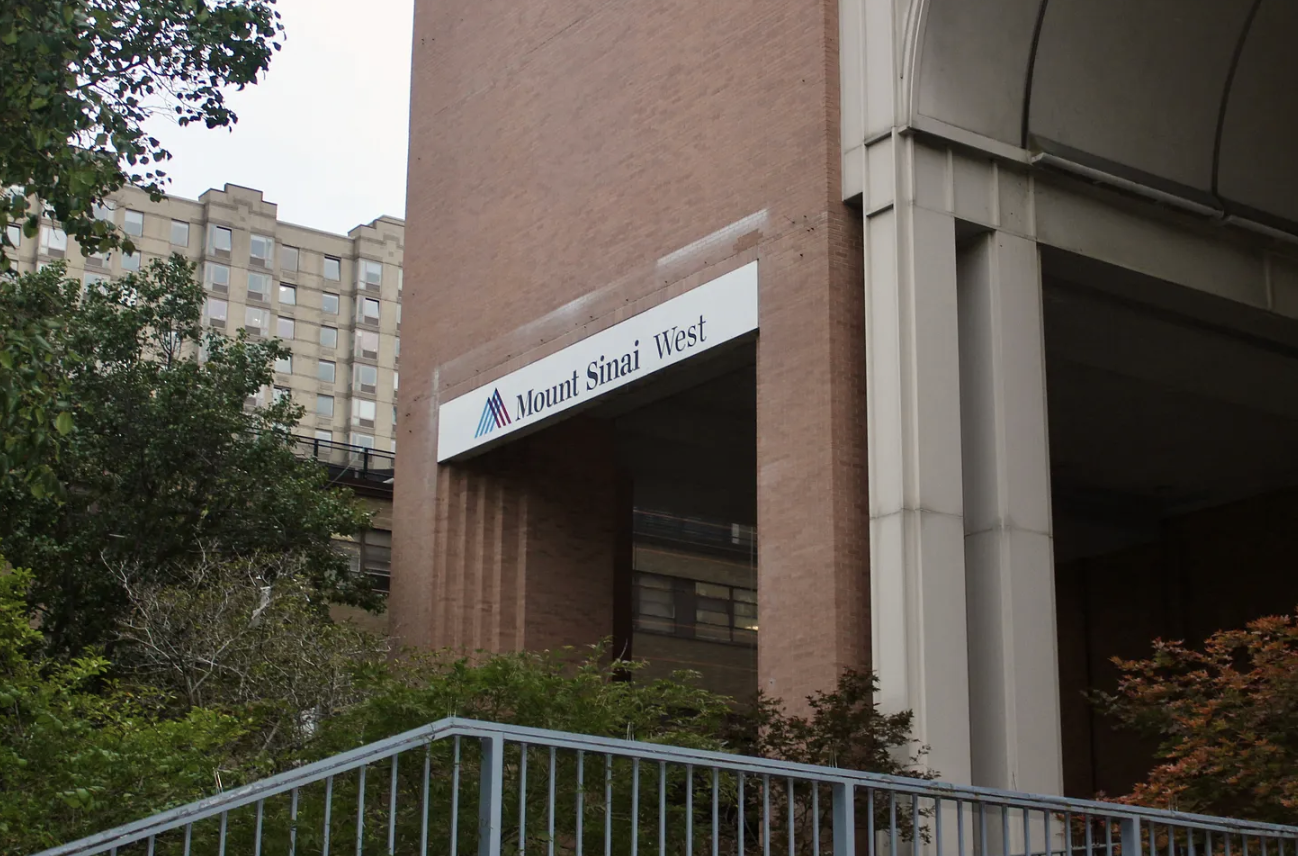
Mount Sinai West Hospital in Midtown Manhattan (Credit: Éilis Mathur)
Resident physicians and fellows at Mount Sinai Morningside and West hospitals have secured funding for elective egg freezing in their new contract. This is a first in New York City for the Committee of Interns and Residents, the union representing more than 8,000 residents and fellows across New York.
The three-year contract, covering more than 500 doctors, was ratified on Sept. 17, a week after an agreement was first reached. It includes a 12% pay increase over three years and a $1,500 annual meal allowance.
But for the residents, the $10,000 for elective — not medically necessary — egg freezing stands out.
The contract has been backdated to Dec. 1, 2025, and will run until Feb. 28, 2029. But the funding for elective egg freezing won’t be available until the beginning of 2028.
Dr. Camelia Malkami, a third-year obstetrics and gynecology resident at Mount Sinai Morningside and West, deals with fertility every day. “Because of my field,” Malkami said, “we see the whole process — close and personal.” Until now, even considering her own fertility treatment wasn’t possible because of the cost. This is a reality for most residents whose starting salary hovers at $80,000 and rises to around $110,000 as they progress.
Doctors at Mount Sinai Hospital, a separate facility on the Upper East Side within the same healthcare system, receive a $30,000 lump sum for fertility treatment as part of their insurance. But it’s the first time elective egg freezing is included in a Committee of Interns and Residents contract in New York, according to the union. “We worked constructively throughout bargaining to add this new benefit under a sustainable structure,” Mount Sinai’s communications department said.
Medical training takes years. For many doctors, that means waiting before having a chance to consider starting a family. Research suggests that roughly one in four women physicians experience infertility or pregnancy complications, according to a study published by the Annals of Surgery. This is about double the national rate.
“It’s really difficult during all of that time to start a family,” said Dr. Greg Garber, an emergency medicine resident who participated in the negotiations. Garber added that the funding “opens the door and makes it feasible for people who really, truly want it.”
“Residency is incredibly, incredibly grueling,” said Rachel Nass, spokesperson for the Committee of Interns and Residents. “New York is like a pressure cooker of the US healthcare system. And residents are at the very center.”
Malkami, originally from Georgia, doesn’t want that intensity to change.
“You can have better shifts, better working conditions, but residency is a very unique time in your life,” she said, adding that residents want the option to delay starting a family. “Many of us are sacrificing so much to go into this field… and we want to be able to give our all to our training without sacrificing being able to have a family later,” Malkami said. She added that prospective residents now ask her what fertility benefits are available before choosing which program to apply to.
This funding is only the first step. In New York, the cost of a round of egg freezing — including retrieval, medications, and storage— ranges from $10,000 to $20,000. The one-time $10,000 benefit means doctors will still have to cover the difference. City Council Majority Leader Shaun Abreu, who along with 25 other City Council members, sent a letter to Mount Sinai supporting this agreement, called the contract “a floor for future conversations,” and said he hopes elective egg freezing funding “becomes a standard term and condition most employers eventually give their workers.”
That hope may not be far off.
“A lot of the New York private hospitals tend to move in tandem,” said Garber. So this contract is not only a victory for residents at Mount Sinai Morningside and West, but “it opens up the door for those other residencies now to have the same benefits that we do.”
About the author(s)

Éilis Mathur is an investigative reporter, who currently covers healthcare and politics.