





Andrew, Nicolas, and Alex Kotzen pictured in North New Jersey. March 10, 2012. (Courtesy: Jeff Kotzen)
Before there was Columbia tennis, there were winter mornings on the mountain.
The three Kotzen brothers grew up chasing speed down the mountains in northern New Jersey, piling into the car before sunrise to spend weekends racing gates. Squeezing in runs whenever they could. Giant slalom, slalom, cold air, early starts, the kind of discipline that builds edge in young skiers.
For a long time during their childhoods, skiing and tennis ran on parallel tracks.
“Skiing was really foundational for us, dealing with pressure and how to overcome adversity,” said sophomore Andrew Kotzen. “It was a lot of fun, we all loved it.”
Toward the end of their alpine skiing careers, all three had reached national rankings as freshmen in high school.
By the time they were 8 or 9-years-old, skiing had turned into something more demanding — defined by repetition, mounting expectations and increasing injuries.
“We would ski probably 30-40 times a winter,” Nicolas Kotzen, 23, said. “And so that meant we would take tennis and tournaments off for most winters.”
But by age 14, one by one, each brother faced the same fork in the road: skiing or tennis.
Luckily for Columbia tennis, the Kotzens each chose the hard courts.
The trio have become central figures in one of the most successful stretches in recent Columbia tennis program history, with the team reaching the NCAA Elite Eight in 2024. Alex developed into an All-Ivy player before graduating in 2024, Nicolas emerged as one of the Ivy League’s top singles and doubles players ahead of his graduation in 2026, and Andrew, a rising sophomore, followed them into the lineup as the youngest member of the trio.
It’s rare enough for three brothers to compete for the same Division I program. Rarer still is the impact the Kotzens have had across multiple generations of Columbia tennis.
Part of the decision to leave skiing behind was practical. Tennis offered a clearer path to college opportunities, fewer injuries, and a professional foundation.
Their father, Jeff Kotzen, was someone who understood that path well. A former college tennis player at Haverford College, now a senior partner at The Boston Consulting Group, he recognized the potential and the sacrifice the sport required. When the time came to take the next step in their junior careers, he and his wife, Danielle Voogt, did everything they could to support their sons’ futures.
In 2013, the Kotzen family left their home on the Upper West Side of Manhattan to pursue better access to top courts, coaching, and competition.
They considered the obvious pipeline states, Florida and Texas. But instead, the family landed in Short Hills, New Jersey. At the time, it had quietly become one of the densest junior tennis pockets in the country.
What started as one brother’s introduction to a sport slowly became a shared path.
The Early Days
Alex Kotzen, the eldest of the brothers, first picked up a racket at 3 years-old. Entranced by the motion, he would hit balls against the wall with his father at PS 199 on West 70th Street.
His first formal lesson was at 5, with his 2-year-old brother Nicolas tottering around the court, and his newborn brother Andrew watching them both from his Baby Bjorn carrier.
“We would position Andrew in the tennis cart on top of all the tennis balls, and he’d just throw balls at them to hit,” Jeff Kotzen said.
For Nicolas, picking up a tennis racket and following in his brother’s footsteps felt like second nature.
“I must have been 2 or 3 when I first started playing tennis,” Nicolas Kotzen said. “Alex was playing with a coach who became my childhood coach. He would play with her in the summers, and I saw him playing, so I just jumped on the court, grabbed his racket and started playing.”

Nicolas Kotzen, age 8, pictured playing tennis on July 1, 2011. (Courtesy: Jeff Kotzen)
But the Kotzens’ father was keen not to force a specialization early and encouraged his sons to play other sports.
“They played lots of different sports,” he said. “Baseball, soccer, basketball. It wasn’t until, depending on the child, seventh or eighth grade, when they basically stopped nearly all the other sports to focus on tennis.”
It was then that the family made their most unusual decision.
Each brother, during seventh and eighth grade, left for Spain to train for a full year at the Emilio Sanchez-Casal Academy outside Barcelona. They repeated a grade to make it work, buying themselves some time to invest in athletic development.
The academy was founded by former professional tennis players Sergio Casal and Emilio Sanchez Vicario in 1998. The Spanish duo reached the ATP World No. 1 ranking in doubles, won 44 ATP doubles titles, three Grand Slam titles, and earned a silver medal in doubles at the 1988 Olympic Games.
The academy prides itself on combining tennis and education “as a vehicle for personal development”. For the Kotzens, it was about getting as fluent in Spanish as possible and becoming much better tennis players.
“It was a critical year athletically,” he said. “I took them over there, set them up in their dorm, but after that, they were by themselves.”
The Columbia Commitment
By the time they each returned home from Barcelona, their paths to college had narrowed. They were serious recruits.
Columbia University wasn’t the obvious endpoint. At the time, it was competitive, but not a traditional tennis power. Under Bid Goswami, the program established a strong foundation, sending four athletes to NCAAs in 2018 and 2019. When Howard Endelman moved from assistant coach to head coach in 2020, Columbia’s rise continued with an NCAA Elite Eight campaign in 2024.
Endelman, a former Columbia tennis captain and coach of the women’s program between 1989 and 1992, was recruiting top talent from around the world to join the Lions.
Alex hopped on board first.
When the recruitment process first began, the family’s attention gravitated more toward the traditional powerhouse schools: Harvard, Stanford, and Duke because of their national rankings and recent success.
Alex, meanwhile, in his junior year of high school, had already become one of the top juniors in the U.S. at No. 12, drawing attention from other top Division I coaches from around the country.
It was Endelman who had the greatest impact on Alex’s choice. After their first conversation, Alex immediately told his father how much he had enjoyed speaking with the Columbia coach. Endelman’s previous career in finance reminded Alex of his own father.
“He told me, ‘I just spoke to the Columbia head coach, he reminds me of you,’” Jeff Kotzen said.
That connection proved paramount in Alex’s decision, with Columbia swiftly moving into his top prospective spot.
Over the next four years, Alex developed into one of the Ivy League’s top players. After immediately breaking into Columbia’s lineup as a freshman, he quickly moved up and played No. 1 singles his junior year, earning First-Team Ivy League honors. By his senior year, he was named the ITA Northeast Region Senior Player of the Year.
During that span, Alex solidified himself as one of Columbia’s most reliable players, with a singles record of 79-36.
Two years after Alex first arrived on campus, after seeing his impact on the team and recognizing that Nicolas had similar talent on the court, Endelman began to recruit Nicolas.
Despite talking with coaches at several Division I schools, to Nicolas, the choice felt like a no-brainer.
“I was already convinced, as were my parents, we all trusted Howie because of the job he did with Alex in his first two years,” senior Nicolas Kotzen said, referencing Alex’s improvements on the court.
Despite being the third brother to go through recruitment, the choice wasn’t initially as obvious to Andrew.
“My dad and I actually made a spreadsheet,” he said. “We put everything together, made lists, and Columbia came out on top in most categories.”
By the time Andrew arrived at Columbia in 2024, the unknowns of how college tennis functioned had mostly evaporated after watching his older brothers navigate the process before him.
“It felt more like a family here, and I felt like I could grow more as a person,” Andrew Kotzen said. “I knew how the coaches operated, how the culture was. I came to all the matches, and it was inspiring.”
The unique combination of academic rigor and high-performance athletics was what ultimately separated Columbia from other schools for the Kotzens.
“It became really clear that Columbia was the rarest of examples of outstanding academics and outstanding athletics in a place where you could get that world-class academic quality and rigor that would set the stage for the game of life,” Jeff Kotzen said. “But you could also excel at the game of tennis as an input into the game of life.”
From Brothers to Teammates
Alex graduated from Columbia in 2024 and went on to a fifth year at the University of Tennessee, pursuing a master’s degree in digital marketing and social media. As part of the class affected by COVID-19, Alex benefited from the NCAA’s decision to offer all athletes in college who competed in the 2020-2021 academic year the opportunity to extend their eligibility clock by one year, known by athletes as the ‘covid year.’ The Ivy League operates a very strict no-graduate-athletes policy, regardless of the NCAA’s exception, forcing athletes with additional eligibility across all sports to look outside the conference for opportunities.
Over his time at Columbia, Alex stacked up win after win with a career-high ITA singles ranking of No.7. He cemented his legacy in Columbia tennis.
At Tennessee, he adjusted quickly to the SEC and rose through the ranks, competing in the No. 1 singles position.
Although Nicolas and Alex only overlapped for one year, Nicolas said that playing alongside his brother was one of his favorite memories and a moment that defined both brothers’ careers.
In 2024, Columbia took on Michigan to advance to the NCAA Sweet Sixteen for the first time since 2019. The Lions went into singles one point up, but lost two courts early to the Wolverines. They needed only one more point to clinch the match.
The only two matches still on court belonged to the Kotzens.
Alex, ranked No. 100 at the time, was battling No. 113 Jacob Bickersteth on court two. Nicolas was on court three, pushing through tiebreaks with Bjorn Swenson.
“I remember we met as a team in the locker room, and Alex and I spoke briefly before heading back out onto the roof,” Nicolas Kotzen recalled. “We knew the match was going to come down to one of us, or both of us.”
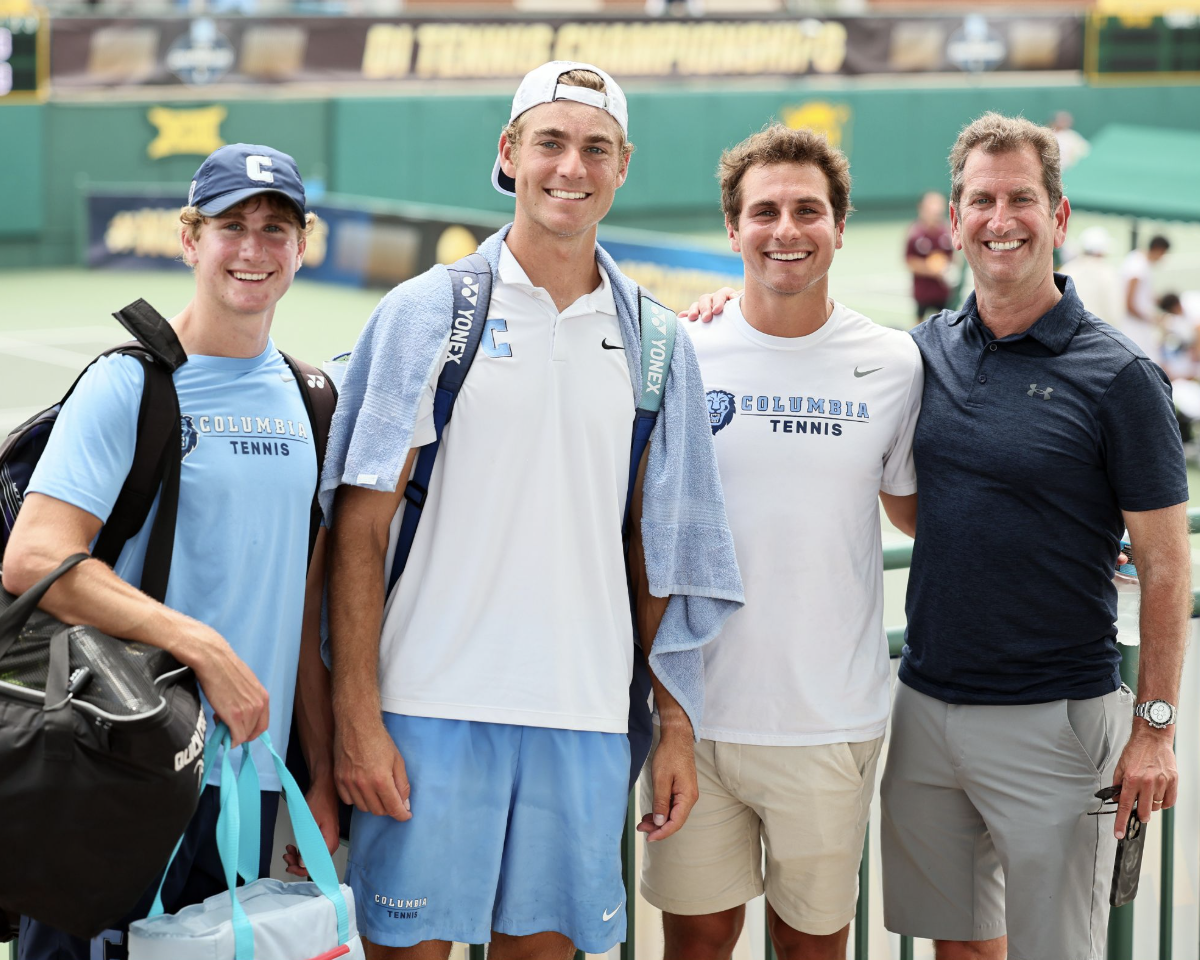
Andrew, Nicolas, Alex, and Jeff Kotzen are pictured together at the NCAA DI Tennis Championships. May 16, 2025. (Credit: Lloyd Clayton, courtesy: yourgameface.com)
Both brothers battled their opponents through three sets, with Nicolas delivering the final blow and giving Columbia the 4-2 lead they needed.
Now, that dynamic has shifted between the brothers. Nicolas stands at the helm as a senior on the team, with his younger brother Andrew patiently training to fill his shoes.
“Now I’m playing at the top of the lineup, and Andrew is doing what I was doing two years ago,” Nicolas Kotzen said. “It’s cool to see Andrew progressing, buying into the culture, and doing little extra things that I didn’t used to see him do.”
By the end of the 2024-25 season, Nicolas was playing primarily at No. 2 singles and No. 1 doubles, earning First Team All Ivy honors in both while finishing the year ranked No. 43 nationally in singles and No. 23 in doubles alongside Michael Zheng.
Although Nicolas’ run at Columbia concluded in May with graduation, his tennis career is only just beginning. With the ultimate goal of going pro, Nicolas will start competing in futures tournaments over the summer.
Futures tournaments, an integral part of the ITF World Tennis Tour, act as an entry point for professional tennis players making their debut from juniors to the Association of Tennis Professionals (ATP) Professional Tour. They’re known for being notoriously difficult, with events scattered around the world and hundreds of top young players fighting for ATP points and survival.
Alex is also still playing on the International Tennis Federation (ITF) professional circuit, playing lower-level M15 and M25 events in the U.S. while continuing to pursue ATP ranking points.
While Nicolas and Alex chase ATP points, Andrew will remain in Morningside Heights for two more years. With a lack of seniors on the team next year, leadership roles will fall upon the rising sophomores, as will the rankings.
For the first time, there will be no older Kotzen ahead of Andrew in the lineup, marking the end of a stretch that is unlikely to be repeated anytime soon.
About the author(s)

Amarna Milne is an M.S. student at Columbia Journalism School, specializing in sports journalism.