





Some ice cream truck customers have had sticker shock when they see their charges. (Credit: Grace Jiang)
On July 4, Devolea Rey and her daughter had just arrived from Argentina and were celebrating Independence Day in Brooklyn. Hungry and eager to cool off, they approached an ice cream truck on Old Fulton Street.
Seeing the colorful pictures on the truck’s side, they ordered two vanilla cones without hesitation. After paying by credit card, Rey suddenly realized she didn’t ask about the price. Her phone hadn’t yet shown transaction details due to processing delays. She expected to pay around $6 for both cones. The actual cost: $28.
“[It’s]more expensive than Argentina,” Rey said. “We have a lot of inflation, but it’s really expensive.”
Even customers familiar with high Manhattan prices expressed surprise. Kayshla Pendleton paid $14.15 for a waffle cone with chocolate ice cream and rainbow sprinkles from the same truck near Brooklyn Bridge. She had only gotten ice cream from Mister Softee before and she had never paid more than $10. “Seeing that it’s $14, it’s like, wow,” she said.
Rey and Pendleton aren’t the only customers that have been stunned by the ice cream prices. Since 2023, the most complained-about business in New York City is a small fleet of ice cream trucks owned by a single operator, Eddie Cumart, including the truck underneath the Brooklyn Bridge.
According to data from the NYC Department of Consumer and Worker Protection (DCWP), his business has generated more consumer complaints than any other in the city, topping a list that includes CVS and Memorial Sloan Kettering Cancer Center.
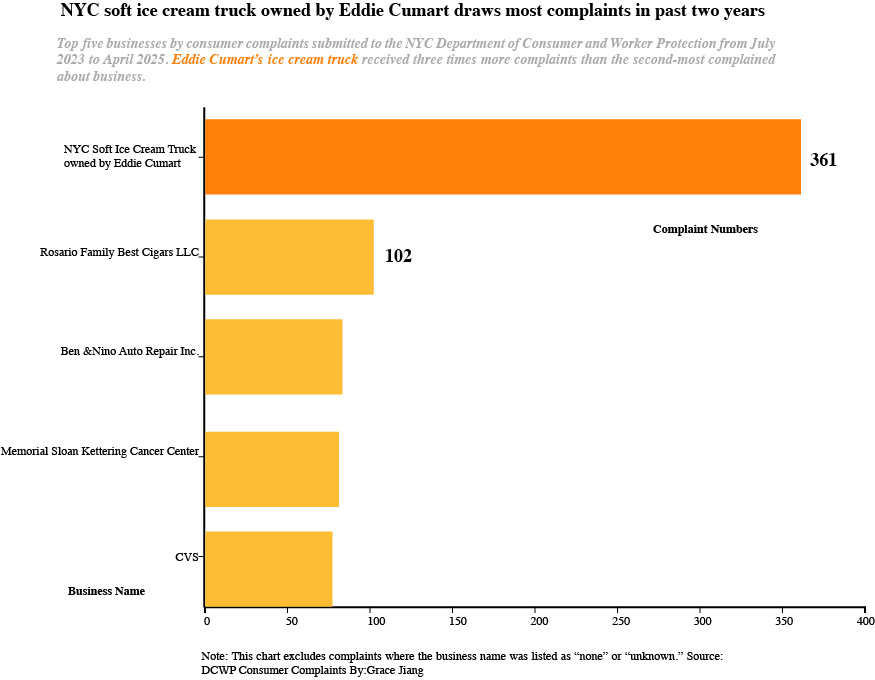
The primary complaints center on: “Price not posted” and operating as a “Cashless Business,” along with complaints about overpricing.

Over the past two years, DCWP conducted 23 inspections of Cumart’s Brooklyn trucks. In October 2024, the department issued a summons for violations that are subject to financial penalties after a hearing (or default) at the Office of Administrative Trials and Hearings (OATH). These violations focused on failure to display prices and refusing to accept cash payments in violation of the city’s consumer protection laws and the Cashless Ban.
In New York City, beginning November 19, 2020, stores must accept cash unless they have a machine to convert cash to a prepaid card. They cannot charge more for paying in cash.
Cumart failed to show up to the hearing and is liable for penalties totaling $1,100 for October 2024 summons, according to DCWP. This includes $100 for failure to conspicuously display prices and $1,000 for refusing to accept cash payments, DCWP said in an email response. If a business continues to violate these laws, they can receive a civil penalty of up to $1,500 for each additional violation from their initial violation. When a business fails to appear to their hearing, then they are found in violation of the charge by a default.
Cumart, who called himself the “King of Ice Cream” during a Zoom interview, operates 33 trucks, mostly in Brooklyn, with others scattered across Queens, Staten Island and New Jersey. His goal, he said, is to own 100 trucks. What customers experience as price confusion, Cumart describes as location-based pricing tied to his operating costs.
Starting in 2015, Cumart started to build his ice cream empire by purchasing trucks from retiring operators, he said. Three managers help train employees, with one dedicated to ice cream operations.
“Nobody [is] allowed to take cash. Everybody must take credit cards,” Cumart said. “Cash business, everybody steals.” The money flows to a bank account, and he pays taxes monthly.

A “Cashless” sign on one of Eddie Cumart’s ice cream trucks in Brooklyn. (Credit: Grace Jiang)
Cumart insists prices are displayed “right next to the permits” on every truck and daily inspections occur. However, no clear posted prices were visible on the truck when Columbia News Service visited three of Cumart’s ice cream trucks in Brooklyn.
“If you don’t ask, I’m not gonna tell you,” he said. “You better ask before you purchase or check the prices. I cannot tell you what to buy. I’m not forcing them to buy,” Cumart said.
He attributes communication problems to language barriers with tourists. “It’s too hard to deal with the tourist people, they don’t speak English,” Cumart said.
Cumart’s pricing varies by location, he said. When the truck is stationed in touristy areas, like the Statue of Liberty, he charges $18 for waffle cones and $8 for regular cones. At Hudson Yards, cones cost $14.
However, Cumart said, customers in mostly residential neighborhoods pay different rates. “If I come to your neighborhood, regular customers, we open the jingle, people come downstairs, it’s $5,” Cumart said. “All about the location. If I don’t pay for that location, it’s $5.”
The majority of complaints have been concentrated in Brooklyn near DUMBO and Clinton Hill, records show.
“Everywhere is a different value. All about location,” Cumart said.
“In some locations, we pay a lot of rent, like for park permits,” Cumart added. In other locations, he said, he’s paying rent to the city.
NYC operates a two-tier permit system requiring both individual licenses and unit permits. Far more demand than supply for the permits, some people rent their permits to others, including Cumart. He rented 23 park permits, the most expensive one being Brooklyn Bridge which costs $180,000 a year.
Cumart said prices of ice creams were lower when he was first starting out, running trucks that moved from location to location rather than being parked in fixed spots. He explained that his current, steeper rates reflect increased operating costs, including payments to parks and apartment buildings for parking permits, insurance costs and employee wages. “Now I have to pay everybody,” he said, contrasting his current operation with his earlier days when he charged $3 for a cone.
For a $15 cone, Cumart said his profit margin is $3.
Some customers said they would still purchase ice cream if prices were clearly posted, though many acknowledged they might choose differently.
“Maybe I would have been like, ‘Oh wow, that’s crazy.’ I probably still would have bought it though,” Pendleton said.
About the author(s)

Xinlin Jiang is a data journalist, photographer and M.S. Data student at Columbia Journalism School, focusing on business, technology and human interest stories.