




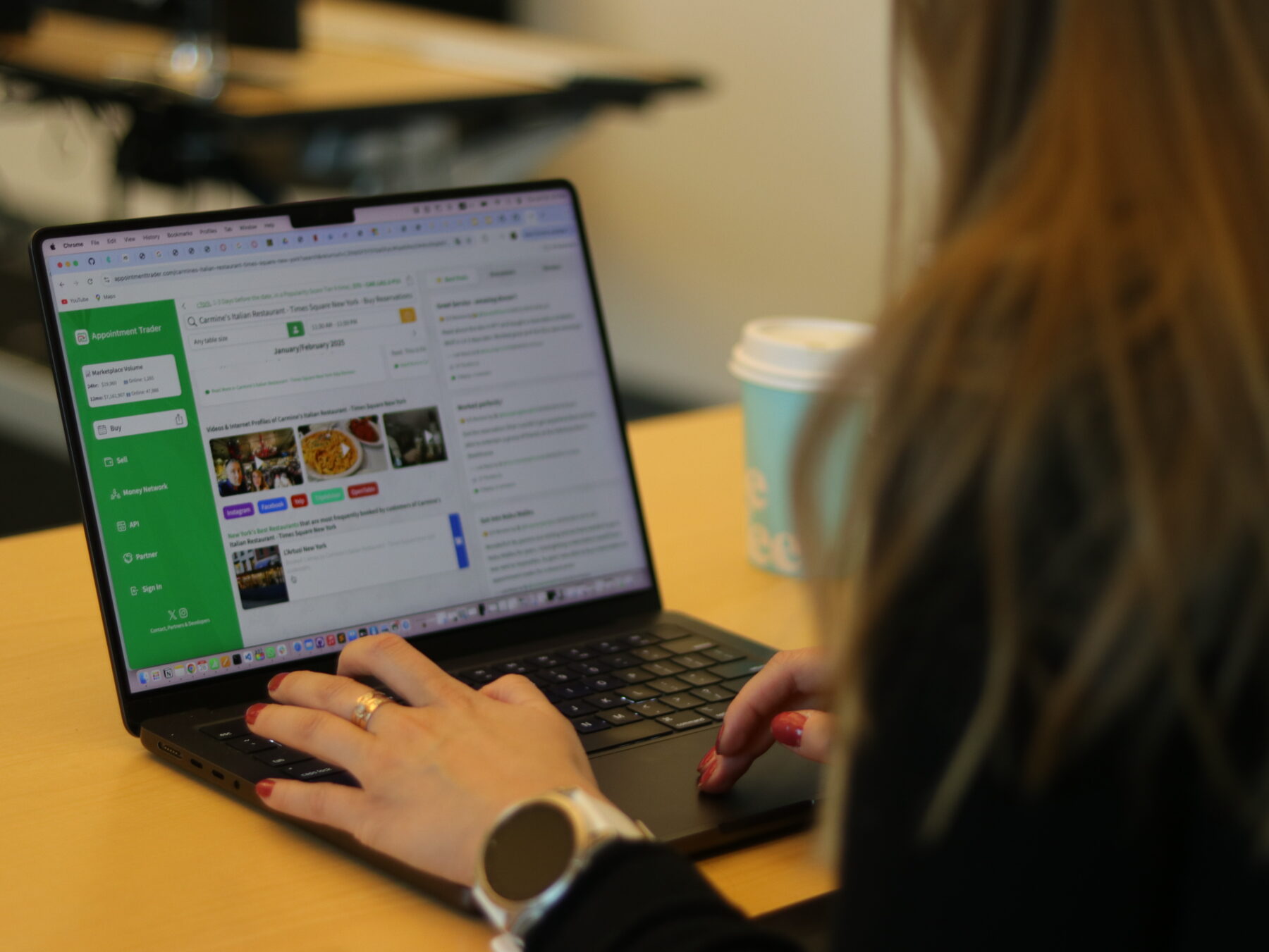
A customer browsed Appointment Trader in January, 2025, trying to book a table at a New York City restaurant. (Credit: Xinlin Jiang)
Every New Yorker knows the panic of making last-minute weekend plans, and the sinking feeling that a dinner reservation will be next to impossible. And, if a spot isn’t booked out during prime time, is it even worth going to?
For years in New York City, a platform made it easy to buy and sell reservations. But it was shut down by a new law that went into effect this spring.
While the platform was, at first, blocked by the Restaurant Reservation Anti Piracy Law, Appointment Trader is now gearing up to relaunch in New York City with an artificial intelligence-driven chat interface. The hope? To use Section 230 of the Communications Decency Act as a legal shield.
Appointment Trader was born of need, its founder said. At a time when people doomscrolled Resy like Instagram, memorized Infatuation’s Toughest Reservations In NYC Right Now (And How To Get Them), and set “Notify” alerts more than alarms, tech entrepreneur Jonas Frey saw an untapped business opportunity.
“We are in America,” Frey recalled thinking. “We can buy everything. Why can’t we buy other people’s time slots?”
And with that philosophy, he founded Appointment Trader in 2021, one of the first third-party marketplaces that allowed users to buy, sell, and trade any type of time slot, but it was restaurant reservations that made it the talk of the town. The platform bloomed with New York City as one of its biggest markets. Interested consumers put up “bids” for impossible-to-get dining reservations, like 4 Charles Prime Rib, while other users who had secured the hot reservation slots could sell them to the highest bidder and make some cash.
The vision was alluring. The promise to diners – never again fight a losing battle against bots every morning at 9 a.m., waiting to snag a date night table for two, a month in advance – if someone opened their purse strings. That’s why, at the end of 2024, with a variable 20-30% cut on every transaction, Appointment Trader facilitated around $7 million in reservation sales with a user base of close to 50,000, according to Appointment Trader data.
Before the Restaurant Reservation Anti-Piracy Law took effect in February, Appointment Trader’s listings included sought-after spots like Bungalow, a Michelin 2024 Bib Gourmand recipient. Despite being officially “fully booked,” the restaurant routinely appeared on Appointment Trader, with as many as 31 reservations resold per month, sometimes for as much as $291, according to Appointment Trader data. Diners who preferred to book their reservations the old fashioned way were not always pleased. Marie Cedano, reservationist for Bungalow, remembers receiving calls from disappointed patrons, demanding to know why reservations not available on Resy were showing up on Appointment Trader.
However, the Restaurant Reservation Anti Piracy Law ended Appointment Trader’s lucrative grasp on New York’s dining scene. The Law, introduced by State Sen. Nathalia Fernandez with the full support of the New York State Restaurant Association (NYSRA), prohibits any third-party marketplace like Appointment Trader from selling a restaurant’s reservations, without a written agreement from that restaurant. The bill was publicly supported by Resy and American Express (which acquired Resy in 2019). Since then, the legislative crackdown has started to spread nationwide: lawmakers in California, Florida, Illinois, Louisiana and Nevada are all pushing similar bills to prohibit unauthorized sales of hard-to-get restaurant reservations.
“The reservations are supposed to be free,” said Kathleen Irwin, government affairs manager for the New York State Restaurant Association. “Some third-party person is making hundreds of dollars, and only people who can afford to pay are getting the reservation.”
In a December 19 post on Appointment Trader, Frey wrote that the company would fully comply with the letter of the law.
“If we fail to make this right by February 17, not one more non-industry or non-wealthy person can go to The Corner Store, Carbone, 4 Charles Prime Rib or Tatiana than before as they will not want to prepay thousands of dollars and as there is more demand than supply,” Frey wrote in a lengthy statement, referencing Dorsia, another reservation app where members can snag reservations for popular restaurants by paying a minimum upfront spend. For example, in order to dine at the notoriously booked-out The Corner Store, the restaurant that became even more popular after each of Taylor Swift’s visits, each member of the dining party must commit to spending at least $250 on some days at the restaurant. In contrast to Appointment Trader, the reservations hosted on Dorsia are sourced directly from the restaurant and the minimum spend also goes to them.
When the law went into effect, Appointment Trader halted all business in New York City, seemingly forever.
With a few tweaks to the interface and a new user-experience, Frey believes that Appointment Trader can fall under the protections of Section 230 of the Communications Decency Act without flouting the Restaurant Reservation Anti-Piracy Law.
Appointment Trader’s original interface provided users with lists of restaurants that were most in demand, the ability to search different locations and view existing reservations that users had put up for sale. Since the anti-piracy law also prohibits Appointment Trader from promoting or advertising reservations, the new Appointment Trader does away with the promotional aspects of the site, including location details and restaurant rankings. It will introduce a new “AI-concierge” chatbot feature that can converse in multiple languages including Spanish and Japanese. Users now interact with the site solely through the chatbot, using it for discovery, to ask for available tables, and list reservations in cities of their choice.
“Section 230 is relatively specific on how user generated content is treated on these platforms and nothing stops us from allowing a customer to hire a concierge for general work, right?” Frey said.
Searches facilitated by Appointment Trader’s chatbot will guide customers to the site’s pages with locations or experiences of their choice. In most cities around the world, the customer will be able to query the interface directly for reservations or services using dropboxes (think: Table for two at 8:00 p.m. tonight). But, in restricted markets like New York, they will be presented with a text box-like form to describe their demand instead, Frey said. Then, users of the platform will be connected to “concierges” or other users who have the ability to fill that demand. Frey believes that reimagining the user experience in this way allows Appointment Trader to act more like a “search engine,” facilitating a question-answer, free-form system rather than advertising reservations directly. Appointment Trader launched its new interface for its global market in May and Frey said that he is waiting to see how it performs before going live in New York.
“Section 230 is designed to shield companies from civil liability for things that their users are posting online,” said Andrew Stebbins, a trial lawyer and partner at Buckingham, Doolittle & Burroughs, LLC. Stebbins cited examples of how Google or Yelp, can’t be sued for restaurant or business reviews posted by users. Section 230 also helps protect publishers and newsrooms from being sued under civil torts such as slander, defamation or libel because of posts left in the comments section.
However, Section 230 is not without statutory exceptions. Such immunity will not apply to lawsuits that are brought under federal criminal law, intellectual property or other such exceptions. And while the Section 230 defense has been widely applied and interpreted over the years, many experts, including Stebbins, do not believe that the play will work for Appointment Trader.
“Section 230 will probably not be useful if you have a state law on the books that says you can’t do something,” said Kristian Stout, director of innovation policy for the International Center for Law & Economics. “If the state says that they don’t want this kind of business, a Section 230 defense is not going to help with that.”
While such defenses and their interpretations are constantly evolving, Stout said, the crux of such a lawsuit involves proving whether an action pertains to speech or conduct. If it is a matter of speech, Section 230 will likely apply, but the prosecution will frame it as a matter of facilitation – in this case, of facilitating a third-party sale of reservations that is not allowed under state law. Because the interpretations and precedents are often so wide in scope, it will depend entirely on the exact framing of the Restaurant Reservation Anti-Piracy Law and the framing of any case brought against the third-party resale platform, according to Stout.
Assemblymember Alex Bores, a co-sponsor of the Restaurant Reservation Anti-Piracy Law, said that “his instinct” is that attempting a Section 230 defense will not succeed, especially because he believes it is in bad faith against an existing state law.
Still, Frey remains confident that Section 230’s protections apply to Appointment Trader because he does not believe that the soon-to-be relaunched version of Appointment Trader’s activities will fall under the domain of the Restaurant Reservation Anti-Piracy Law.
“It prohibits third party restaurant reservation services from listing, advertising, promoting or selling reservations. We are not a third-party restaurant reservation service. We, Appointment Trader, don’t list anything, we don’t advertise anything, we don’t promote anything, and we don’t sell anything because users are doing that. We are user-generated content,” said Frey. He believes that only platforms like Resy, which curate reservations that aren’t supplied by users, classify as the third-party restaurant reservation marketplaces that fall under the law.
The language of the bill states that “third-party restaurant reservation service” means any website, mobile application or other internet service that: (i) offers or arranges for reserving on-premises service for a customer at a food service establishment; and (ii) that is owned and operated by a person other than the person who owns such a food service establishment.
It also absolves any marketplace that has agreements with restaurants to sell its reservations (like Resy and Opentable) from the definition of “third-party restaurant reservation service.”
Frey said that he saw Appointment Trader as a way to give the average Joe a fighting chance against established members clubs and elitist dining networks. He firmly believes that he’s drawn ire because he’s serving a need in the restaurant landscape.
“When Uber started to really have traction, the taxi unions tried everything in the book to kill that service,” Frey said. “I’ve been a tech entrepreneur my whole life and I know what it feels like when nobody gives a rat’s a– about what you do – but the way I see it, if nobody was using Appointment Trader, we wouldn’t have a law opposing it.”
Unfortunately, restaurants did not see it the same way. With reservations for restaurants like Carbone and Torrisi selling for hundreds of dollars, and not a dime of that going to the proprietors, restaurant owners and staff saw it more as a perversion of elegant dining – and disruptive to business.
The fear was not unfounded. As Appointment Trader became more and more popular, many like Alex Eisler, turned the scalping of restaurant reservations into a lucrative side-hustle by mass booking primetime reservations with the intent of selling them. And when not all of them are sold, restaurants have been left with many no-shows during primetime. In fact, Resy’s reservation data from October 2023 to April 2024 found that no-show rates for presumed bots and brokers are four times that of the general population of Resy users’. And late cancellations are two times higher in reservations made by presumed bots and brokers than regular users.
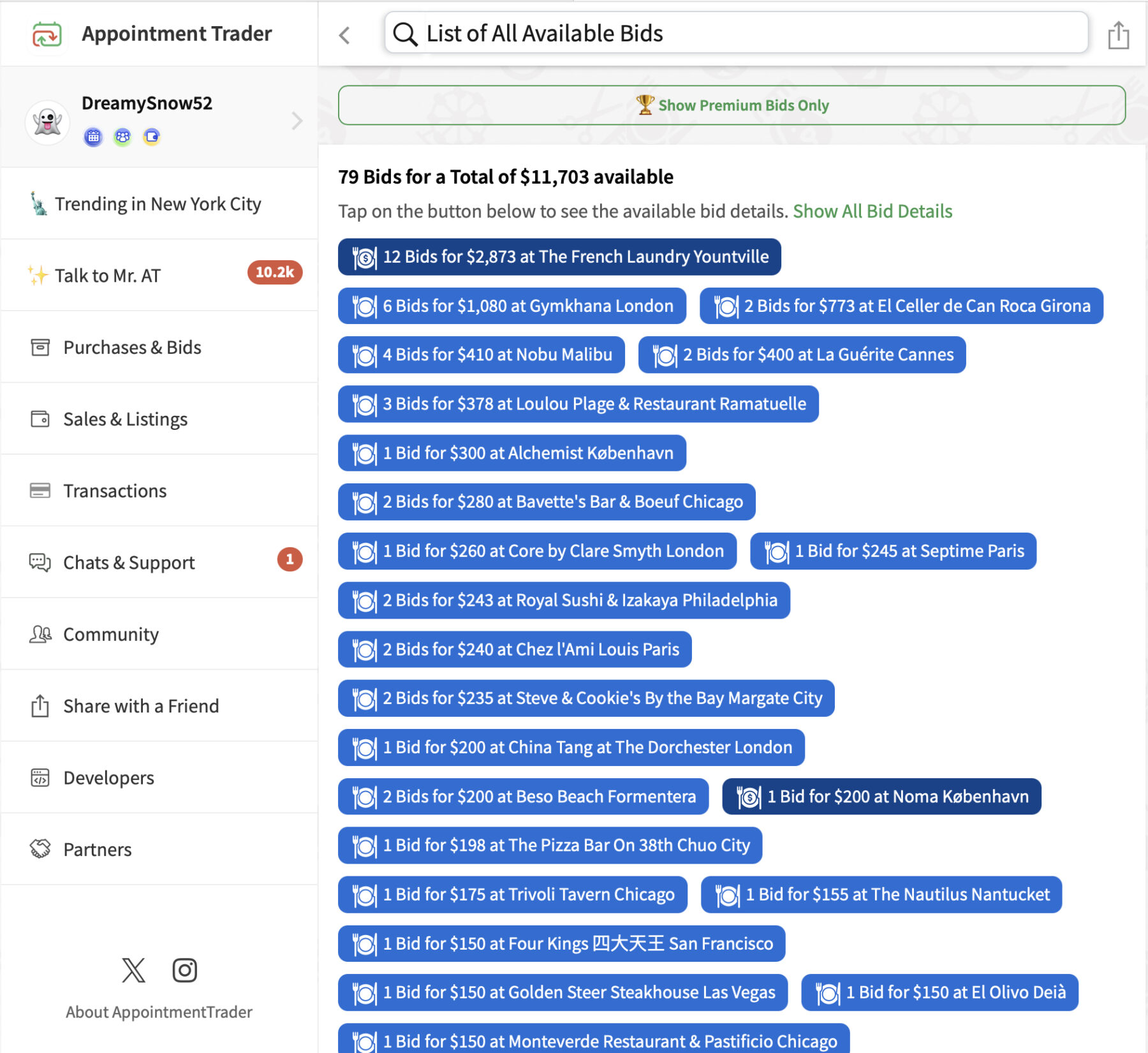
Image shows a screenshot of the bids page from the current version of Appointment Trader in non-restricted cities with all the restaurants for which interested buyers requested reservations.For example, there are 12 requests for tables at French Laundry, with the buyers making bids worth more than $2800.
“As a former restaurant owner, I’d be flattered if someone is willing to pay four times the price to eat at my place,” said Stephen Zagor, an adjunct assistant professor at Columbia Business School. “But if I don’t make anything from it because I never authorized the sale, I’d be furious.”
Zagor, who previously operated multiple restaurants and now teaches hospitality and business strategy, said he understands why Appointment Trader drew backlash. He contrasted it with platforms like Dorsia.
“At least those restaurants are seeing real returns,” he said. “That’s very different from scalpers who profit while the restaurant gets nothing.”
Others, like Vikas Khanna, the Michelin-starred celebrity chef Bungalow, were concerned about customer service.
“I will never do that,” he said, when asked if would give Appointment Trader permission to trade in Bungalow’s reservations. “For someone like me who is so into customer service, I feel that it takes away from this element if customers have to pay extra. If Resy is the only place to get reservations, there should just be an open, clean platform where everyone can try. We keep our menu prices reasonable for a reason.”
Frey admits that the only way to know for sure if Section 230 can apply is to test how the new Appointment Trader does in live use and see how it plays out. But he’s willing to take the risk.
“At the end of the day, you can’t avoid being sued because anyone can do it. But you sure can make it uninteresting for them to sue you,” said Frey.
About the author(s)

Anusha Subramanian, originally from Mumbai and San Francisco, is a data journalist at the Columbia Journalism School.

Xinlin Jiang is a data journalist, photographer and M.S. Data student at Columbia Journalism School, focusing on business, technology and human interest stories.