




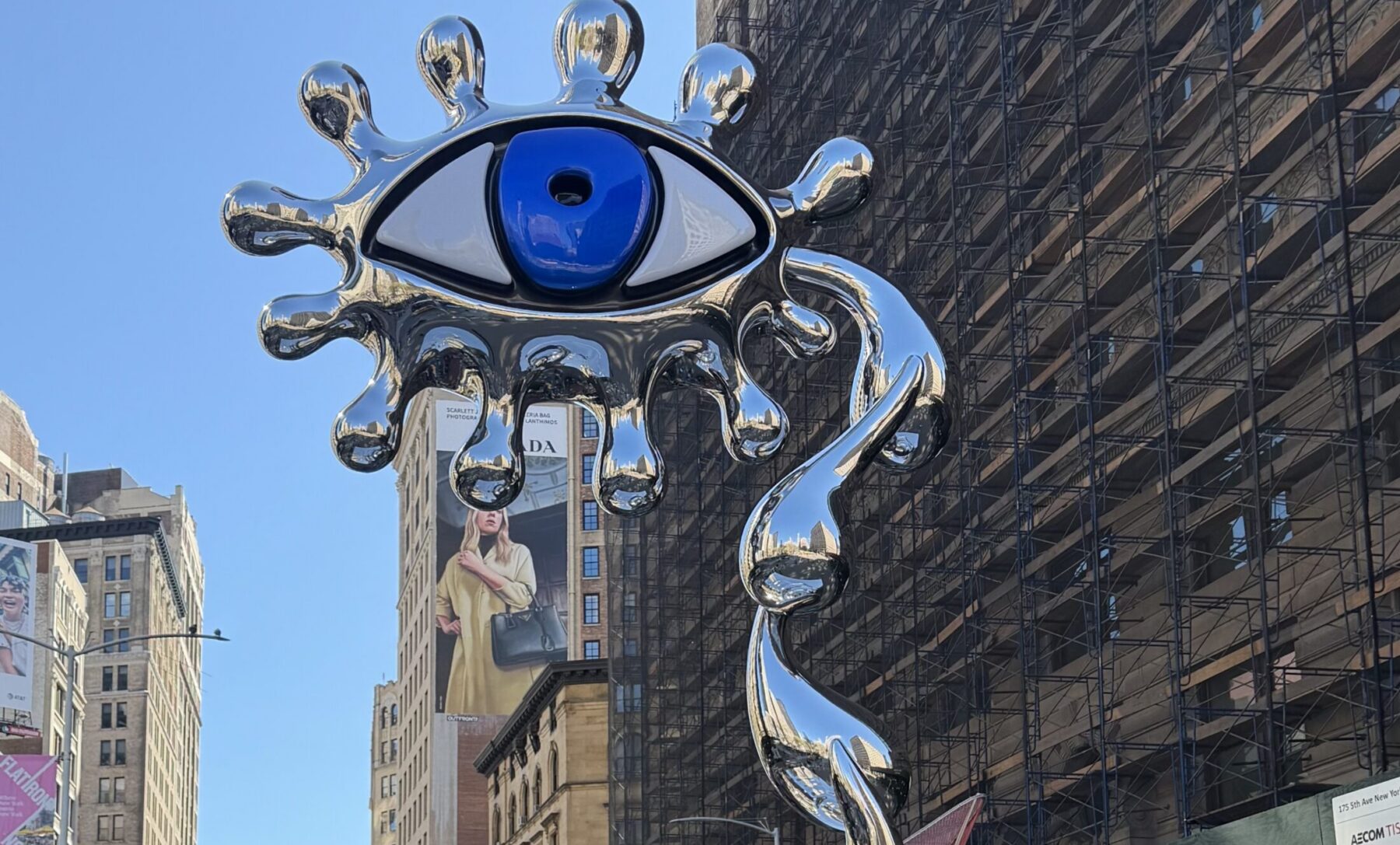
Charlotte Colbert’s “Dreamland Sirens” was stationed in the Flatiron South Plaza from March 10 to May 27. (Credit: Anna Lee)
The Flatiron Building has a new neighbor.
Until May 27, Charlotte Colbert’s 30-foot-tall “Dreamland Sirens” will occupy Flatiron’s South Plaza. The sculpture, which arrived on March 10, does not just bend the geometric rules of urban architecture; it warps, distorts, and projects the city back onto itself.
If the rambunctious little lamp from Pixar’s studio logo took an exorbitant amount of LSD, “Dreamland Sirens” might be what greeted it in the mirror. A puddle of hard steel composes the base. Emerging from that mass, an arm composed of four, tear-shaped bulbs supports the core of the 26-foot-wide, nearly 30-foot-tall artwork: a towering, two-sided eyeball. Twelve bulbous lashes encircle the eye, with a brown iris leering down Broadway, and a blue iris glaring over the Madison Square Park tree line. “Dreamland Sirens” is one of the two 30-foot-tall steel sculptures in Colbert’s “Chasing Rainbows” exhibition for the NYC DOT Art Program. The other creation, “Where Angels Live,” resides in Chelsea, taking the shape of a tree with dangling talismans and amulets, etched with smaller versions of the eye in “Dreamland Sirens.”
While “Where Angels Live” is less of a spectacle in gallery-filled Chelsea, “Dreamland Sirens” stands out amid the angular tech offices and luxury retailers of the Flatiron District. It is made of steel — the same material undergirding the once-controversial Flatiron Building that juts out of Manhattan’s grid like a ship’s prow. Yet the sculpture’s winding, bulbous structure presents the metal in an unusual form. Through each of its tear drops and eyelashes, “Dreamland Sirens” warps its surroundings into truncated, top-heavy, and liquified reflections. Passersby might be tempted to look only at their own reflections — after all, the sculpture provides a thrill similar to that of a funhouse mirror. But Colbert also makes the city a participant in her artwork, probing the capacity of urban architecture to take on unimaginable forms.
The title of the sculpture encourages the viewer’s imaginative impulse. “Dreamland Sirens” embodies the Surrealist appreciation for alternative realities, often brought to fruition through powerful dreams, and often figured through images of the eye: Colbert’s work pays homage visually and thematically to Magritte’s “False Mirror” (1928). As Salvador Dalí quipped in 1929, “Surrealism is destructive, but it destroys only what it considers to be shackles limiting our visions.” In the projection of the unconscious, Surrealist art signifies a desire to move past rigid structures, formations, and figurations. Unlike Dali’s static paintings, Colbert uses the sculptural medium to make each reflection dynamic and fluid, with each minor movement producing a different image.
The latter half of the title captures the sculpture’s alluring, seductive gaze. Much like a mythological siren beckons her victim to come closer, the eye invites viewers to pause, look, and look again. Complemented by the wailing ambulance sirens in the periphery, the sculpture is at once a response to, and reflection of, the environment.
Across other cities, several, large-scale metal sculptures have followed a similar impulse. For instance, Anish Kapoor’s “Cloud Gate” (2006) in Chicago, affectionately known as “The Bean”, reflects and distorts its urban surroundings, while inviting visitors to travel under its concave belly. Where “The Bean” seems more like an inanimate, amorphous blob, however, “Dreamland Sirens” possesses human elements. Viewers see versions of themselves in the sculpture’s shiny exterior. At the same time, the sculpture — and its blue and brown irises — stare back.
By making the dual-colored eye the focus of “Dreamland Sirens,” Colbert asks passerby to envision public spaces anew, as fertile places where imagination does not just enliven artworks, but Manhattan itself. The eye is not a new motif in the British multimedia artist’s work; since 2008, Colbert has incorporated eyes in dystopian films, and in small-scale sculptures of benches and even toilets. With “Dreamland Sirens,” which marks her first public art installation in the U.S., Colbert adapts the eye to reflect the specific nature of New York City. Unblinking and unlidded, the eye offers a surrealist take on “the city that never sleeps,” and, perhaps, a surveillance-state comment on the city that is always watched.
“Dreamland Sirens” embraces the endless shapes and slants that Manhattan can take. The city has not necessarily ached for architectural ingenuity — it took more than 60 years for the Flatiron Building to earn a landmark status in the city because of its triangular form. While it may take several more decades to materially create the reflections captured in Colbert’s sculpture, “Dreamland Sirens” enlarges the possibilities of imagining what the city could be.
About the author(s)

Anna Lee is a general assignments reporter based in New York and Boston. They are currently reporting on environmental legislation and criminal justice reform.