




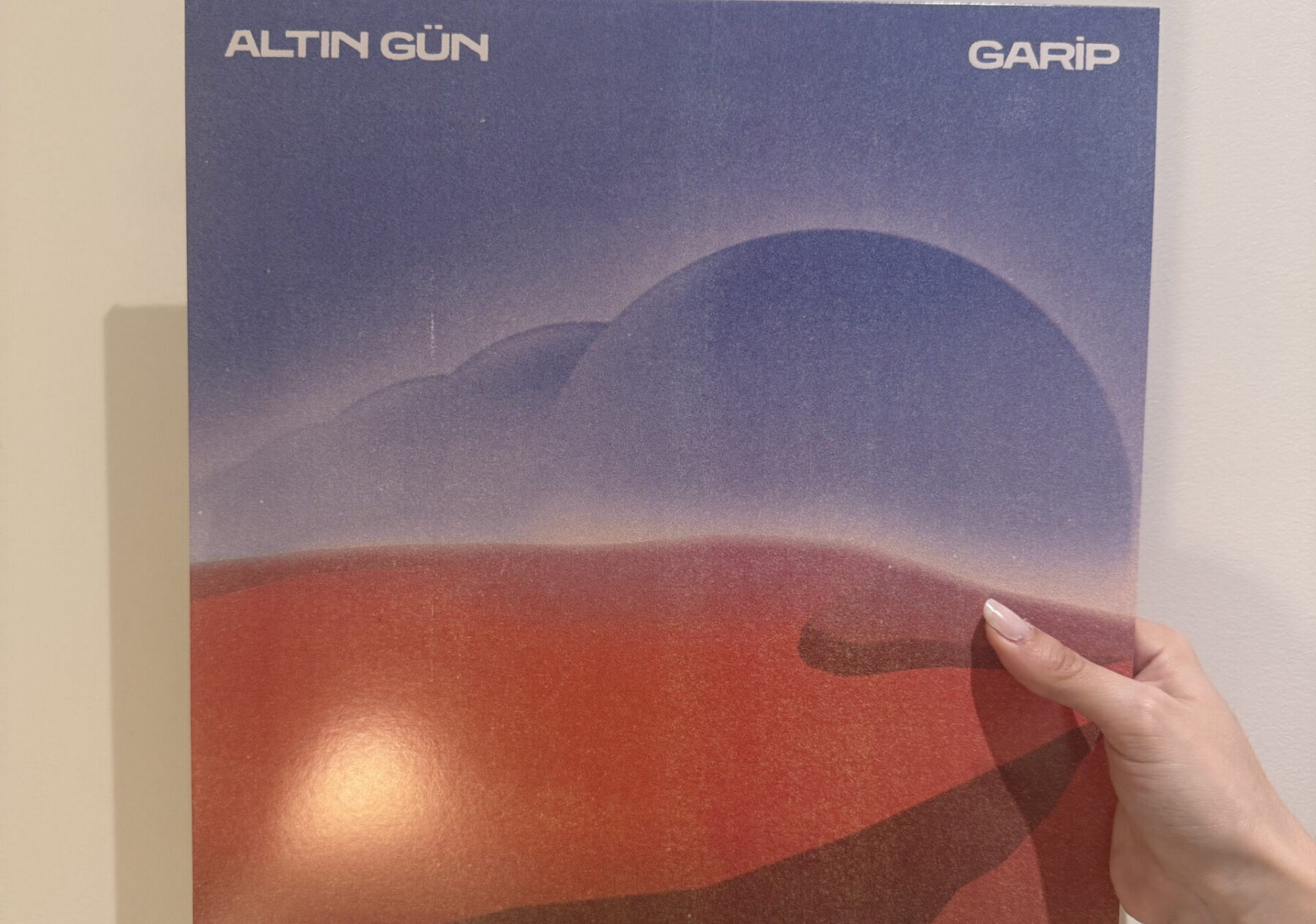
Altın Gün’s vinyl album cover is shown. (Credit: Dalya Turunc)
Altın Gün’s music is intentionally deceptive. The listener is kept constantly on their toes: the screech of an electric bağlama, the long-necked fretted lute used in the folk music of Türkiye, is joined by a drum kick; a snazzy electric guitar riff is suddenly interrupted by makam vocal runs.
The band’s latest album Garip – roughly translating to “the unfortunate one” from Turkish – embraces the sharp musical turns that it’s known for, finding new ways to marry synth-pop, psychedelic rock and funk with decades-old Turkish folk songs. The album is an ode to the discography of the Turkish folk singer Neşet Ertaş, with each track reimagining one of his originals.
The band’s strategy is distinctive within the world fusion genre: they draw on culturally beloved türküs – orally passed down folk songs – and modernize them to bridge older and younger generations of listeners. Rather than allowing these songs to fade for new audiences, Altın Gün globalizes them on its own terms. In an age when the same Top 10 tracks dominate charts globally, often driven by the U.S. music industry, innovative approaches to world fusion are essential for keeping local musical traditions alive for new generations.
In past work, the band appealed to Turkish Gen Z listeners by making these songs more danceable, while simultaneously anchoring a deep sense of nostalgia for older generations who grew up with the originals, a difficult balance. The 2018 album, Yol, holds some of Altın Gün’s most well-known songs like “Goca Dünya” and “Maçka Yolları,” which are heavy on synths and 70s- influenced grooves. Garip leans into a more contemplative, calibrated soundscape, prioritizing acoustic sounds and slowing the pace of the songs.
The album is the group’s first since lead vocalist Merve Daşdemir left the band.
Without the soprano lead, the band takes greater liberties with its genre-bending, as instruments, rhythms and forms flow freely across styles. “Benim Yarim,” the instrumental-only reinterpretation of Neşet Ertaş’s 1986 song, kicks off with a blues-inspired acoustic guitar lick, before reintroducing the original türkü’s vocal melody on a synthesizer.
Vocal reinterpretations drive Altın Gün’s cross-cultural approach, dissolving the language barrier and rendering their music even more global and porous, a quality they’ll bring once again to the Brooklyn Steel stage this September. At times, the heavy instrumental approach overwhelms the songs, occasionally stripping away the emotional weight Altın Gün otherwise captures effortlessly. In “Suçum Nedir,” a reinterpretation of Ertaş’s 2001 composition, a saxophone solo dominates the latter half before the song abruptly transitions into the lyrics “Is it a sin to love you/Tell me what other fault I have,” making the song conflicted in its mood, tone and message.
This musical disconnect is a rare case; most transitions are executed seamlessly. The opening track, “Neredesin Sen,” re-imagines Neşet Ertaş’s 1986 original, transforming its somber, aching vocals into pop-influenced belts, and translating its dissonant saz riffs into clean electronic guitar tones. Turkish folk elements seep through in the dissonant inflections in Erdinç Eçevit’s vocals, balancing the modern Western influences with traditional Eastern ones. The transitions and instrumentation feel carefully calculated, and unlike “Suçum Nedir,” the reinterpretation not only does justice to Ertaş’s original, but also introduces a fresh take that feels both heartfelt and energized.
The final track, “Bir Nazar Eyledim,” is inspired by a more recent track by Neşet Ertaş from 2000, a ballad accompanied by the bağlama, and it’s a surprisingly close interpretation of the original. No amped-up beats, heavy drums or elusive transitions come in. With only a moodykeyboard-synth in the background, it stays comfortably close to Ertaş’s version, while remaining subtly innovative. It feels like a tribute to the original masters, a way of illuminating the song’s beauty by opting for simplicity.
These songs are evidence that derivative works in music, especially within world fusion, arenecessary to revive the cultural heritage of traditional music. They offer a method for preserving the traditions and cultural memory embedded in both music and lyrics across decades and can be even more powerful than a fully original composition.
The genre is not asking modern listeners to adapt to older traditions. Instead, local songs are reinterpreted for globalized, largely Westernized listening tastes. If done at a surface level, with little consideration of the original, the outcome can be more detrimental than musically fruitful.
But when done right, as it is for most of Garip, world fusion becomes an intergenerational conversation, mediating musical understanding across time and place.
About the author(s)

Dalya Turunç is an M.S. Journalism student from Istanbul, Türkiye, focusing on arts, culture, and politics in New York City.