


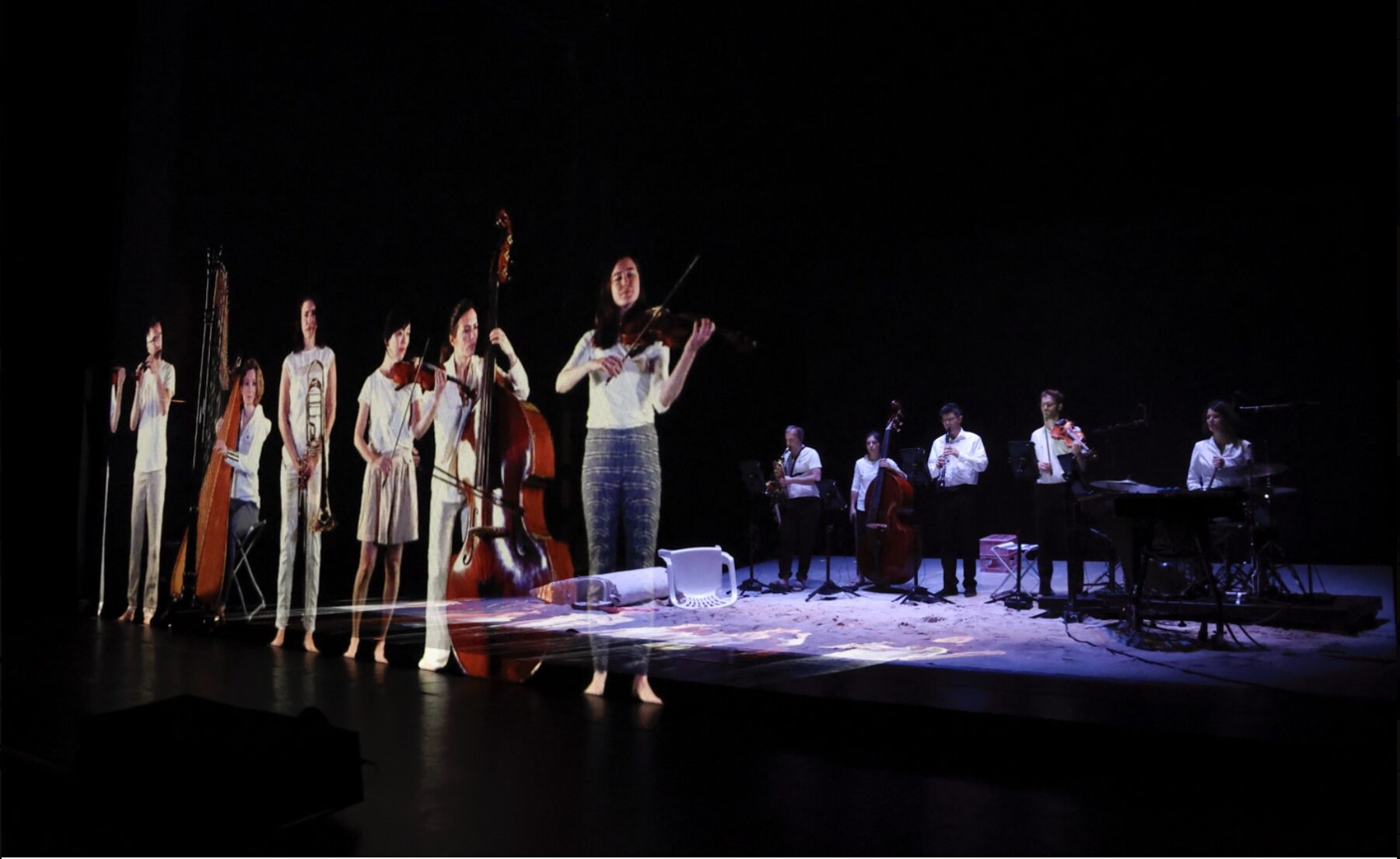
“All right. Good night” was part of the Crossing the Line Festival 2025. (Courtesy: Merlin Nadj-Torma)
The wide-ranging Crossing the Line arts festival closed its 18th edition on Nov. 22. Produced by L’Alliance New York, home of francophone cultures and French language classes, the annual fall event features film, music, dance, theater, installation, performance, and hybrid forms. What these offerings have in common, said Violaine Huisman, the festival’s curator and artistic director at L’Alliance, is that they all experiment with form in some way or involve an international perspective.
Huisman ambitiously expanded the festival’s scope this year. It used to run for a month or so; this time it began on Sept. 9 with a family-friendly visual art exhibition-workshop, and it closed out right before Thanksgiving with Will Rawls’s New York premiere of “[siccer],” an installation and live performance that considers, festival material states, “The ways Black bodies are relentlessly documented, distorted, and circulated in the media.”
In between Crossing the Line — “the one fest to rule them all,” according to The New Yorker — presented 15 works in nine venues across the city. “Partnerships are the norm” among arts presenters in Europe, Huisman told Columbia Journalism School’s Arts & Culture M.A. students in an interview. But they are less common in the United States. Crossing the Line, she said, has been a “forerunner” in building collaborations, teaming up with NYU Skirball Center for the Performing Arts, Performance NY, the Chocolate Factory Theater in Queens, Japan Society, among others.
It’s not only that everyone “needs to pool resources” in an eroding funding landscape, said Huisman. Collaborations also expand the kinds of work the festival can present, from the large space and high-tech needs of a show like the multimedia “Lacrima,” which came from the Théâtre National de Strasbourg for a run at BAM, to the intimate black-box space needed for “bLUr,” by the American choreographer Kimberly Bartosik, which ran at New York Live Arts. What’s more, she said, an international festival has “huge relevance,” at a time when the U.S. is becoming more insular.
Experimental arts will never appeal to a mass audience, Huisman acknowledged, but that is not the point. The work does reach some thousands of dedicated followers, she said, and it “seeps into the culture in ways that are impossible to read” in the moment. We “believe in the percolative power of small moments of the intangible.”
Columbia Journalism School’s Arts & Culture M.A. covered five of them this year.
Here are the reviews:
- In an Effort To Give Childhood a Voice, ‘The Big Sleep’ Gives It a Body by Barbara Blum
- You Are Here. Now You Are There. Where Are You Going? by Sigrid Adamsson
- Playing on Extremes, ‘bLUr’ Delivers on Its Promise by Nicole Schaller
- ‘Lacrima’ Confronts Broken Systems and Reckons with Colonial Power Structures by Neville Bhandara
- Tiago Rodrigues’ ‘By Heart’ Explores the Inviolable Power of What We Carry Inside by Mashael Shah
About the author(s)

Columbia News Service