




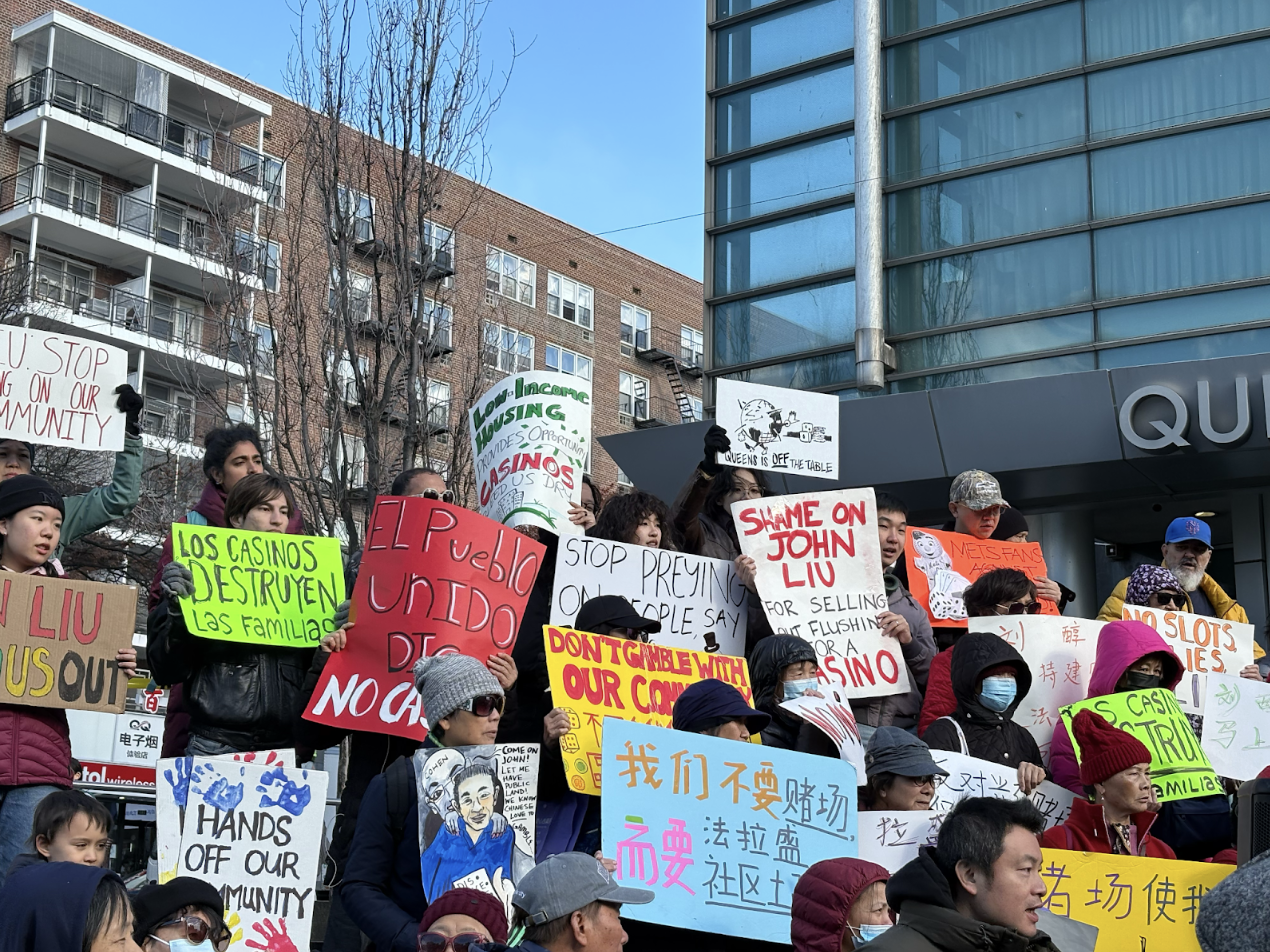
Demonstrators held signs on the Queens Library Steps on Nov. 16. (Credit: Olivia Morrison)
An anti-casino movement is bubbling in Queens.
On Nov. 16, hundreds gathered outside of Flushing’s Queens Library on Main Street to protest billionaire Steve Cohen and Hard Rock Entertainment’s proposed casino, Metropolitan Park. Faith leaders and residents of Flushing voiced community concerns to the crowd. Standing on the library steps behind speakers, rows of protesters faced the onlookers who watched, listened, and raised their flyers high as the crowd repeated chants in Mandarin, Spanish and English: “Strike down this casino.”
“This has not been a place that folks have cared about and people showed up today,” said Jack Hu, a lifelong community member of Flushing.
Just a few weeks before, Hu handed out flyers on Main Street with Emma Winters, a fellow Flushing resident who he met on a Flushing Subreddit discussing the casino. Winters and Hu braved the evening chill to raise awareness about the anti-casino community movement. There was no crowd. Passing residents paused on their commute home to hear Hu speak, despite the interrupting hum of airplanes flying over Main Street. Hu persisted, alternating between English, Cantonese and Mandarin, to ask residents: “Have you heard about the casino that’s coming to Flushing?” Many hadn’t. Now a month later, as hundreds gathered on the same block, he reflected on how much the movement has grown.
“Never in my wildest dreams did I think that it would turn out this way,” said Hu, almost in tears.
Since the grassroots coalition’s first Instagram post on July 25, the group has amassed widespread local support of community members and organizations to protest Metropolitan Park, backed by Mets owner Steve Cohen and Hard Rock International. With $8.1 billion of investment, Metropolitan Park would replace the parking lots behind Citi Field with an “entertainment venue, multiple restaurants, a convention center, retail areas, hotel” and casino, according to Hard Rock’s proposal released in October. The proposal states the project will bring in “42,100 direct, indirect and induced jobs,” and yield $33.5 billion in tax revenue over the next three decades.
In addition to Metropolitan Park, the Gaming Facility Location Board is currently reviewing two additional applicants for casino licenses in New York state, including Resorts World in Southeastern Queens and Bally’s in the Bronx. The Gaming Facility Location Board is evaluating the casino applicants on the following criteria: “economic activity and business development (70%); local impact siting (10%); workforce enhancement (10%); and diversity framework (10%),” according to the GFLB website. The board is expected to have a decision on all three by Dec. 1 with licenses granted “by the end of the year,” said Lee Park, a spokesperson for the New York State Gaming Commission, in an email to Columbia News Service.
On Nov. 17, the board visited the three casino sites to “obtain an understanding of the physical location and…seek clarification regarding the transportation, parking, infrastructure, and layout components of the proposal,” according to the GFLB website. At 5 p.m. that day, as the board met to discuss site visits from earlier, Flushing community members, including Hu, entered the board meeting room, as reported by QNS.com. Hu spoke to the board.
“Steve Cohen is not of good moral character,” Hu said he told the board, citing Cohen’s insider trading investigation from 2013. Hu brought up New York State Law, Chapter 47, Article 13 on Destination Resort Gaming which states there must be “clear and convincing evidence [of] the applicant’s good character…pertaining to…financial affairs…covering at least the 10 year period immediately preceding the filing of the application.” Cohen’s firm pleaded guilty to insider trading with a $1.8 billion penalty, according to a press release on the U.S. Attorney’s Office, Southern District of New York’s website.
In late September, the Metropolitan Park Community Advisory Committee unanimously voted in favor to advance the proposal to the Gaming Facility Location Board, following two Community Advisory Committee public hearings where the committee listened to comments from the public. Cody Herrmann, a Flushing resident who serves on the board of Guardians of Flushing Bay, said the two hearings that preceded the final vote “manufactured consent” to convey the false premise of community support.
“The Flushing casino only had five hours total of public hearing time,” said Herrmann, other casino projects had up to 11 hours, according to Hermann. In addition, organizers of the hearings “let pro-casino people in before they were letting in anti-casino people…so everybody that spoke…was always pro-casino,” said Herrmann.
Following the advancement of the casino to the Gaming Facility Location Board, Flushing’s residents marched just over a mile from Corona, Queens to Flushing Meadows Corona Park on Oct. 5 to call out the betrayal of local officials.
“Senator John Liu drafted the bill to alienate the parkland…[and] pushed it through the New York state legislature in three months. When have your politicians ever worked that quickly for you?” Hu asked the crowd at Flushing Meadows Corona Park.
Thomas Grech, president of Queens Chamber of Commerce, said he was an “overwhelming champion of [the] project” and that the public parkland Metropolitan Park will replace is “50 acres of parking lot behind Citi Field.” Only 25 acres of the 50 will remain parkland, “five acres of those 50 [acres] will be ballfields and 20 acres will be parkland,” said Grech.
At an anti-casino community town hall on October 19 at the Muslim Center of NY, State Senator Tony Avella, said that “you cannot take away parkland without replacing it, one acre, you take away, you have to replace one acre.” If Metropolitan Park moves forward, “the public are going to lose 25 acres of parkland…once you lose parkland, you never get it back…parkland should always be preserved for future generations,” said Avella.
In 2024, Senator Liu co-authored an opinion piece for The New York Daily News. In the article, Liu wrote that the development of a casino for Asian American New Yorkers will coincide with “increased rates of gambling addiction, financial hardship and strained familial relationships,” and noted that the casino’s “proximity to Asian American-populated communities raises concerns.” A year later, in April 2025, Liu introduced the parkland alienation bill which allowed the casino to be built on the public parkland.
In a request for comment, Liu’s office shared his March 2025 statement that Metropolitan Park has committed to building the Flushing Skypark, “a series of interactive areas that form a bridge and transform a pedestrian and bike crossing into vibrant hubs that serve as flexible public spaces for community gatherings, events, rest, and social interactions.”
Metropolitan Park spokesperson Karl Rickett said the project “will invest $1.75 billion in public infrastructure, including a transformed Mets-Willets Point 7 train station,” in an email request for comment. Rickett stated “with Metropolitan Park bringing increased entertainment, restaurants, and other options around Citi Field, people can come early and stay longer and ultimately help alleviate the rush,” a regularity on the 7 train.

Jack Hu listens to state Senator Jessica Ramos’ speech during the town hall. (Credit: Olivia Morrison)
With the exception of state Senator Jessica Ramos—who attended the community march and town hall but was not present at the community protest—local officials in Flushing are yet to stand behind the community’s casino concerns, meaning residents like Hu are taking matters into their own hands to protect their community and home.
“Nobody is going to save us but ourselves. We need to build our own movement…and what we decide to do or not do will determine [what] our community looks like for the next couple decades,” said Hu during a community march from Corona to Flushing Meadows Corona Park on Oct. 5.
Community members still continue to voice concerns on how a casino will hurt the Flushing community, including the congestion of public transit and a rise in gambling addiction.
“[Hu] definitely came in hot, in a good way. I was really excited [by] how energized he was coming in because I feel like these days it’s really hard to get people to come out,” said Kara Fan, a volunteer with the Flushing Workers Center.
Hu’s parents are working class immigrants from Guangzhou, China, and to him, the possibility of a casino in his backyard reminds him of a painful wound.
“For as long as I’ve been alive, my father has struggled with gambling,” he said. “My father still gambles…and every time he goes, he’ll lose a couple hundred dollars…the house always wins in the long run.”
While addressing crowds at community anti-casino efforts over the last couple months, Hu has openly shared his family’s emotional and financial struggles at the hand of his father’s gambling.
In Metropolitan Park’s application to the board, Hard Rock acknowledges the risks a casino poses to communities, stating “that a small proportion of the population will struggle to control their gambling behavior and experience harm,” in a report on gambling. In the same report, Hard Rock stated the casino “seeks to attract players who are good for business while addressing risks to the patron population.”
“If it comes down to it…I promise you, with everyone here as my witness and with this community support, I will leave my private life and I will primary John Liu in 2026,” said Hu in October during the community march speaking to attendees.
About the author(s)

Olivia Morrison is a part time M.S. student at Columbia Journalism School.