




On a crowded sidewalk in Jackson Heights, Muhammad Mohtar Ali, 55, stood behind a display of shimmering bangles, gold necklaces, and floral kurtas laid out over a small table. With a warm smile on his face, his eyes scanned passersby for potential customers—but also for plainclothes inspectors. His livelihood depends on avoiding their gaze.
Mohtar Ali came to New York with his family from Chittagong, Bangladesh, more than a decade ago, dreaming of the opportunities the city promised. Like thousands of Bangladeshi immigrants, he found a sense of belonging in Jackson Heights. The smell of cardamom tea and fried samosas made it feel like home.
However, his experience has not been one of success but one of waiting—waiting for a street vendor permit he may never receive.
Mohtar Ali said he first applied for a permit six years ago and has “tried following up about it several times.” But, he added, “it is always the same reply: ‘You are on the waiting list.’ I’m tired of hearing it now. My daughter was in high school when I had applied. She is married now. But I still have no license.”
That endless wait is at the heart of a broader crisis facing thousands of street vendors across New York City. Most are immigrants, many from South Asia and Latin America, who have built informal businesses selling food, clothing, or handmade goods. Under the city’s outdated permit system, though, legal vending opportunities remain capped, trapping workers in a cycle of fines, confiscations and fear.
City Council Member Shekhar Krishnan, who represents part of Queens, has made a push to reform street vending. His bill to decriminalize street vending is scheduled to take effect by the end of the year. The measure follows a recent analysis by City Limits that shows a sharp rise in enforcement by the New York City Police Department: 9,376 tickets were issued to vendors in 2024, compared to 4,213 in 2023.
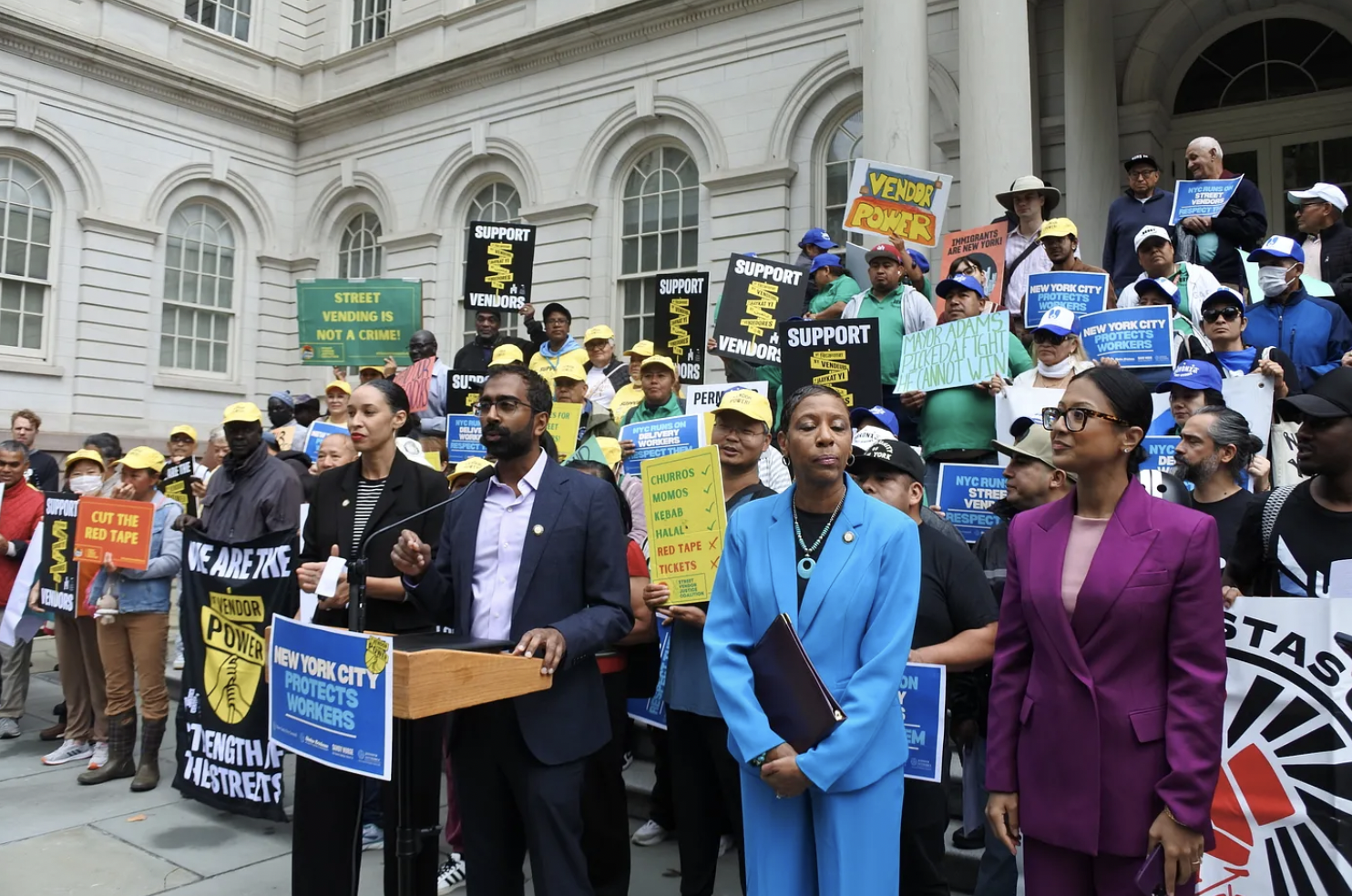
City Council Member Shekhar Krishnan at City Hall, speaking about his vending bill on Sept. 10 (Credit: Hikari Hida)
Vendors can face misdemeanor charges, with fines of up to $500, or 30 days in jail, for infractions like setting up too close to a curb, displaying goods on cardboard boxes, or leaning a pushcart against a lamppost. Operating without a permit can lead to $1,000 fines and up to three months in jail.
Under the new bill, violations would be treated as civil, not criminal, offenses. Vendors would pay $250 for time, place, or manner violations, and $1,000 for operating without a permit – but without the threat of arrest or jail.
For many decades, street vending has been a lifeline for immigrants, especially those without English proficiency, education or documentation. New York’s tightly capped system, with 5,100 food permits and 853 merchandise permits, has turned this lifeline into a trap. More than 20,000 vendors are waiting for a license.
The cap was placed in the 1980s and hasn’t been raised since. In 2021, the City Council passed Local Law 18, which aimed to expand food vending by offering 445 supervisory licenses annually for 10 years. The supervisory license requires the permit holder to be present and vending at the stall. If all had gone according to plan, the city would have issued more than 2,000 new permits by now. However, since 2022, only 713 licenses have been issued.
The general-vendor license, which allows someone to sell merchandise, is issued by the city’s Department of Consumer and Worker Protection. That one is also tightly capped: Only 853 licenses can be granted to non-veterans. The waiting list for non-veterans was closed in 2006. More than 10,900 applicants are on that list.
Food vendors are required to have two permits from the city’s health department, one for the cart owner and one for the cart itself. The rollout of these permits has also been slow.
Debipriya Chatterjee, former senior economist at Community Service Society of New York, a nonprofit that supports protections for vendors, wonders why the process is such a slog. “Why don’t they go down the waiting list and mail the people who are already on the waiting list? They know who these people are.”
Mohtar Ali’s story echoes that of a vendor nearby: Muhammad Nasiruddin, 40, who runs a food stall near the Jackson Heights subway station. Nasiruddin sells tea, fritters and other snacks every evening. Nasiruddin, who came to New York from Bangladesh in 2018, is also on the waiting list. A few years ago, he said, he managed to rent a food-vending permit on the black market for around $1,000 per month. But the COVID-19 lockdown hurt his sales, and he eventually couldn’t afford that permit.
“It was like paying a ransom. There were times when I didn’t have money to feed my family because I had to pay the man who gave me his license. Sales were down, and police were issuing huge fines. I didn’t know how to escape the situation,” said Nasiruddin.
The illicit vendor market has been thriving for years. While an official permit from the city costs only $200 for the first two years with a $75 renewal charge every year after that, illegal permits in the black market can cost between $17,000 to $25,000 annually.
Chatterjee says that most street vendors have not been educated about their rights, which makes them more vulnerable to the black market.
“There’s no proper education system for the vendors to know the rules and their rights. So they are naturally funneled into the black market,” Chatterjee said. “A lot of them are never going to get out of the debt that they have incurred.”
Nasiruddin says he receives hefty fines from the police almost every other day. “Sometimes I get fined $200 for blocking the sidewalk, and sometimes $500 for vending too close to the crosswalk. A couple of weeks ago, the police seized my cart, and I had to pay $1,000 to get it back,” he said.
Nasiruddin paid these fines from his wife’s savings because he used his own while renting the permit from the black market a few years ago. “Sometimes I earn only $70 a day but have to pay $200 in fines.”
Rafi Islam, who worked with vendors at the Street Vendor Project, says there are crackdowns on vendors during festivals when more people are on the street trying to sell their wares or food.
“They’ll choose a specific holiday like Ramadan, when they know that a lot of vendors are going to come out more than the usual,” says Islam.
Islam said that instead of repeatedly targeting the vendors with enforcement, the city should focus on educating them and providing more permits. “What are you doing to stay engaged with this community, what are you doing to make sure that they’re following all the rules and regulations?”
And for some vendors, there are few options. When asked if he would consider returning to Bangladesh, a teary-eyed Mohtar Ali thinks about the political turmoil back home: “There is nothing left for me to go back to. I lost everything I had left in Bangladesh last year. My country is not safe anymore. Here I am struggling, but at least I am alive.”
About the author(s)

Shivangi Sen is a multimedia journalist and Columbia Journalism School student in the Stabile (investigative) program with experience spanning India, the UK, and the US.