




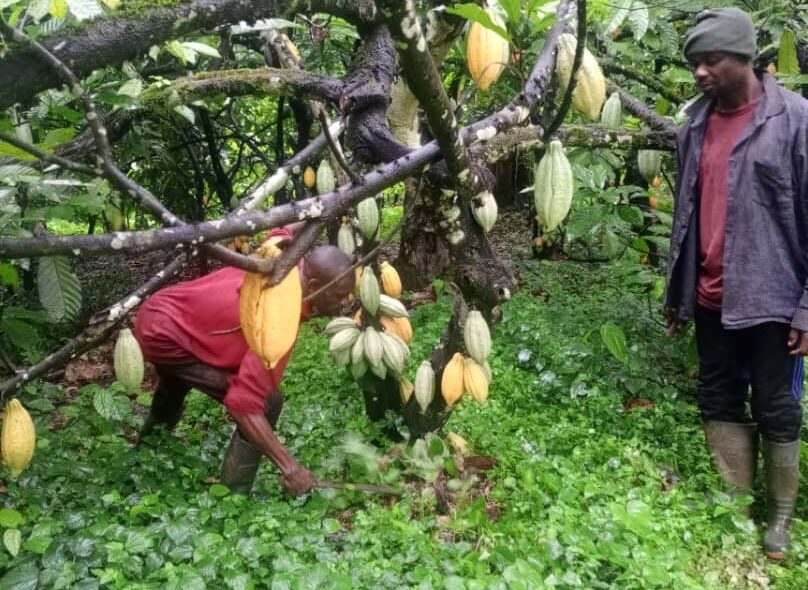
(Courtesy: Hrm Amb Anthony Ntui Etta Ntufam)
Nigerian cocoa farmers fear their livelihoods are in danger. The European Union intends to ban all agricultural goods produced on deforested land within the next year. The biggest impacts would be on cocoa, coffee, palm oil, and soy products sold in Europe.
Cocoa is especially critical to farmers eking out a livelihood in Nigeria, where one out of three people live in extreme poverty, according to the World Bank.
Ntufam Anthony Ntui-Etta, Paramount ruler of Etung, a local government area in Cross River State, has relied on cocoa farming for two decades to support his four children and wife.
“Without it, I would lose my livelihood, be unable to pay for my children’s education, and would have to abandon my social life,” said Ntui-Etta, 58, who has about 20 extended relatives living with him under one roof.
An estimated 300,000 to 350,000 smallholders and farmers could be at risk in Nigeria, one of the world’s top cocoa producers. Small farmers like Ntui-Etta account for 90 percent of the beans, according to a 2024 European Union report, and what happens to them ripples across an already strained economy.
In October 2024, Brussels decided to extend the deadline to allow time for farmers and others to adapt. The original date for compliance was the end of 2024, but farmers were given a year’s reprieve. Now, with the new deadline approaching, the EU proposed in October 2025 that small operators would have one more year to comply and that large businesses would have a grace period until the middle of 2026. That proposed timeline will go to EU governments and the EU Parliament for approval in the coming weeks.
Despite the proposed phase-in, the European Union is vowing to fight the loss of biodiversity and curb global warming by working to preserve forested land. According to the United Nations, about 6 million hectares of forest are lost worldwide each year, forests that play a crucial role in absorbing carbon and slowing increases in global temperature. Nigeria alone loses 253,000 hectares of natural forest annually, according to Global Forest Watch estimates.
Yet full compliance with Europe’s new rule is unlikely. Some are warning it could even backfire. With numerous obstacles along the way, market analysts warn that the global market for cocoa could splinter, leading to higher prices in Europe, farmers being unjustly punished, and other unintended consequences.
Simply determining if cocoa products for sale come from deforested land will be difficult for the EU because of poor enforcement of forestry laws and corruption.
Furthermore, Nigeria’s poor farmers might respond to the ban by redirecting their crops through middlemen to other worldwide markets than Europe, albeit at lower prices. Lower revenues in such a poor population might prove counterproductive by actually encouraging the farmers to clear more forest land to grow more beans, according to a study looking into the unintended effects of the EU’s rules.
Europe is the leading market for Nigerian cocoa farmers, and they grow much of their product on land that does not comply with the new rules adopted in Brussels. More than half of Nigeria’s cocoa production is shipped to the EU, Trade Map data showed, with the rest going to Canada, the United States, China and Brazil.
Besides cocoa, rubber exports and prices could be affected by the new rules. Roughly 70 percent of Nigeria’s rubber exports go to the EU. Natural rubber, which is made from the milky sap of trees and plants, causes far less deforestation than cocoa, however. Cattle ranchers and timber producers see minimal impact, because they export little to Europe.
Brussels’ rules would apply to all land cleared after 2020. Estimates vary about how much of Nigeria’s cocoa actually conforms to the EU’s rule. A non-profit research group Trase found that about 35% of cocoa crops in Côte d’Ivoire were compliant or traceable in 2022. Nigeria’s percentage is likely similar, said Jonathan Parkman, head of agriculture at Marex group, a global financial services platform that provides data, analytics and advisory services to clients.
With cocoa prices soaring in 2024 amid a global shortage, more and more Nigerian producers have turned to the crop. Prices surged to historical highs of over $12,000 a ton at the end of 2024 before settling below $8,000 this year, according to JP Morgan Chase. Five years ago, the price was closer to $2,500 a ton.
“Cocoa is in very short supply, which results in very high prices and an attractive market for local communities,” said Mr. Parkman.
While many large firms are expected to begin conducting due diligence on the land where cocoa beans are grown as early as January, some other big firms may seek workarounds to the EU rule. They could use small companies to export, for example, taking advantage of the yearlong delay for those firms.
“There is a loophole that creates an opportunity for big companies to get around the rules,” Parkman added.
The government of Nigeria has repeatedly tried to curb deforestation by launching a national strategy, setting up a national task force and establishing a policy framework, with little to no success.
“Permits were initially given to people for one tree, but now people just go and cut as they like,” said Patrick Adegola, executive director of the Cocoa Research Institute of Nigeria (CRIN) and secretary of the National cocoa management committee. “You can’t really pick which ones are legal anymore.”
In theory, forest rangers enforce the laws. But “they are very poorly trained and resourced, and most don’t understand the technicalities,” said Mathew Page, an analyst on governance and socioeconomic issues in Nigeria for the British think tank Chatham House. Corruption and bribery further complicate the issue. “Once money changes hands, anything can pass,” Page added.
To meet the EU’s deadline, the Nigerian government has announced that it will geolocate farms and regulate traceability. Farmers are sharing information to prepare.
“I hold regular meetings with 200 farmers to warn them against deforestation and urge them to rehabilitate land rather than clearing new forests,” said Ntui-Etta.
The cocoa producer describes himself as a lifelong farmer, “from birth,” an activity he learned directly from his parents. Yet, he insists that his four children pursue education rather than join him in the fields. Two are already university graduates, while the others are still in school, a rarity in a region where children often help on family farms.
Analysts see education as essential to curbing deforestation, and “awareness among smallholders of how to comply is very low,” said Ridwan Bello, an economist and evaluation officer at the World Bank to Columbia News Service.
The costs of meeting new standards — audits, documentation, mapping — could weigh heavily on the small farmers. Exporters are expected to pass the extra costs down. The intermediaries could also pressure local communities to trade their product at a discount.
“They may be told their beans are not compliant and then have the price knocked down, whether or not that’s actually true,” warned Parkman, from Marex group.
Ntui-Etta, for instance, operates within a local trading chain, selling his cocoa to middlemen who handle exports. “I do not know where the cocoa goes after I sell it,” he said.
One looming question is whether Nigeria’s producers can pivot to sell cocoa that is not compliant to buyers in other countries. And what price will others pay for a product that Europe has rejected.
With a global cocoa shortage, farmers should be able to find buyers.
“Nigeria’s beans will always find a home, but without Europe, there will be two markets, one at premium, the other at discount,” Parkman said. Beans failing to meet EU’s rules could end up in Asia, the Middle East or the U.S. at 5 to 20% less.
To nudge farmers to comply, the higher prices of a premium product could provide an incentive — in theory.
“Past evidence shows premiums often don’t trickle down; fairtrade, organic did not raise incomes for Nicaraguan coffee farmers,” said a team of forest economists and economists in a paper examining the unintended effects of the EU’s regulation. Efforts to ensure compliance could also lead to consolidation among exporters, meaning fewer buyers and many small suppliers, which might weaken “their bargaining power,” according to the study. Redirecting trade to other markets would not be automatic either.
“Changing routes, building the relationship, setting up the logistics will take time,” said Feyi Fawehinmi, a financial analyst and local journalist in Nigeria.
Overall, the impact could be harsh. “The farmers will bear the brunt of it,” emphasized Bello of the World Bank.
For Ntui-Etta, the farmer in Etung, the worry is daily. “On average, I make about 150,000 naira ($100) a month, though some months it drops much lower. It is a very stressful job,” he said.
Observers warn of parallels with India’s cotton crisis in the 1990. Many smallholders fell into debt when global cotton prices fell. Crushed by debt and without safety nets, more than 300,000 farmers committed suicide between 1995 and 2019, according to the University of Massachusetts Amherst.
Nigeria’s small farmers depending on cocoa income could face despair.
“Most of the cocoa communities already live in high poverty,” warned Philippe Jakor, Nigeria environmentalist, journalist and activist. “If you remove their income, children will drop out of school, and the idle youth could be drawn into crime.”
About the author(s)

Alix Coutures is an MA student in Business and economics concentration at CJS.