




A customer boards the Bx31 bus. (Credit: Aleah Gatto)
As leading mayoral candidate Zohran Mamdani campaigns on a sweeping promise to eliminate bus fares citywide, the people who operate the system are anything but aligned.
Chapter presidents from the Transport Workers Union (TWU) and the Amalgamated Transit Union (ATU) — two of the city’s largest transit unions — are divided over how a fare-free bus proposal would affect workers’ safety, and over where the funding would come from.
“Bus operators already face assaults and harassment on the job,” said Daniel Cassella, president of ATU Local 726, in a rally on Sept. 27, where the Staten Island chapter endorsed independent mayoral candidate Andrew Cuomo. “Removing fares will make it worse, not better.”
Recalling a Covid-era free-bus policy that was meant to protect bus drivers, Luis Alzate, president of ATU Local 1056 in Queens, recounted a noticeable increase in homelessness on the buses. “It wasn’t the best time for our members,” he said.
Cassella’s and Alzate’s concerns over members’ safety is top of mind for most union leaders. According to data from the Metropolitan Transportation Authority (MTA), employees who worked in the corporation’s bus sectors between 2019 and 2024 reported close to 10,000 violent incidents — far more than all other MTA sectors combined.

Data obtained through New York State Open Data. Graph created using Google Sheets. (Credit: Aleah Gatto)
But while some leaders feel that a fare-free bus program would increase violence against workers, others have reason to believe it would improve safety.
An evaluation of a 2023 fare-free bus pilot program, which was spearheaded by Mamdani and State Sen. Michael Gianaris, reported a nearly 40% decrease in verbal and physical assaults against bus drivers, compared to the systemwide decrease of about 20% over the same time period.
“By eliminating the fare box, riders did not need to interact with bus operators, interactions that were often the source of altercations,” Mamdani and Gianaris stated in an essay published by The Nation last year.
John V. Chiarello, president of TWU Local 100, which represents 44,000 transit workers, agrees.
“There’s a correlation of collecting the fare and our members getting hurt,” Chiarello said. Unlike Cassella, Chiarello has refrained from endorsing in the mayoral race due to the range in political affiliation among his chapter’s membership.
Along with the decrease in assaults, John Samuelsen, president of TWU International, said the pilot program demonstrated how free buses would elevate ridership and “spark a whole bunch of residual economic activity.”
“I’m absolutely in favor of it,” Samuelsen said at the Labor Day Parade in Manhattan.
A driving idea behind Mamdani’s fare-free bus campaign is that public transit should be more affordable to low-income New Yorkers. This is a notion that has swayed groups like Riders Alliance, which gave its first-ever endorsement of a candidate to Mamdani in September. Even so, the idea can be a hard sell with the pilot evaluation reporting a $12 million loss in revenue and related costs over nine months.
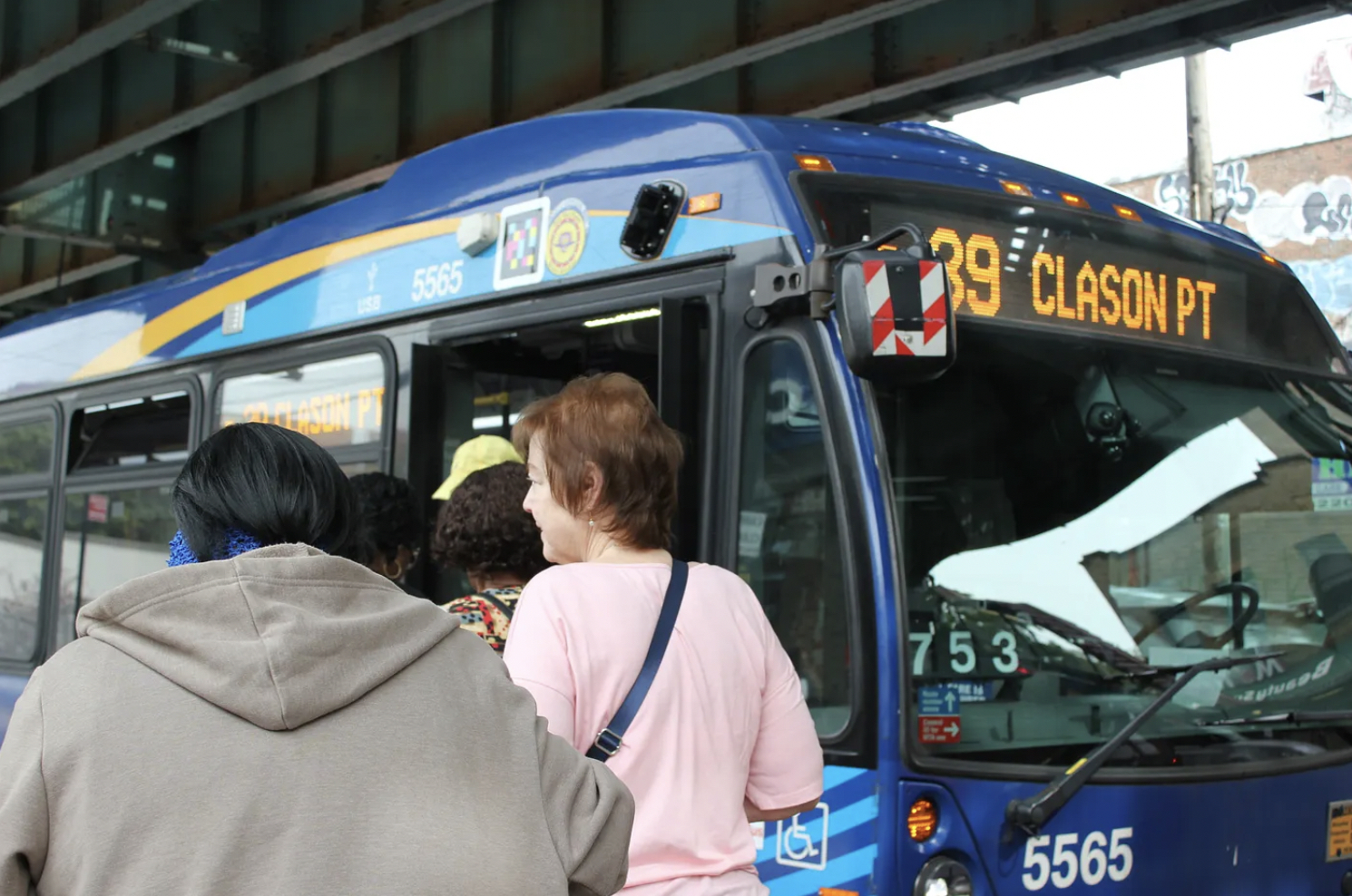
Riders line up to board the Bx39 bus at the corner of 233rd Street and White Plains Road. (Credit: Aleah Gatto)
The MTA’s current $50 billion debt profile is forecast to increase to $87 billion by 2034, according to the New York State Comptroller. This increase does not take into account the significant loss in fare revenue invoked by a free bus program.
Funding is a main concern for Zhan Guo, associate professor of Urban Planning and Transportation Policy at NYU Wagner.
“We have other options we haven’t fully utilized,” he said, suggesting that the city could test different levels of discounted fares. Guo also expressed concern over how Mamdani would implement the program, since the MTA does not fall under the mayor’s jurisdiction, but that of New York State.
In a speech at the September Staten Island rally, Cuomo cited a Covid-era free bus program in Kansas City that was recently forced to end due to budgetary constraints.
“His answer to every problem is: Free. Free transportation. Free food. Free clothes. Free everything,” Cuomo said. “But New Yorkers know there’s no such thing as a free lunch — somebody has to pay.”
Neither Mamdani nor Gianaris’s press offices responded to Columbia News Service’s requests for comment.
When asked how he thought the revenue loss could affect workers, Jose DeJesus — chapter president of ATU Local 1179 in southern Queens — said he would support a plan that reflects fair pay and working conditions for bus operators and maintenance crews. But he said he has not yet seen those assurances from Mamdani’s plan.
“If he wins, where is he gonna get the funding from?” he asked.
Philip Valenti, president of the Transit Supervisors Organization, which represents bus and subway supervisors across the city, said that the same people who say they cannot afford to travel every day buy a $6 cup of coffee from Starbucks.
“The fact he brought it up is completely idiotic,” said Valenti, “and not even possible.”
About the author(s)

Aleah Gatto is an M.S. Candidate specializing in investigative reporting at the Columbia Journalism School.